
Orchestral composition process
What does musical stillness sound like when it is not completely at rest?
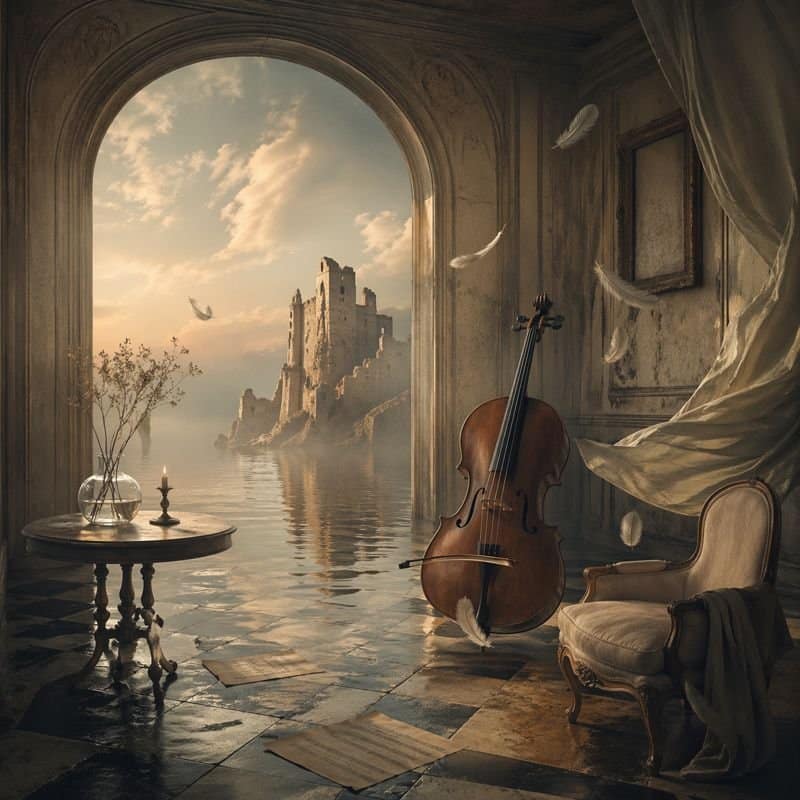
Rest Room, from the album Forgotten Castle, represents a moment of pause within the narrative: a space of calm inside a larger structure shaped by memory and time.
Rather than stillness, the piece explores controlled tranquility—a quiet environment sustained by subtle internal movement. The piece does not stop—it suspends motion.
This article explores my orchestral composition process through the piece “Rest Room”.
Listen while reading and focus on the subtle harmonic rhythm shaping the piece:
The Core Idea
The piece is built on calm surface with internal rhythmic tension.
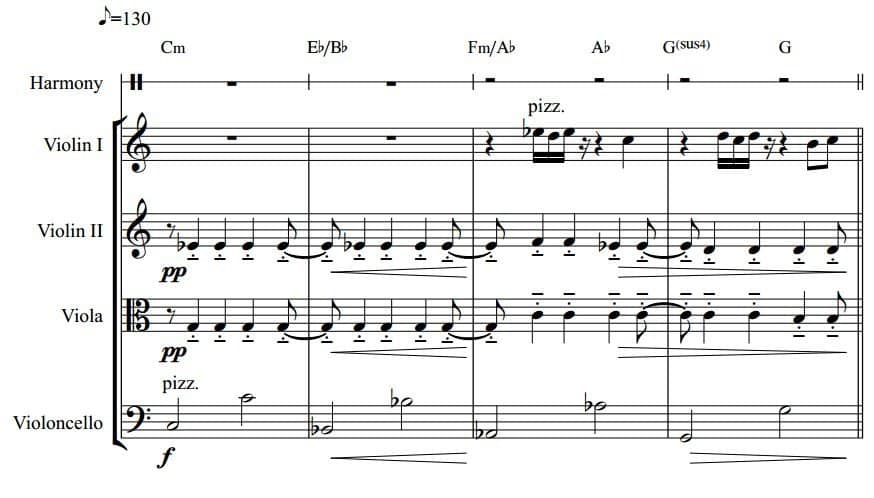
From the opening (♩ = 75) :
- soft dynamics dominate (pp–p)
- harmonic progression unfolds slowly (Cm – Eb/Bb – Fm/Ab – Ab – Gsus4 – G)
- pizzicato articulation introduces rhythmic definition
This creates a dual perception:
- external calm
- internal activity
The music rests—but it does not stop.
Harmonic Language
Harmony is central to the piece’s identity.
As shown in the opening system :
- extended and inverted chords create smooth transitions
- functional resolution is suggested but softened
- harmonic motion is continuous but non-dramatic
The use of:
- Cm → Eb/Bb → Fm/Ab → Ab
- followed by G(sus4) → G
creates a sense of:
- suspension
- delayed resolution
- harmonic breathing
Harmony here does not drive the form—it stabilizes the atmosphere.
Rhythmic Behavior
The defining feature is a subtle syncopated harmonic rhythm.
- pizzicato figures introduce displacement
- accompaniment patterns avoid strict regularity
- rhythmic gestures are understated but persistent
This produces:
- a sense of gentle instability
- internal movement beneath a static surface
- temporal softness
Unlike driving rhythmic structures, this rhythm suggests motion rather than enforcing it.
Texture and Orchestration
The orchestration is intentionally restrained.
Across the ensemble:
- pizzicato in lower strings provides articulation
- upper voices sustain or gently shape melodic fragments
- dynamics remain controlled (pp → mp → f in selected moments)
The contrast between:
- percussive pizzicato
- sustained lines
creates a balanced texture:
- clear
- transparent
- quietly active
Melodic Behavior
The melodic material is simple but expressive.
- phrases are smooth and connected
- intervallic movement is moderate
- gestures avoid strong contrast
Rather than standing out, the melody:
- blends into the harmonic field
- emerges gradually
- dissolves naturally
This reinforces the idea of rest without complete stillness.
Structural Design
The piece follows a compact, cyclical structure:
- A — harmonic and rhythmic foundation established
- B — slight expansion and dynamic increase
- A1 — return to initial material with variation
- Coda — gradual reduction (ritardando and thinning texture)
The structure does not aim for contrast, but for continuity and balance.
Compositional Approach
In this piece, I focused on:
- combining harmonic smoothness with rhythmic displacement
- maintaining low dynamic intensity
- using texture to create subtle variation
- avoiding strong directional development
The goal was to create a space that feels:
- calm
- stable
- but gently active
Compositional Techniques in Rest Room
This work combines syncopated harmonic rhythm, pizzicato-based articulation, and non-dramatic harmonic movement. The result is a controlled and transparent texture typical of contemporary neoclassical writing, where atmosphere emerges from balance rather than contrast.
Final Thought
Rest Room is not silence—it is suspended activity.
Through soft dynamics, syncopated harmony, and restrained orchestration, the piece creates a space where time slows down without stopping.
Listen to Rest Room and focus on how the harmonic rhythm subtly shifts beneath an apparently calm surface.
If you would like more information on these topics, explore the following related posts: