
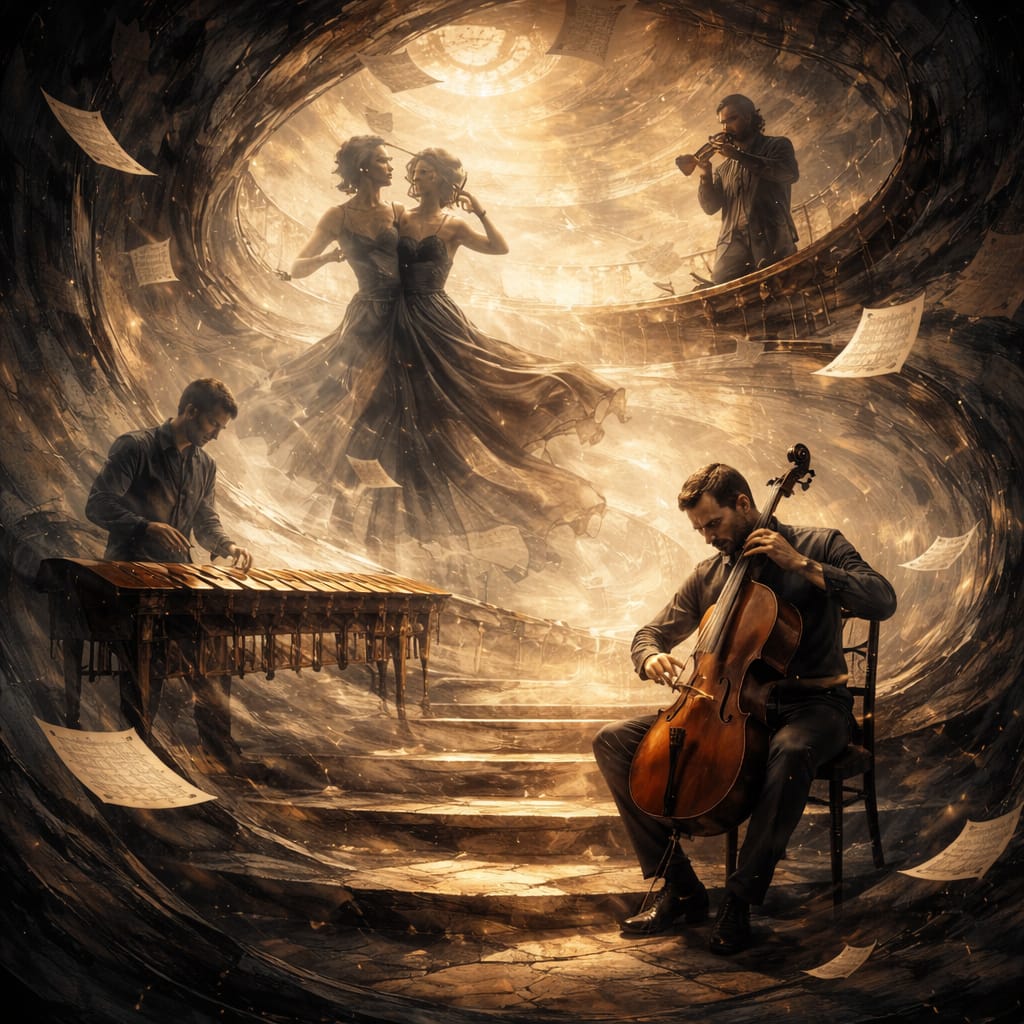
This article explores my orchestral composition process through the piece “White Lament”.
What does a restrained lament sound like? White Lament explores melancholy through repetition, gesture, and suspended harmony. The piece does not express emotion directly—it suggests it through interruption and repetition.
White Lament explores a restrained form of melancholy: not dramatic, but contained and persistent. Originally written for marimba, cello, and harmonica, and later arranged for brass quintet in Brassing Reflections, the piece blends a subtle tango character with a more suspended, introspective atmosphere.
Rather than expressing emotion through intensity, the music relies on gesture, repetition, and timbral contrast.
Listen while reading (two versions of the same piece):
The Core Idea
The piece is built around a lamenting gesture within a tango-like framework.
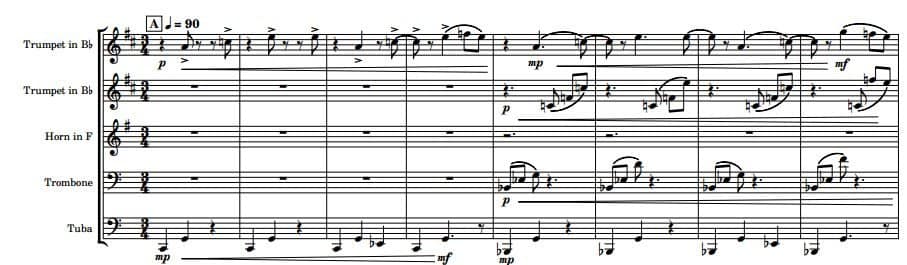
From the opening (♩ ≈ 90) :
- low brass establish a steady, grounded pulse
- short melodic figures emerge in upper voices
- phrasing alternates between motion and hesitation
This creates a dual character:
- rhythmic regularity (tango reference)
- expressive instability (lament)
The result is not a dance, but a memory of a dance.
This and other similar approaches can also be found in tracks such as ‘Spiral Stairway’ or ‘Old stone & vines’…
Rhythmic Language
The rhythmic identity is subtle but decisive.
Across the score :
- repeated accompaniment figures appear in lower voices
- syncopated gestures emerge in melodic lines
- rests interrupt the continuity of phrases
This produces:
- a sense of forward motion that is constantly delayed
- tension between pulse and expression
- a fragmented perception of time
The tango influence is present, but softened—never fully asserted.
Harmonic Language
The harmonic approach reinforces ambiguity.
Throughout the piece:
- chromatic inflections appear frequently
- bass motion suggests direction but avoids clear resolution
- harmonic shifts occur without strong cadential closure
This creates:
- a fluid harmonic space
- emotional uncertainty
- continuous expectation without release
Harmony does not resolve—it lingers.
Melodic Behavior
The melodic writing is based on short, expressive gestures.
As seen in the opening pages :
- phrases rise and fall within a limited range
- intervals often suggest tension (minor seconds, chromatic movement)
- lines are frequently interrupted
These gestures function as:
- fragments of expression
- incomplete statements
- emotional traces rather than full melodies
Silence plays a key role: what is not played is as important as what is.
Texture and Orchestration
The contrast between versions is central to the piece.
In the original instrumentation (marimba, cello, harmonica):
- marimba provides a soft percussive pulse
- cello carries expressive, sustained lines
- harmonica adds a fragile, breath-like quality
In the brass quintet version:
- articulation replaces fragility with weight
- timbral contrast (trumpets vs low brass) sharpens the texture
- use of mutes (cup mute) modifies color and distance
Despite these differences, the structural idea remains unchanged: distributed expression over a stable base.
Structural Design
The piece follows a flexible, process-based structure:
- A — Introduction of pulse and fragmented gestures
- B — Increased activity and density
- A1 / A2 — Return of initial material with variation
- Coda — Gradual reduction and dissipation
Rather than clear contrast, the structure evolves through:
- accumulation
- variation
- reduction
This mirrors the emotional trajectory: persistence rather than resolution.
Development
As the piece progresses:
- more voices participate simultaneously
- dynamics expand (mp → f → ff)
- rhythmic density increases
However, this does not lead to a climax in a traditional sense.
Instead:
- intensity rises
- but resolution is withheld
The music grows, but does not conclude—it fades while still unresolved.
Compositional Approach
In this piece, I focused on:
- combining a melancolic tango-derived pulse with non-functional harmony
- building expression through short, fragmented gestures
- using orchestration to redefine the same material
- avoiding full melodic or harmonic closure
The goal was to create a controlled lament, where emotion is present but restrained.
Compositional Techniques in White Lament
This work combines a steady rhythmic foundation with fragmented melodic writing and non-functional harmonic movement. The integration of tango-like rhythm with suspended harmonic language places the piece between expressive chamber music and contemporary cinematic composition.
Final Thought
White Lament is not a dramatic outburst, but a quiet persistence.
Through repetition, interruption, and unresolved harmony, the piece reflects a state where emotion remains present, but never fully expressed—like a memory that continues to return without ever finding closure.
Listen to White Lament and focus on how the tango-like pulse remains constant while the melodic gestures avoid resolution.
If you would like more information on these topics, explore the following related posts: