
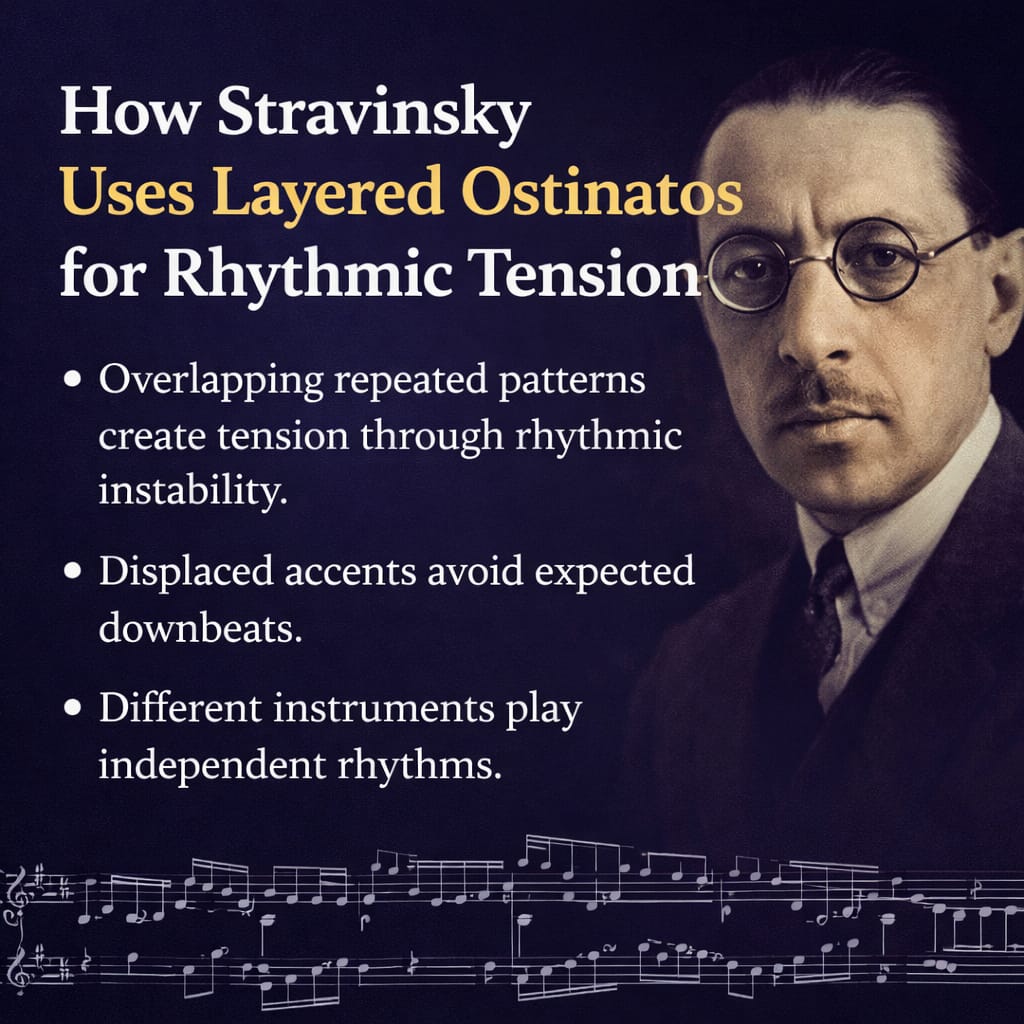
Stravinsky’s Layered Ostinatos Explained
Stravinsky’s rhythmic language is built on layered ostinatos that interact in complex and often unpredictable ways. Understanding this technique is key to analyzing works like The Rite of Spring.
Understanding Rhythmic Tension in Stravinsky’s Music
One of the most powerful rhythmic techniques in Stravinsky’s music is the use of layered ostinatos.
When people talk about Stravinsky, they often mention complexity or rhythm, but what really makes his music compelling is how he creates tension without relying on harmony alone. Much of that tension comes from rhythm itself—specifically from how he layers repeating patterns.
Instead of guiding the listener through chord changes in a traditional way, Stravinsky often builds momentum through overlapping rhythmic ideas. The result is a kind of controlled instability: the music feels grounded, but never fully settled.
What Is a Layered Ostinato?
An ostinato is simply a repeated figure, rhythmic or melodic. In Stravinsky’s music, though, it rarely appears on its own. He tends to stack several of these patterns together, each one slightly different in rhythm, accent, or character.
What makes this interesting is that these layers don’t always line up neatly. One instrument might be emphasizing a regular pulse, while another introduces a conflicting grouping. Over time, this creates a texture where repetition and unpredictability coexist.
You can hear this clearly in The Rite of Spring, where different sections of the orchestra repeat short figures that seem almost mechanical on their own, but become tense and unstable when combined.
Displacement and Accent: Where the Tension Really Happens
A key part of Stravinsky’s approach is how he handles accents. He rarely reinforces a predictable beat for long. Instead, he shifts emphasis in ways that make the listener question where the “center” of the rhythm actually is.
This often involves:
- Groupings that break regular meter (for example, 2+3+2 instead of a balanced 4+4)
- Accents that move across the bar rather than staying fixed
- Layers that emphasize different pulses at the same time
Even when the material is repetitive, these subtle shifts prevent the music from feeling static. There is always a slight sense of imbalance, and that’s exactly what keeps it alive.
Instrumentation as Part of the Rhythm
Stravinsky doesn’t treat orchestration as something separate from rhythm. In many cases, the choice of instrument defines how a pattern is perceived.
A steady ostinato in the strings can feel almost mechanical, while a similar figure in the woodwinds might sound more fluid or unstable. Percussion can either reinforce the pulse or disrupt it entirely, depending on how it’s used.
By assigning different rhythmic layers to different sections of the orchestra, he creates clarity within complexity. You can follow each layer, even when they are working against each other.
Why This Technique Works
What makes layered ostinatos so effective is the balance between familiarity and tension.
Repetition gives the listener something to hold onto. You recognize the pattern, you start to anticipate it. But as soon as another layer interferes—slightly out of phase, or with a different accent—the sense of control slips.
You’re no longer just listening to a pattern. You’re listening to the interaction between patterns. That interaction is where the real tension lives.
Applying This Idea in Composition
You don’t need a large orchestra to explore this idea. Even with a few instruments, you can create a similar effect.
A practical approach could be:
- Start with a simple rhythmic figure
- Add a second layer with a different grouping or accent pattern
- Introduce contrast through instrumentation or register
- Let the layers interact without forcing them to align perfectly
The goal is not complexity for its own sake, but controlled friction. Small differences between layers can be enough to generate movement and interest.
A Personal Perspective
This way of thinking about rhythm has influenced how I approach certain pieces, especially when I’m more interested in atmosphere than melody.
In works like Urban Nightlife Stories, I tend to build textures from repeated patterns that evolve gradually. Different elements enter, overlap, and shift slightly over time, creating a sense of motion without needing constant thematic change.
It’s less about developing a theme in the traditional sense, and more about shaping a space where rhythm itself carries the narrative.
Final Thoughts
Stravinsky shows that rhythm can do much more than support harmony—it can be the main driver of tension and structure.
By layering simple patterns and allowing them to interact in imperfect ways, he creates music that feels both organized and unstable at the same time. That balance is what gives his work its distinctive energy, and it’s a technique that remains incredibly relevant for composers today.
If you would like more information on these topics, explore the following related posts: