The Machine That Was in a Hurry — Inside the Composition

arpeggio string quartet composition rhythmic tension musical motion abstract music structure

Orchestral Composition Process What does urgency sound like when it never accelerates? The Machine That Was in a Hurry explores tension built through continuous motion rather than speed. It uses continuous arpeggiation to create tension through repetition and harmonic instability. Originally written for piano and vibraphone (2021), and later adapted for string quartet in the … Read more

Rest Room — Inside the Composition

calm orchestral composition pizzicato strings harmonic rhythm minimal texture music

Orchestral composition process What does musical stillness sound like when it is not completely at rest? Rest Room, from the album Forgotten Castle, represents a moment of pause within the narrative: a space of calm inside a larger structure shaped by memory and time. Rather than stillness, the piece explores controlled tranquility—a quiet environment sustained … Read more

Inside “Crossroad Mood”

urban night orchestral composition rhythmic pattern traffic motion music abstraction

Orchestral composition process This article explores my orchestral composition process through the piece “Crossroad Mood”. The music does not settle. It keeps moving. What does a stressful night drive through a city sound like? Crossroad Mood, from the album Urban Nightlife Stories, captures a tense and restless journey through a city at night.. Rather than … Read more

White Lament — Inside the Composition

Melancholic orchestral composition tango rhythm fragmented melody white lament

This article explores my orchestral composition process through the piece “White Lament”. What does a restrained lament sound like? White Lament explores melancholy through repetition, gesture, and suspended harmony. The piece does not express emotion directly—it suggests it through interruption and repetition. White Lament explores a restrained form of melancholy: not dramatic, but contained and … Read more

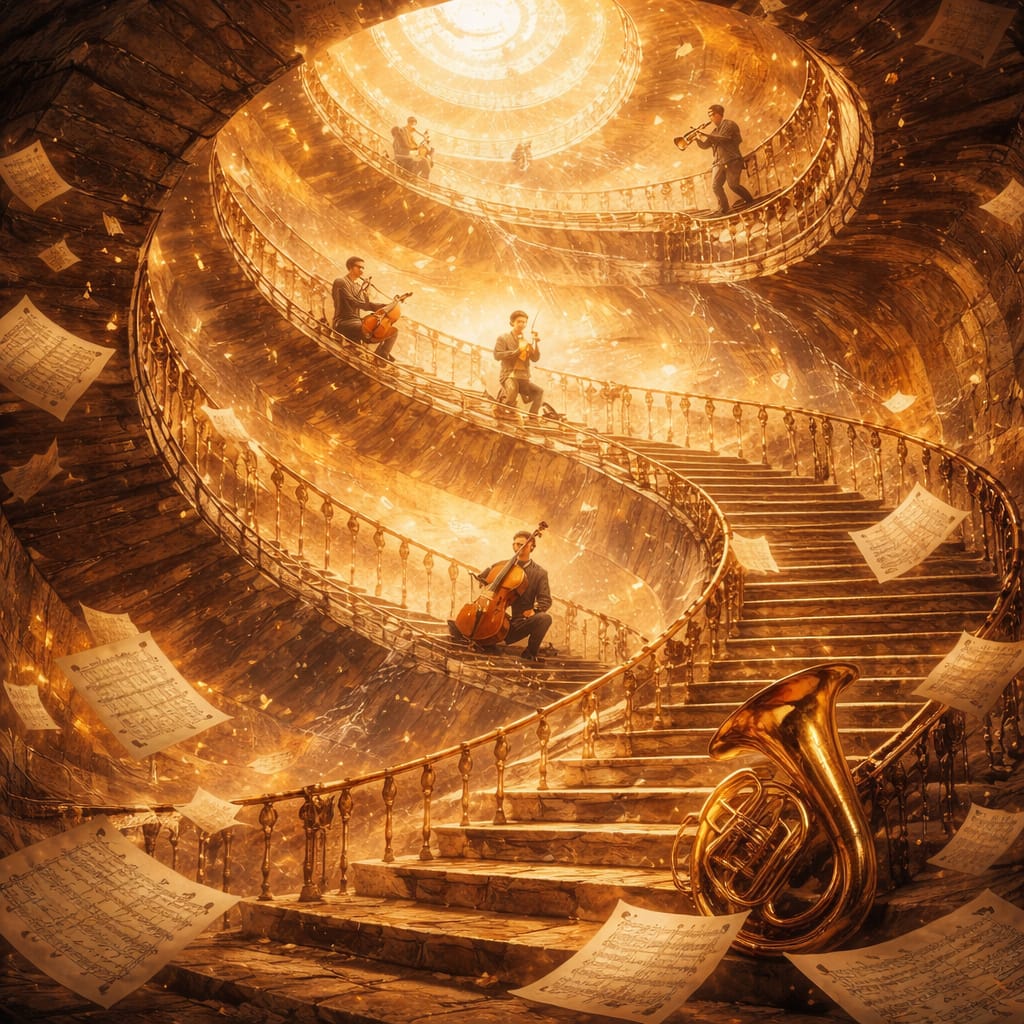
Spiral Stairway — Inside the Music

orchestral score spiral stairway circular motion harmonic oscillation composition

Orchestral composition process This article explores my orchestral composition process through the piece “Spiral Stairway”. Spiral Stairway explores the idea of circular movement: not linear progression, but continuous ascent without a clear beginning or end. Originally written for piano and cello, and later arranged for brass quintet in Brassing Reflections, the piece translates a visual … Read more

September — Inside the Composition

orchestral score september low register rhythmic motif composition

Orchestral composition process What does the beginning of autumn sound like? September explores the subtle shift between cycles, using repetition and low-register rhythm to represent the passage of time. Originally written for piano, cello, and clarinet, and later arranged for woodwind quintet in Woodwinds Blowing, the piece explores the idea of cyclical time—how seasons return, … Read more

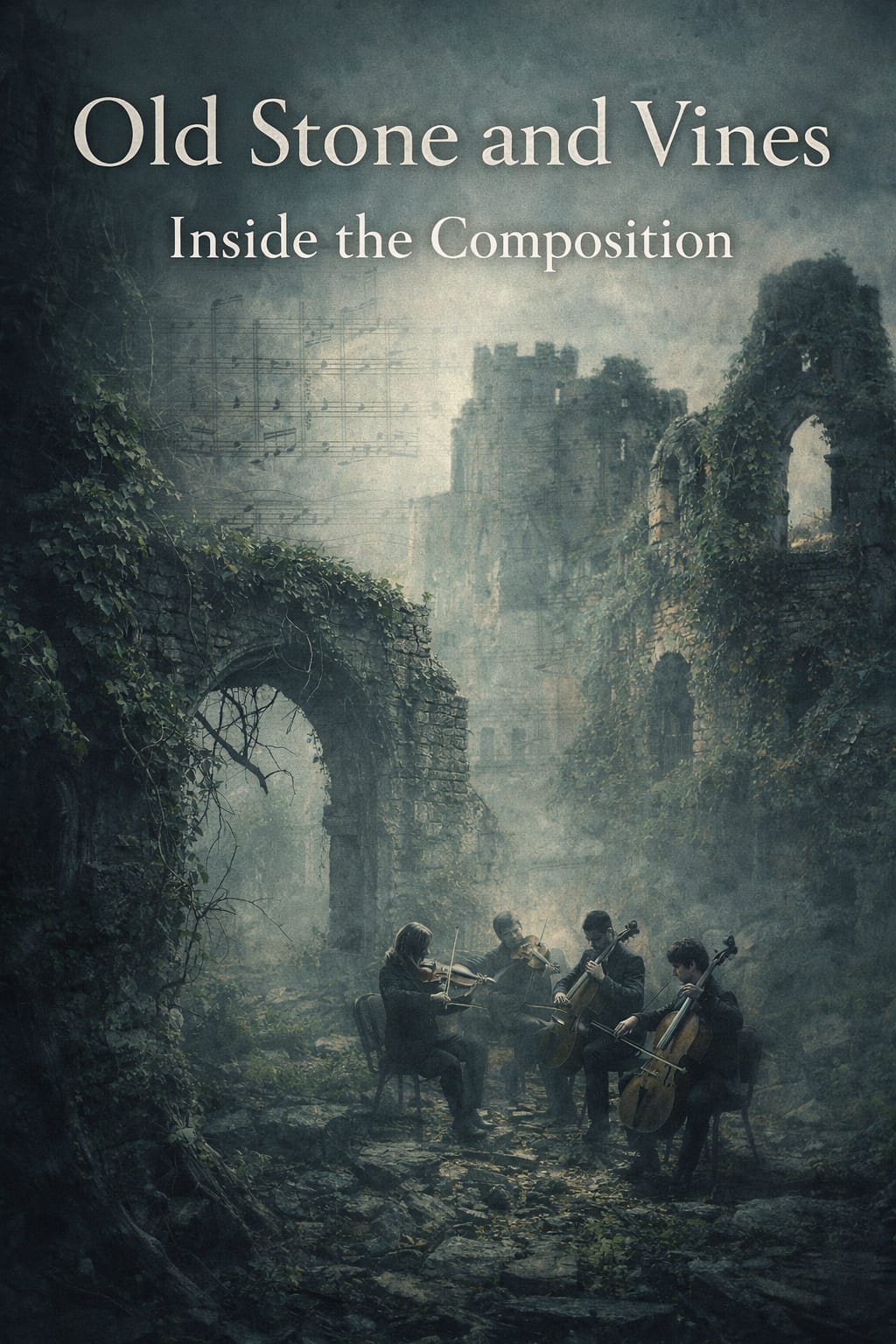
Old Stone and Vines — Inside the Composition

orchestral composition process using harmonic transformation in string quartet

Orchestral composition process I tried to remove harmonic direction completely. But every progression I wrote kept pulling the music forward. The challenge in Old Stone and Vines was not how to move — but how to avoid moving, while still changing. Part of the album Forgotten Castle, the piece reflects the present state of the … Read more

Parade — Inside the Composition

orchestral score parade rhythmic motif semiquaver composition

Orchestral composition process What does a musical celebration sound like? This article explores my orchestral composition process through the piece “Parade”. It captures the energy of a crowd as knights pass through the castle, transforming movement and rhythm into a continuous musical flow. Part of the album Forgotten Castle, inspired by the castle of Astúlez, … Read more

How I Composed “Stained Glass”

stained glass surreal colorful light kaleidoscope orchestral composition

How do you translate light into music? Stained Glass is built as a constantly shifting texture, where rhythm and harmony behave like fragments of colored light. It explores a visual idea translated into sound: the experience of looking at stained glass windows from inside a church. Light passes through shifting colors and shapes, constantly transforming—never … Read more

Where Did They Go? — Inside the Composition

Where Did They Go orchestral composition alien mystery surreal scene

Where Did They Go? explores a different psychological layer within Gateway, a Psychological Introspection: not discovery, but uncertainty after discovery. GATEWAY: A PSYCHOLOGICAL INTROSPECTION (album) by Pilpil Music Listen while reading — this piece is built around a recurring unresolved motif. The piece reflects a fundamental question raised in Frederik Pohl’s novel: if the alien … Read more

The Discovery — Composition breakdown

the discovery article

The Discovery opens the album Gateway, a Psychological Introspection and represents a decisive moment: the encounter with the unknown. Inspired by the novel Gateway by Frederik Pohl, the piece reflects the discovery of an asteroid containing alien transportation technology—something both fascinating and deeply unsettling. GATEWAY: A PSYCHOLOGICAL INTROSPECTION (album) by Pilpil Music The Core Idea … Read more

Hourglass — Inside the Music

Hourglass - How to article

Hourglass is built around a simple idea: time that doesn’t move forward, but loops endlessly. Instead of a clear beginning and destination, the piece explores repetition, subtle change, and suspended motion—like sand continuously falling inside an hourglass. HOURGLASS by Pilpil Music The Core Idea From the very first bars, the piano establishes a continuous ostinato … Read more

Inside “Hidden Alleys”

mysterious urban night alley instrumental music scene

Some pieces are built around clarity and direct expression, while others explore ambiguity and contrast. Hidden Alleys, part of the album Urban Nightlife Stories, belongs to the second category. It is a composition that moves through shadowed spaces, suggesting the experience of walking through unknown or hidden corners of a city at night. This piece … Read more

Inside “After the Neon Fades”

After the neon fades

Some pieces are built around energy and movement, while others emerge from a more reflective state. After the Neon Fades, included in the album Urban Nightlife Stories (2025), belongs to the latter. It captures a very specific moment within the narrative of the album: the end of the night, when the city begins to quiet … Read more

The making of “Dancing Where We Belong”

How to Dancing where we belong

Some compositions are driven by introspection or atmosphere, while others emerge from a more direct and spontaneous musical impulse. Dancing Where We Belong, included in the album Urban Nightlife Stories (2025), belongs clearly to the second category. It is a piece that captures a specific moment: the joy of meeting friends at night in a … Read more

How I Wrote “Night Walk in the Forest”

How to compose

Some compositions begin with a clear melodic idea, while others emerge from a more abstract musical gesture. “Night Walk in the Forest” belongs to the latter. The piece, originally composed in 2021 for piano and oboe, started from a rhythmic and harmonic idea that immediately suggested a sense of urgency and movement. From the very … Read more

The Story Behind “Green Train to Gorliz”

FEVE green train

Some musical ideas begin with abstract emotions, while others are connected to specific memories or places. Green Train to Gorliz belongs to the second category. The piece was inspired by a railway line that once connected the city of Bilbao with the coastal village of Gorliz in northern Spain. Until the 1990s, an old electric … Read more