

Enter Fluency, originally released for solo piano in 2022 and later adapted for piano and cello in the album Piano & Cello Junction, explores continuity through perpetual motion and harmonic transformation.
The piece is built around flowing arpeggiated movement that constantly evolves while maintaining a stable pulse. Rather than dramatic thematic development, the music focuses on circulation, transition, and momentum.
This article explores my compositional process through this piece.
Listen while reading (two versions of the same piece):
Composition Process
The Core Idea
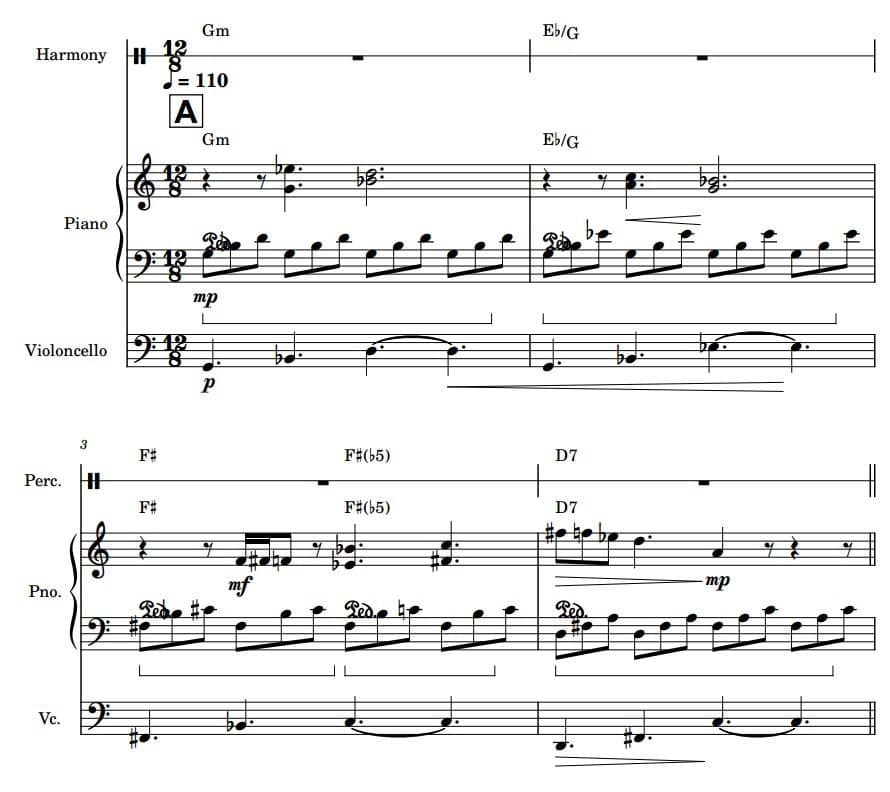
The piece is based on continuous harmonic flow through repetitive arpeggiated figures.
From the opening (♩ = 110):
- the piano establishes uninterrupted rhythmic motion
- harmonic changes occur gradually beneath the surface
- the cello sustains long tones above the texture
This creates:
- fluidity
- continuity
- forward motion without abrupt contrast
The music behaves like a continuous stream rather than a sequence of isolated sections.
The A Sections — Motion Through Repetition
The A sections (A, A1, A2, A3, A4) establish the central identity of the piece.
Recurring harmonic areas include:
- Gm
- E♭/G
- F♯
- F♯(♭5)
- D7
The piano maintains constant arpeggiated motion while harmony shifts progressively.
This creates:
- rhythmic continuity
- harmonic circulation
- gradual accumulation of tension
The repetition is structural rather than minimalist. Small harmonic changes continuously reshape the emotional atmosphere.
Harmonic Language
Harmony functions through transformation instead of resolution.
Across the piece, the progression moves between:
- stable minor sonorities
- altered dominant harmonies
- suspended harmonic colors
- chromatic transitions
Particularly important are:
- F♯(♭5)
- Faug
- C♯sus4
- E♭m
These harmonies:
- destabilize tonal expectation
- avoid definitive cadences
- maintain constant motion
Harmony here acts as a mechanism of transition.
Rhythmic Behavior
Rhythm is the true structural engine of the piece.
The piano accompaniment maintains:
- continuous quaver motion
- regular pulse
- repetitive articulation patterns
Meanwhile:
- ritardando sections briefly suspend momentum
- accelerando passages reactivate motion
- cello phrasing expands temporal perception
The result is a sensation of breathing motion: expansion and contraction within a continuous flow.
The B Sections — Harmonic Diversion
The B sections (B1 and B2) introduce contrast through harmonic displacement and reduced stability.
Here:
- tonal centers shift more rapidly
- harmonic ambiguity increases
- melodic motion becomes less grounded
The transitions through:
- C
- Cm
- D
- C♯sus4
- E♭m
create temporary uncertainty before returning to the more stable A material.
These sections function less as interruption and more as deviation from the main current.
The C Section — Temporary Release
The C section introduces a more open and lyrical atmosphere.
Here:
- the cello becomes more melodic
- harmonic rhythm slows slightly
- the texture feels less mechanical
This creates:
- temporary release
- emotional openness
- contrast without rupture
The music briefly relaxes before re-entering the perpetual motion of the final A sections.
Texture and Instrumentation
The piano–cello version expands the original solo piano texture through timbral contrast.
The piano provides:
- rhythmic continuity
- harmonic structure
- perpetual motion
The cello introduces:
- sustained resonance
- melodic expansion
- expressive tension
Rather than functioning as soloist and accompaniment, both instruments contribute to a shared continuous texture.
Structural Design
The piece follows an expanded cyclic structure:
- A → A1 → B1 → A2 → C1 → A3 → B2 → A4
This design reinforces:
- recurrence
- transformation
- continuity through variation
The repeated return of A material creates familiarity, while harmonic deviations prevent stasis.
Compositional Approach
In this piece, I focused on:
- using repetitive motion as structural continuity
- transforming harmony gradually
- controlling tension through harmonic color
- balancing motion and suspension
The goal was to create a piece that feels permanently in motion without becoming mechanically repetitive.
Compositional Techniques in Enter Fluency
This work combines perpetual arpeggiated motion, cyclic harmonic structures, and gradual transformational processes. Continuous rhythmic flow and harmonic reinterpretation generate momentum while maintaining structural coherence characteristic of contemporary chamber and neoclassical music.
Final Thought
Enter Fluency is not about arriving at a destination.
It is about remaining inside movement itself.
Through repetitive motion, harmonic transformation, and cyclic structure, the piece creates a musical space where continuity becomes the central expressive element.
If you would like more information on these topics, explore the following related posts: