

Introduction
Bilbao Memories is a musical reflection on my hometown, Bilbao. The piece is not intended as a literal portrait of the city, nor does it attempt to describe particular streets, buildings, or events. Instead, it is built around the emotional experience of remembering a place that is part of one’s personal history.
The version included on Faces & Places (2026) is written for string quintet: two violins, viola, cello and double bass. It is a reworking of an earlier piano version from 2022. Moving the piece from piano to strings allowed me to preserve its melodic and harmonic identity while giving the music a more spacious, vocal and intimate character.
The result is deliberately melancholic. The music is less about remembering Bilbao as it physically exists and more about the way a familiar city can survive in memory: fragmented, emotional, sometimes distant, but still recognizable.
Listen while reading the 2026 string-quintet and the 2022 piano version of this single:
Composition Process
The starting point for Bilbao Memories was not a specific scene or event, but a feeling: the melancholy of remembering my hometown from a distance.
The original piano version was written in 2022. When I returned to the piece for Faces & Places, I did not simply orchestrate the piano part. I treated the string quintet as a new expressive environment in which the original musical ideas could be rediscovered.
The basic material remains recognizable, but its presentation changes substantially. Instead of one instrument controlling melody, harmony and accompaniment simultaneously, the quintet allows those functions to be distributed among several voices.
This creates a more fragmented form of musical memory. A melodic idea can appear in one instrument, be answered or supported by another, and then disappear into the texture.
The Core Idea
At the centre of Bilbao Memories is a relatively simple melodic idea.
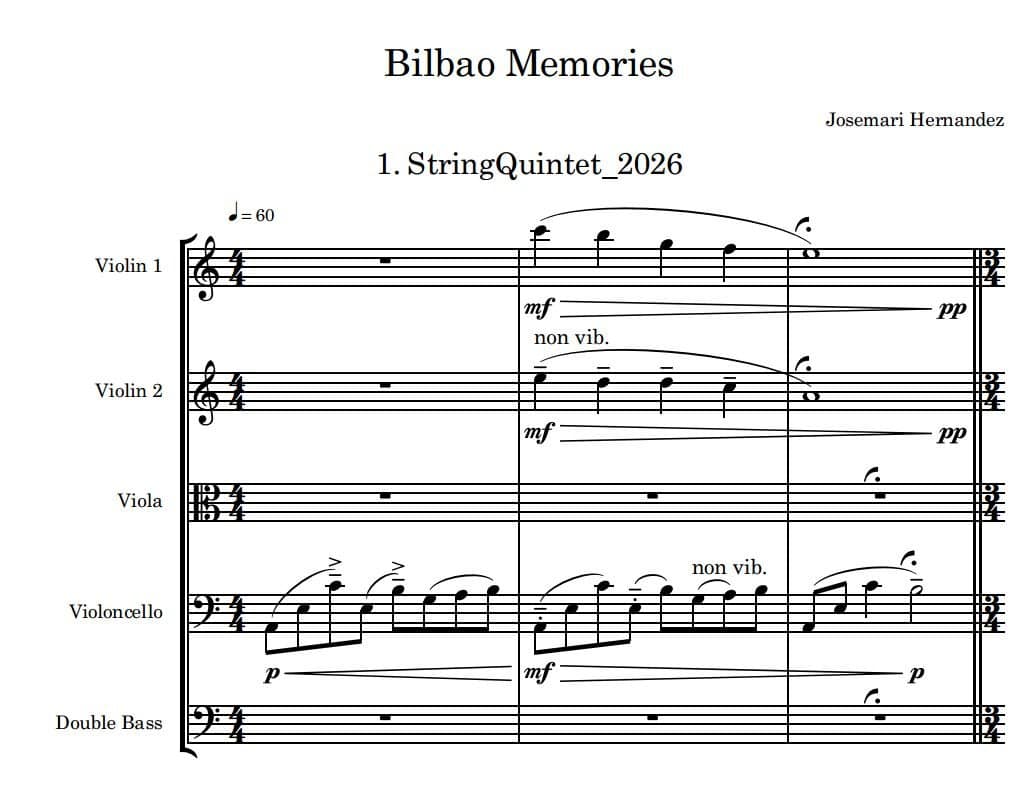
The music begins quietly, with the cello establishing the first musical gesture while the upper strings gradually enter. The opening tempo is slow, ♩ = 60, creating an immediately reflective atmosphere. The first violin and second violin use sustained lines with non-vibrato, while the cello carries more movement beneath them.
This contrast is important. The upper strings create a sense of distance and stillness, while the cello provides a more human, almost conversational quality.
The opening does not try to make a dramatic statement. It feels more like the beginning of a memory.
The A Section
The first substantial section moves to ♩ = 95, introducing a more active rhythmic character.
Here the string quintet becomes much more conversational. The instruments alternate between melodic gestures, short rhythmic figures and accompanying patterns. Pizzicato is also introduced, creating a clear contrast with the sustained arco writing of the opening.
The harmonic foundation includes chords such as Am/E, B/E♭, Dm, C and E7/B, eventually returning toward A minor. The use of inversions is particularly important because the bass does not simply reinforce the root of each chord. Instead, the changing bass notes help create a continuous harmonic movement.
The result is neither conventionally tonal nor completely detached from tonality. The music retains a recognizable harmonic centre while allowing chromatic colour and unexpected bass movement to create instability.
That instability fits the emotional idea of the piece: the memory of a familiar place is recognizable, but it is never completely fixed.
Harmonic Language
The harmonic language of Bilbao Memories is one of the main elements that creates its melancholic character.
The music frequently combines familiar minor and major sonorities with chromatic alterations and diminished harmony. Later in the piece, the harmonic vocabulary becomes more distant, including sonorities such as E♭m(♭5), C♯ and F♯dim7.
These chords do not function simply as isolated colours. They create transitions between areas of greater stability and passages where the tonal centre becomes less obvious.
One particularly important contrast is between the relatively familiar harmonic world of the A material and the more chromatic language of the B sections.
The harmony therefore participates in the memory concept: some moments feel immediately familiar, while others feel distorted or distant, as memories often do.
Rhythmic Behavior
Although the emotional character of the piece is reflective, the rhythm is not static.
The score uses a combination of:
- changing between 4/4 and 3/4
- syncopated gestures
- rests and spaces between phrases
- triplets
- accented notes
- pizzicato
- accelerando and allargando
- contrasting rhythmic densities between the instruments
The frequent use of accelerando and allargando is particularly significant. Rather than maintaining a completely mechanical pulse, the music repeatedly expands and contracts its sense of time.
This allows the performance to breathe.
The rhythmic language therefore supports the emotional character without relying on a single repetitive accompaniment pattern.
The B Section
The B section begins around measure 15 and introduces a noticeable change in harmonic and textural character.
The harmony moves toward more ambiguous sonorities, including repeated E minor-flat-five and C relationships. The repeated alternation creates a harmonic tension that is different from the more familiar A material.
The upper strings become more active, and the ensemble increasingly works as a collection of interacting voices rather than a melody accompanied by supporting instruments.
This section also contains stronger dynamic contrasts and more pronounced accents. The music becomes more restless without losing its underlying melancholic character.
It is not a completely new musical world; rather, it feels like another layer of the same memory.
Return: A1
At approximately measure 35, the A material returns.
This is important structurally because the piece does not simply progress continuously toward a climax. Instead, it repeatedly returns to previously established material.
However, the return is not an exact repetition in terms of texture.
The cello and double bass become particularly important in reinforcing the harmonic movement, while the upper strings redistribute the melodic material. Pizzicato and arco techniques continue to alternate, giving the repeated material a different physical character.
The return therefore functions less like a literal repetition and more like remembering the same thing again from a slightly different perspective.
B1: Increasing the Intensity
The second B section begins around measure 49.
The harmonic ambiguity becomes more pronounced, and the instrumental interaction becomes denser. The score includes sul tasto, glissandi, triplet figures and increasingly expressive dynamic gestures.
The use of non-vibrato, sul tasto and vibrato at different moments gives the strings several distinct colours. These are not merely technical choices; they alter the emotional distance of the sound.
The section gradually develops greater intensity before moving toward the final return.
Return: A2
At around measure 65, the A material returns for the final major section.
By this point, the listener has already heard the principal material several times, but its context has changed.
The final A section brings together elements introduced earlier: melodic gestures, pizzicato, arco, triplets and the harmonic relationships established in the opening sections.
The result is a sense of recognition rather than resolution. The music has returned to familiar material, but the listener has experienced several transformations of it.
The Ending
The final part of the piece gradually slows back toward the original tempo of ♩ = 60.
This is structurally significant. The music begins slowly, becomes more active through the central sections, and eventually returns to a slower temporal space.
The final allargando extends this process even further.
Rather than ending with a strong final statement, the piece gradually releases its energy. The sustained final sonorities leave the impression of something remembered rather than something definitively concluded.
This is important to the concept of Bilbao Memories: a memory does not necessarily have a clear ending. It simply becomes quieter.
Texture and Instrumentation
The string-quintet instrumentation—two violins, viola, cello and double bass—allowed me to expand considerably on the original piano version.
One of the main differences is the possibility of independent melodic layers.
The first and second violins can sustain related but independent lines, while the viola occupies the middle register and the cello and double bass provide different levels of harmonic and rhythmic support.
The score also makes extensive use of different string techniques:
- arco for sustained and lyrical material
- pizzicato for lighter and more articulated passages
- non vibrato for a more distant, restrained colour
- sul tasto for softer, less focused string sonorities
- vibrato for more expressive passages
- glissandi for moments of instability and transition
These techniques allow the same musical material to acquire different emotional meanings depending on how it is presented.
Structural Design
The string-quintet version follows a clearly defined recurring structure:
Opening → A → B → A1 → B1 → A2 → Coda/Ending
The opening is slow, at ♩ = 60, while the principal sections move around ♩ = 95. The final section returns to the slower tempo.
The recurrence of A material provides the structural coherence of the piece, while the B sections introduce contrast through harmonic language, texture and rhythmic intensity.
The score contains 85 measures, with changes between 4/4 and 3/4 contributing to the flexibility of the phrasing.
The structure can therefore be understood as a process of recollection and transformation rather than a linear narrative.
From Piano to String Quintet
The 2022 piano version and the 2026 string-quintet version are two interpretations of the same underlying composition.
The piano version presents the musical material through a single instrument. Melody, harmony, bass and accompaniment are contained within one physical sound source.
The string quintet changes that relationship completely.
A melodic phrase can now pass between instruments. Harmonic notes can be sustained independently. Rhythmic figures can be layered rather than played sequentially. The bass can establish its own identity instead of simply being part of the pianist’s left hand.
This makes the 2026 version less like an orchestration and more like a recomposition of the original material for a different musical organism.
The result is more transparent in some places and more complex in others, while retaining the essential melodic and harmonic identity of the 2022 piece.
Compositional Approach
With Bilbao Memories, I was interested in how a relatively simple musical idea could carry an emotional meaning without relying on explicit musical description.
There is no attempt to imitate Bilbao through recognizable folk melodies or literal references to particular locations.
Instead, the city exists as an emotional background.
The melody represents the act of remembering. The recurring A sections suggest recognition. The contrasting B sections introduce distance and instability. The gradual return to the opening tempo suggests the fading of the memory back into silence.
The string quintet reinforces this idea by allowing the musical material to appear in different voices, colours and registers—as if different fragments of the same memory were being recalled.
Compositional Techniques in Bilbao Memories
Several techniques are central to the piece:
1. Recurring thematic material
The A material returns several times, providing the principal structural identity of the composition.
2. Harmonic transformation
The harmonic language moves between relatively stable minor-centred material and more chromatic sonorities, particularly in the B sections.
3. Instrumental redistribution
Material is continuously redistributed among the five string voices rather than remaining attached to a single instrument.
4. Register as expression
The placement of material in the high violin register, middle viola/cello register or low double-bass register changes its emotional weight.
5. Timbral contrast
Arco, pizzicato, non-vibrato, sul tasto, vibrato and glissando provide different shades of the same musical language.
6. Tempo flexibility
Accelerando and allargando are used as structural and expressive devices rather than merely as performance indications.
7. Dynamic shaping
Long crescendos and diminuendos frequently shape phrases, allowing the music to grow and recede organically.
8. Silence and space
Rests are an important part of the texture. They prevent the ensemble from becoming continuously dense and give individual gestures room to resonate.
Final Thought
Bilbao Memories is ultimately about the distance between a place and the memory of that place.
Bilbao is my hometown, but the piece does not attempt to reproduce the city itself. It reflects the way a familiar place can remain inside us after time has passed.
The 2022 piano version was the first expression of that idea. Returning to it in 2026 and rewriting it for string quintet allowed me to look at the same memory again from another perspective.
The musical material is familiar, but its voice has changed.
And perhaps that is what memory does: it keeps the essential shape of something while constantly changing the way we hear it.