
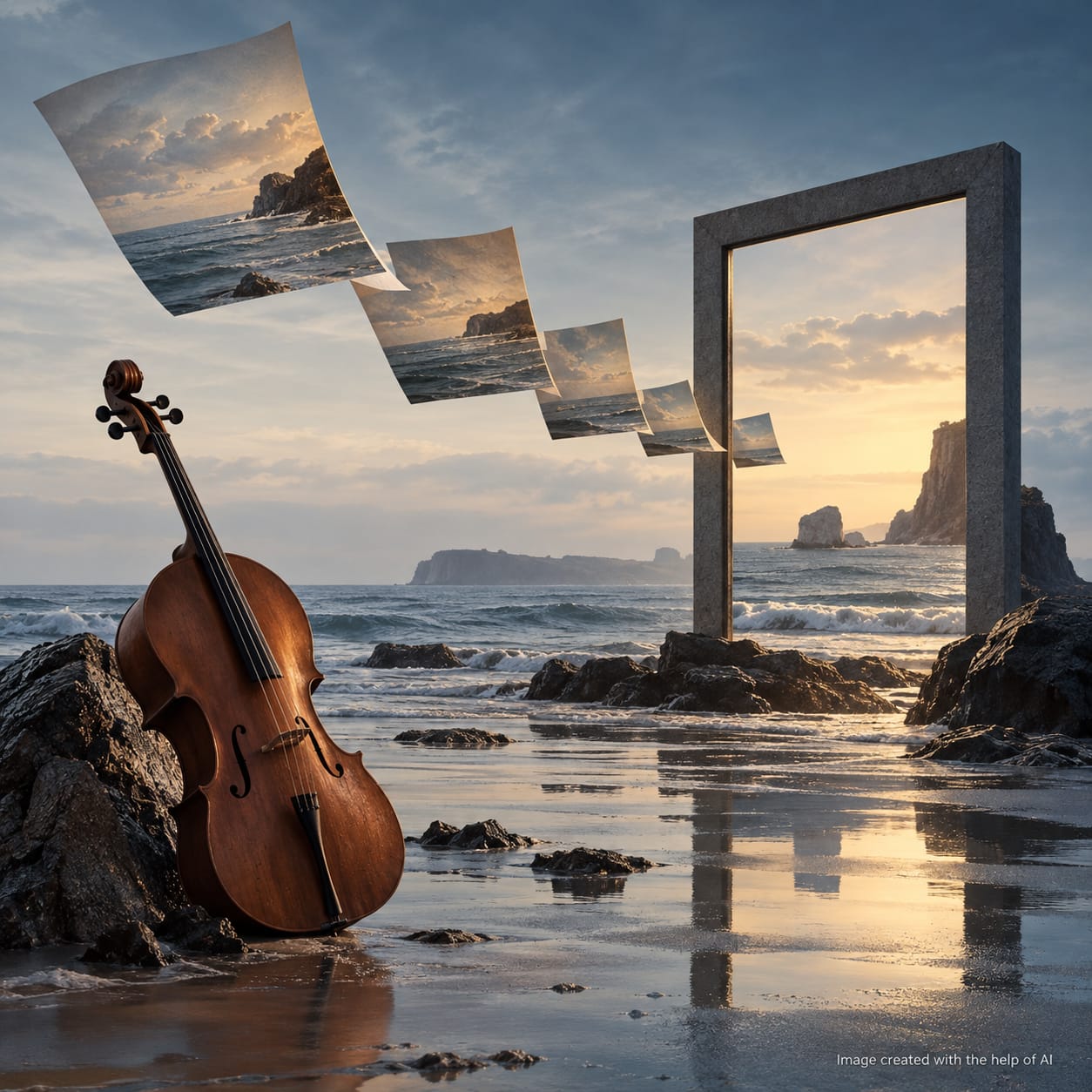
How memory, harmony and string texture become a musical landscape
What does a memory of the sea sound like when it is no longer a precise image, but a collection of sensations?
Salt Air Memories, from the album Faces & Places, explores that question through a string quintet texture built around repetition, harmonic transformation and changing instrumental colour.
The piece does not attempt to describe a particular coastline or reproduce the sound of waves. Instead, it focuses on something more elusive: the way a place can remain in memory through fragments of atmosphere, distance, movement and sensation.
The music is written for violin I, violin II, viola, cello and double bass, and its structure grows from recurring harmonic and rhythmic materials that return several times, each time with subtle changes in texture and intensity.
Listen to Salt Air Memories while reading and focus on how the recurring harmonic and rhythmic material changes each time it returns:
The Core Idea
The starting point of Salt Air Memories was the idea of fragmented recollection.
A memory of a place is rarely continuous. We tend to remember isolated elements: a particular colour, a movement, a sound, a change in the air, or simply the feeling of being somewhere.
I wanted the musical structure to behave in a similar way.
Rather than developing a long melody in a conventional narrative form, the piece relies on recurring harmonic cycles and rhythmic figures. The material comes back, but it is never experienced in exactly the same way.
This creates a sense of returning to a familiar place while discovering something slightly different each time.
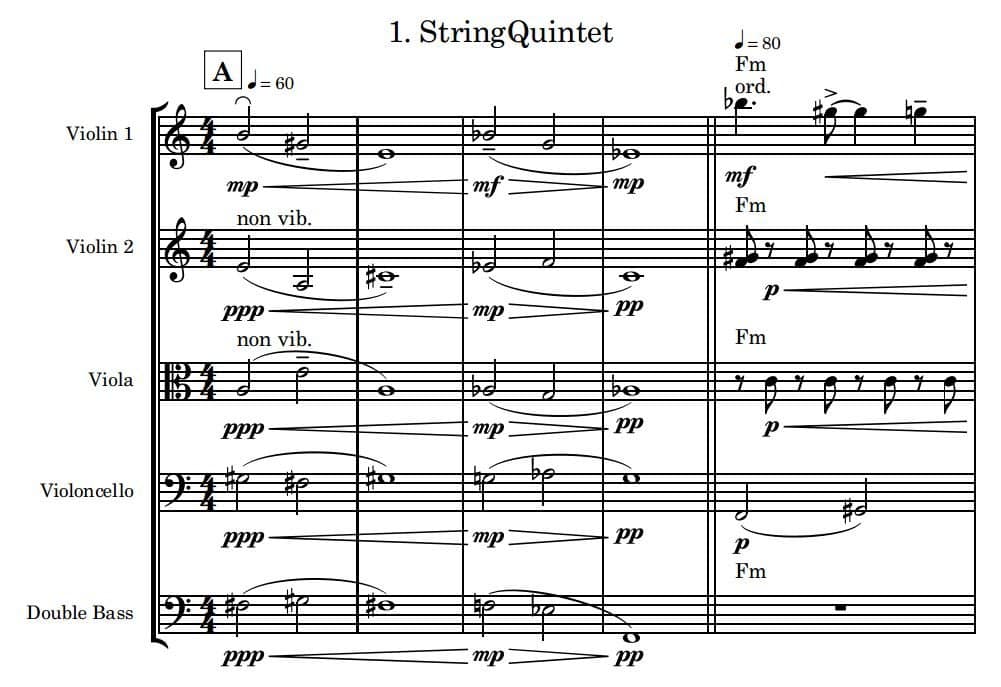
The opening is deliberately restrained. The score begins at ♩ = 60, with the strings marked non vibrato and very soft dynamics. The sound is therefore relatively exposed and controlled before the rhythmic energy gradually becomes more pronounced.
The Opening — A Memory in Suspension
The first section establishes the main atmosphere of the piece.
The opening harmonic environment is centred around F minor, but the harmony does not remain static. It moves through changing sonorities including F minor, D♭ and E, creating a mixture of familiarity and instability.
The important element here is not a traditional harmonic progression leading toward a strong cadence. Instead, the harmony functions as a changing landscape.
The strings sustain and reshape these harmonic colours while the upper instruments introduce small melodic gestures. The use of non vibrato contributes to a cooler, more distant quality, almost as if the sound were being heard through memory rather than directly in the present.
The opening therefore establishes one of the central ideas of the composition:
the music remembers, but it does not completely recover the original image.
Repetition as Memory
One of the main compositional devices in Salt Air Memories is repetition.
Several harmonic and rhythmic patterns return throughout the work. However, repetition here does not mean exact duplication.
The recurring material is continuously recontextualized through changes in:
- articulation
- register
- dynamics
- harmonic colour
- instrumental texture
- vibrato
- rhythmic density
This is particularly important in a piece about memory.
A remembered event can return repeatedly in the mind while changing slightly every time. The musical material behaves in much the same way.
The score shows several recurring harmonic cycles, including combinations built around D minor, D augmented, A, E and F minor, followed by further transformations involving D♭, E and related sonorities.
The harmonic language therefore provides continuity without requiring a conventional tonal journey.
From Stillness to Movement
As the opening material develops, the music becomes more active.
The tempo moves from ♩ = 60 to ♩ = 80, and the rhythmic figures become increasingly articulated. The ensemble begins to function less as a sustained harmonic body and more as an interconnected rhythmic mechanism.
This transition is important because the piece does not remain purely atmospheric.
The memory begins to move.
Short repeated figures appear in several instruments, creating a subtle pulse beneath the more lyrical material. The cello and double bass help provide weight and continuity, while the violins and viola introduce more active melodic and rhythmic gestures.
The result is not a dramatic change of character, but a gradual increase in internal movement.
Timbre as Part of the Composition
For this piece, orchestration is not simply a way of assigning notes to five instruments.
Timbre is part of the musical structure.
The score makes extensive use of different string techniques, including:
- non vibrato
- arco
- pizzicato
- sul tasto
- vibrato
- glissando
These techniques allow essentially the same musical material to acquire different emotional and spatial qualities.
For example, sul tasto produces a softer and more veiled colour, while pizzicato introduces a much more articulated and percussive character.
Glissandi appear as another expressive device, briefly destabilizing the otherwise controlled harmonic environment.
This is one of the reasons I think of Salt Air Memories as a piece about atmosphere rather than description.
The musical image is created through sound colour as much as through melody or harmony.
The A Material — Returning to the Same Place
The first major musical idea returns several times throughout the piece.
The score marks successive returns as A1 and A2, while contrasting material appears in sections marked B and B1.
This recurring architecture gives the composition a strong sense of identity.
But the returns are not simple repetitions.
Each appearance occurs in a different harmonic and textural context. The listener recognises something familiar, but the surrounding sound has changed.
That is exactly how I wanted memory to work in the piece.
A place can remain recognisable even when the memory of it has been altered by time.
The B Material — A Change of Perspective
The contrasting sections introduce different harmonic and rhythmic perspectives.
Instead of abandoning the main musical language, they transform it.
The score moves through harmonic areas including C, C6, C augmented, C minor, E, B and related sonorities. Rhythmic figures become more pronounced, while changes between pizzicato and arco alter the physical character of the ensemble.
This contrast prevents the recurring A material from becoming static.
The piece is therefore not based on a simple alternation between two completely unrelated themes. The contrasting material feels like another view of the same musical landscape.
Harmony Without a Traditional Destination
The harmonic language of Salt Air Memories is intentionally fluid.
Rather than constructing the piece around a conventional functional progression, I use chords as sonic fields.
Minor sonorities, augmented chords, sixth chords, seventh chords and suspended structures appear repeatedly. Their role is often more colouristic than functional.
For example, the score moves through combinations such as:
C → C6 → Caug
and later:
A → E → Dmaj7 → Fm
These transformations create movement while preserving a certain ambiguity.
This approach allows the harmony to behave almost like changing light.
The listener can perceive that the musical environment has changed without necessarily feeling that the music has arrived at a completely new destination.
The String Quintet as a Single Instrument
Although the piece is written for five independent string instruments, I wanted the ensemble to frequently behave as a single organism.
The repeated rhythmic figures are distributed across the instruments, while sustained tones and melodic gestures overlap between voices.
This can be heard particularly clearly in the recurring passages where the upper strings maintain repeated figures while the lower strings provide longer harmonic or melodic movements.
The double bass is especially important in grounding the texture, while the cello often connects the harmonic foundation with more active melodic material.
The violins and viola can then move between rhythmic repetition, sustained tones and expressive gestures.
The result is a chamber texture in which individual voices remain audible, but the overall impression is of a continuously changing collective sound.
A2 — The Memory Becomes More Distant
When the main material returns again in A2, the listener already knows its musical vocabulary.
But familiarity changes the perception of the material.
The recurring figures no longer sound like an introduction. They have become memories of something the listener has already heard.
This is where repetition becomes structural rather than decorative.
The same basic musical language can now carry a different emotional weight simply because of everything that has happened around it.
The Final Passage
Toward the end, the music gradually reduces its sense of forward momentum.
The final pages return to familiar harmonic colours and rhythmic material before the score marks a rallentando. The last sonority is Fm9, leaving the piece in a soft but unresolved harmonic space.
I wanted the ending to feel less like a conclusion than a fading recollection.
There is no need for a large final cadence.
The memory simply becomes quieter.
Compositional Approach
In Salt Air Memories, I focused on several ideas:
- translating the experience of memory into recurring musical material
- using harmony as colour rather than purely as functional progression
- creating variation through orchestration and articulation
- using string techniques to change the emotional character of recurring material
- balancing repetition with gradual transformation
- allowing the ending to remain open rather than completely resolved
The piece is therefore less about telling a story in a linear way and more about creating a musical environment in which memories can appear, disappear and return.
Final Thought
Salt Air Memories is not a musical description of the sea.
It is about what remains after a place has disappeared from view.
The salt air, the distance, the light, the atmosphere — these things can survive in memory long after the original moment has passed.
The composition tries to recreate that process through repetition and transformation: familiar material returning in unfamiliar surroundings, colours changing gradually, and a musical landscape that never quite settles into a single fixed image.
Perhaps that is why the title contains the word Memories rather than simply Salt Air.
The music is not trying to reproduce a place.
It is trying to remember it.