

How a Small Musical Idea Becomes Something Larger
Matter Magnifier is one of the pieces included in Piano & Cello Junction, my 2022 album exploring the expressive possibilities of piano and cello as a two-instrument chamber ensemble.
The piece is built around a simple compositional idea: magnification.
The title refers to the way a small amount of musical material can be examined from different perspectives and gradually expanded. Instead of introducing a large number of unrelated themes, the composition works with a relatively limited harmonic and melodic vocabulary, transforming it through changes in rhythm, register, density, dynamics, articulation and instrumental interaction.
The result is a piece that moves from an initially restrained atmosphere toward greater rhythmic and expressive intensity before gradually returning to the original musical world.
Listen to Matter Magnifier while reading and pay particular attention to how the same musical environment changes each time it returns.
The Core Idea
The piece begins with a relatively contained musical texture. The opening is in 3/4, with a moderate tempo and a clear harmonic centre. The piano establishes the harmonic environment while the cello provides a more expressive, human presence.
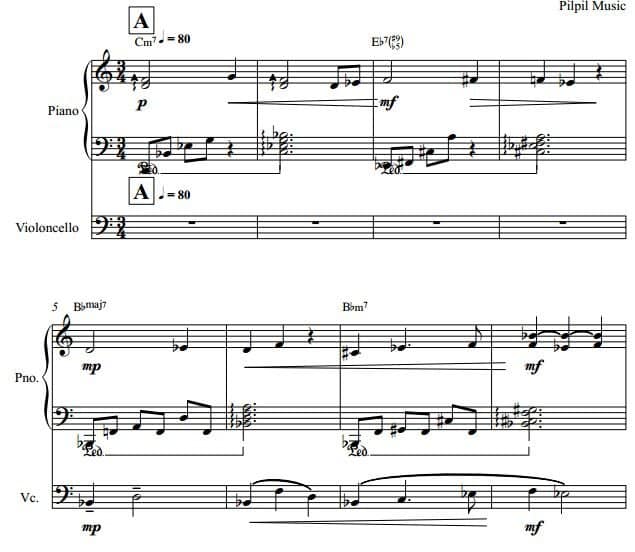
The initial harmonic material includes:
- Cm7
- E♭7
- B♭maj7
- B♭m7
- E♭maj9
- Aø7
- A♭7(♭5)
- G7
What interests me here is not a conventional functional progression in which every chord has a clearly defined destination.
Instead, the harmony behaves more like a sequence of changing colours.
The movement from B♭maj7 to B♭m7, for example, changes the emotional character of the same pitch area without requiring a complete change of tonal centre. Later, Aø7 – A♭7(♭5) – G7 introduces a much stronger sense of instability before returning toward C minor.
This is one of the basic principles of the piece:
the material changes without completely disappearing.
That idea becomes important later, when the music begins to expand.
The Opening — Introducing the Material
The first section establishes the main musical vocabulary.
The piano carries much of the harmonic information and creates the underlying motion, while the cello remains comparatively contained.
The texture is intentionally intimate.
At this stage, the musical material does not need to sound large. The idea is still being introduced.
This is where the title Matter Magnifier begins to make sense: the piece does not start with its maximum expressive scale. Instead, it begins with something relatively small that can later be examined more closely.
The cello’s role is particularly important because it prevents the harmonic material from becoming purely abstract. Even when the piano is dealing with extended or altered sonorities, the cello gives the music a more vocal and expressive dimension.
Looking at the Same Material Again
The opening material returns several times throughout the piece.
But the repetitions are not exact repetitions.
Each return changes the perception of the material through differences in:
- tempo
- rhythmic density
- register
- dynamics
- articulation
- cello technique
- harmonic emphasis
This is an important part of my approach to repetition.
I am not particularly interested in repeating a section simply because it belongs to the formal structure. I prefer repetition to have a perceptual function: when the material comes back, something about the surrounding context should make us hear it differently.
In Matter Magnifier, this gradually transforms the piece from a relatively intimate chamber work into something much more expansive.
From 3/4 to 4/4 — Expanding the Scale
One of the most significant structural changes occurs when the music moves from the more measured 3/4 sections into 4/4.
The change of metre is not merely a technical alteration.
It changes the physical character of the music.
The 3/4 sections allow the material to breathe and create a more circular, contemplative sensation. The 4/4 sections introduce greater stability and forward momentum.
At this point the tempo also increases, and the cello moves into pizzicato.
This creates an important transformation in the relationship between the two instruments.
The cello is no longer functioning primarily as a lyrical voice. It becomes part of the rhythmic mechanism of the piece.
The piano, meanwhile, becomes increasingly active.
The musical matter has effectively been magnified.
The B Section — Increasing Density
The first major expansion occurs around the B section, where the tempo moves to approximately ♩ = 100.
The texture becomes more energetic, the rhythmic activity increases and the dynamics grow substantially, eventually reaching ff.
The use of pizzicato in the cello is particularly important here.
Instead of adding another instrument to create greater energy, I use the same two instruments differently.
This is one of the central ideas behind Piano & Cello Junction as a whole: the expressive range of the ensemble can be expanded without expanding the instrumentation.
The piano and cello can produce a very different musical identity simply by changing their roles.
The cello can be a singing instrument, a rhythmic instrument or a colouristic voice.
The piano can be accompaniment, harmonic environment, rhythmic engine or structural framework.
Matter Magnifier brings several of these possibilities together.
Returning to the Beginning
After the increased energy of the central material, the music returns to the earlier harmonic environment.
The tempo falls back toward ♩ = 80, and the original 3/4 character reappears.
But this return is not a complete reset.
The listener has already experienced the material at a greater level of intensity.
The same harmonic language now carries a different weight.
This is one of the things I find interesting about musical transformation: sometimes the most effective development does not require completely new material. Changing the context can be enough.
The music has effectively looked at the same object through a stronger magnifying glass.
The Second Expansion
Later in the piece, the music once again moves toward greater activity.
The structure repeats the basic contrast between the more restrained material and the faster, more rhythmically active sections.
Again, the cello adopts pizzicato and the musical density increases.
There is also an important section in which the harmony moves through a different group of colours, including C6, A♭ and A♭6, before the music accelerates.
This section functions less like the introduction of a completely new theme and more like another perspective on the same musical world.
The piece is therefore based on a principle of recontextualisation.
Material returns.
The surrounding conditions change.
Our perception of the material changes with them.
The Cello as a Changing Character
The cello plays a particularly important role in the development of the piece.
Its identity changes progressively throughout the composition.
At the beginning it is restrained and expressive.
Later it becomes rhythmic through pizzicato.
Toward the end, the cello becomes much more colouristic, using techniques including:
- glissando
- molto vibrato
- sul ponticello
- ordinary arco
- pizzicato
These techniques are not decorative additions.
They are part of the structural development.
The final section, for example, combines several contrasting cello colours, allowing the instrument to move between instability, tension and warmth.
This creates a kind of timbral magnification parallel to the harmonic and rhythmic development.
The musical material becomes larger not only because there are more notes or greater volume, but because the range of possible sounds becomes wider.
The Final Section — Returning to the Core
Near the end, the music gradually reduces its intensity.
The tempo falls back toward the slower world of the opening, and the cello becomes increasingly expressive.
The harmony eventually moves through:
E♭maj7 → A♭7 → A♭7(♭5) → G7 → Cm7
The final return to Cm7 is significant.
The piece does not end with a large, emphatic resolution.
Instead, the final harmony is allowed to remain present and resonate.
The cello’s final expressive gestures and the sustained piano harmony create a sense of arrival without turning the ending into a conventional climax.
The magnification process has reached its limit.
After becoming denser, louder, faster and more complex, the music returns to something relatively simple.
But it is no longer heard in exactly the same way.
Composing Through Transformation
In Matter Magnifier, I focused on several compositional principles:
- developing a limited amount of musical material rather than constantly introducing new ideas
- using harmony primarily for colour and transformation rather than conventional functional progression
- creating contrast through changes of metre and tempo
- increasing musical density progressively
- changing the cello’s role from lyrical voice to rhythmic and colouristic instrument
- using articulation and instrumental technique as structural elements
- allowing repeated material to acquire different meanings through changing context
- using dynamics, register and texture as forms of musical magnification
- returning to the original musical environment after the expansion
The piece therefore works less like a traditional narrative and more like a process of observation and transformation.
A small musical idea is introduced. It is examined. It becomes more active. It becomes denser. It acquires new colours.
And finally, it returns to its original environment.
Why “Matter Magnifier”?
The title came to represent the compositional process itself.
A magnifier does not necessarily create something new. It allows us to see something that was already there in greater detail.
I approached the music in a similar way.
The fundamental material of Matter Magnifier is relatively limited, but the piece continually changes the scale at which we experience it.
At one moment we hear harmony. Then rhythm becomes more prominent. Then the cello becomes the focus. Then density and dynamics take over. Then the music retreats again. The object remains recognisable, but our perception of it changes.
That is the central idea behind the composition.
The music does not need to become something completely different in order to develop. It only needs to reveal more of what was already contained within it.
Final Thought
Matter Magnifier occupies a particular place in Piano & Cello Junction.
The album explores what can be achieved with a deliberately reduced instrumental palette, and each composition approaches the piano–cello relationship from a different perspective.
Matter Magnifier takes that idea of exploration one step further.
Instead of simply presenting contrasting musical sections, it examines how the same musical matter can be transformed through scale, density, rhythm, harmony, articulation and timbre.
Perhaps that is the simplest way to understand the title.
The music is not about magnifying sound. It is about magnifying musical possibilities.