
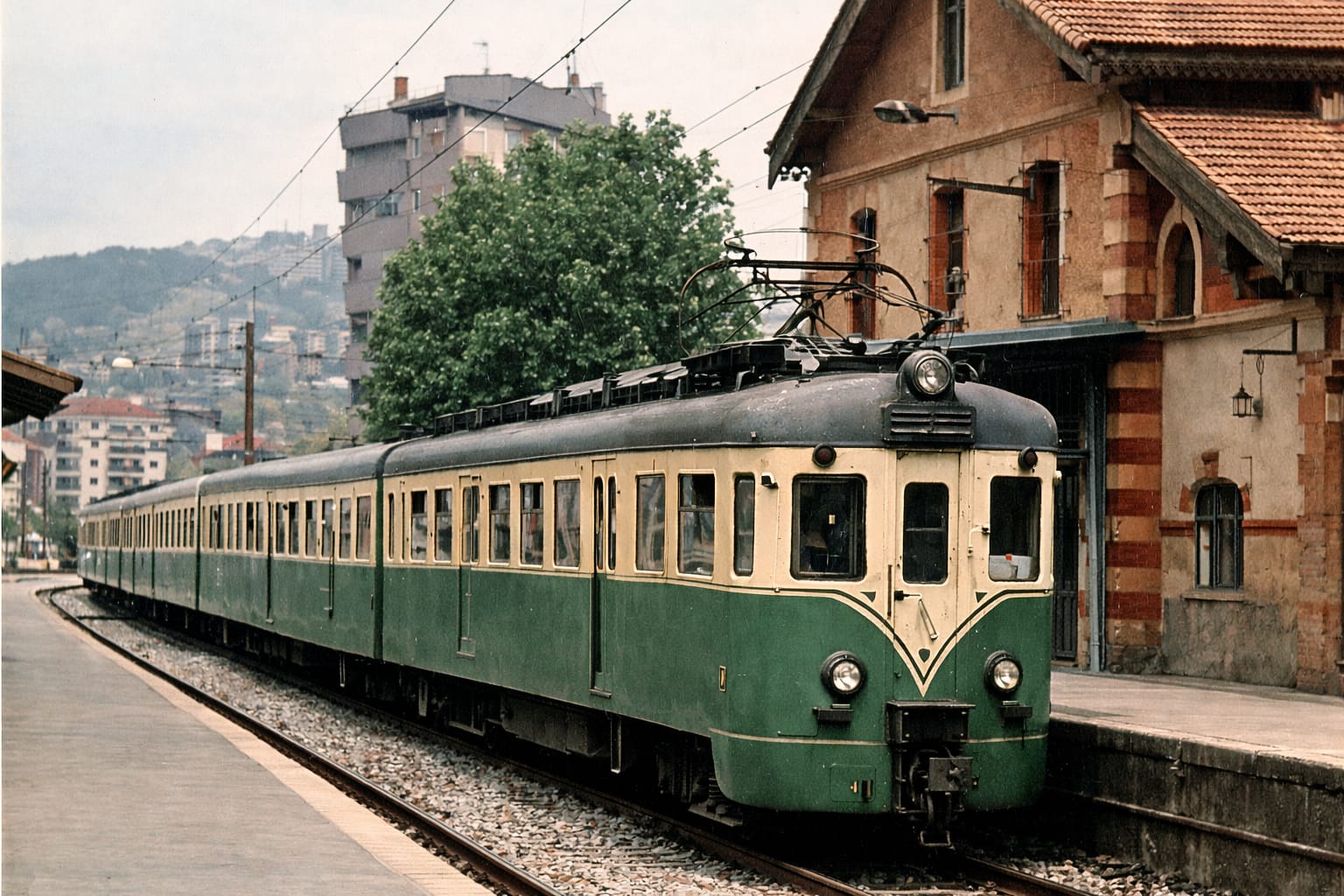
Some musical ideas begin with abstract emotions, while others are connected to specific memories or places. Green Train to Gorliz belongs to the second category. The piece was inspired by a railway line that once connected the city of Bilbao with the coastal village of Gorliz in northern Spain.
Until the 1990s, an old electric train travelled along this scenic route of roughly thirty kilometers. For many people, the journey was more than simple transportation. It was part of the experience of going to the coast: a slow approach to the sea, passing through landscapes that gradually changed from urban surroundings to open countryside and finally to the shoreline.
This atmosphere of anticipation, movement, and nostalgia became the starting point for the composition.
A Musical Memory of a Train Journey
The idea behind the piece was not to imitate a train literally, but to evoke the emotional memory of travelling on it. Many passengers remember the rhythmic sound produced by the wheels moving along the rails, the steady mechanical motion, and the gradual acceleration as the train left the city behind.
These elements suggested a musical approach based on repetition and rhythmic motion. Instead of focusing only on melody, the texture of the accompaniment plays an important role in the piece.
Behind the main melody, the instrumental parts create a gentle, continuous pattern that resembles the subtle mechanical rhythm of a train moving along the tracks. This repeating movement provides the musical foundation of the work and helps shape the atmosphere of the journey.
Beginning with Harmony
Like many of my compositions, Green Train to Gorliz began with a harmonic idea rather than with a melody. I often start composing by exploring a sequence of chords that captures the emotional atmosphere I want the piece to convey.
In this case, the harmonic progression was designed to reflect a sense of calm nostalgia. The chords move gradually, allowing the music to breathe and develop slowly, much like the rhythm of a train travelling through the landscape.
Once the harmonic framework of the opening section was established, the rest of the structure of the piece could begin to take shape. The harmony suggested the emotional direction of the music and eventually guided the creation of the melody.
The Emergence of the Melody
After defining the harmonic progression, the melody gradually emerged above this foundation. The goal was to create a lyrical line that felt reflective and slightly nostalgic, as if remembering a familiar journey.
Rather than writing a highly virtuosic melody, I preferred a simple and expressive melodic line. This allows the listener to focus on the atmosphere of the piece rather than on technical display.
The melody moves gently through the harmonic landscape while the accompaniment continues its steady motion underneath. Together, these elements create a sense of travel and continuity.
Musical Motion and the Sound of the Rails
One of the most distinctive aspects of the piece is the role of the accompaniment. The instrumental patterns behind the melody were designed to evoke the sound of a train moving along the rails.
This does not appear as a literal imitation but rather as a subtle musical suggestion. Repeated rhythmic figures and soft pulses in the texture create the impression of wheels rolling across the tracks.
As the music unfolds, these patterns evolve slightly, reflecting the gradual acceleration of the train during the journey. The motion remains smooth and steady, reinforcing the sense of forward movement.
The Destination: Gorliz
The destination of the train journey, Gorliz, is a coastal village known for its wide bay and beautiful sandy beach. Sheltered from the northern winds, the beach has long been a popular place for visitors from Bilbao.
The music reflects this destination through its warm and relaxed character. As the piece progresses, the harmonic colors become slightly brighter, suggesting the arrival at the open coastal landscape after the journey through inland scenery.
In this sense, the piece becomes both a musical journey and a musical memory.
Two Versions of the Piece
Green Train to Gorliz has been released in two different instrumental versions: one for string ensemble and another for woodwind quintet.
The string version highlights the lyrical and nostalgic qualities of the melody. Strings naturally lend themselves to long, expressive lines, allowing the melody to unfold with warmth and continuity. The repeated accompaniment patterns can be distributed among the different string sections, creating a smooth and flowing texture.
The woodwind quintet version offers a different perspective on the piece. Woodwinds introduce greater timbral contrast and clarity between voices. Each instrument brings its own color to the musical dialogue, giving the texture a slightly lighter and more transparent character.
Although the instrumentation changes, the core idea of the composition remains the same: a nostalgic musical journey inspired by the rhythm and memory of the train.
Instrumentation and Atmosphere
When adapting the piece to different ensembles, the goal was not simply to transfer the notes from one instrument to another. Instead, the orchestration was adjusted to suit the natural character of each ensemble.
In the string version, sustained tones and legato phrasing emphasize the reflective atmosphere of the piece. The sound can expand smoothly, allowing the harmonic progression to resonate fully.
In the woodwind quintet version, articulation and color become more prominent. Shorter gestures and subtle timbral changes create a different type of motion, while still preserving the rhythmic suggestion of the train.
Both versions offer distinct listening experiences while sharing the same musical narrative.
A Musical Journey Through Memory
Ultimately, Green Train to Gorliz is less about the physical train itself and more about the memory associated with the journey. For many people, the train ride represented the beginning of a day at the beach, a small adventure that started long before reaching the destination.
Music has a unique ability to capture these kinds of memories. Through melody, harmony, and texture, a simple idea can evoke landscapes, movement, and personal experiences.
In this piece, the steady rhythm of the accompaniment suggests the motion of the train, while the melody reflects the quiet nostalgia of remembering a familiar journey from the past.
The result is a musical portrait of a place, a route, and a moment in time that many people still remember with affection.
If you would like more information on these topics, explore the following related posts: