
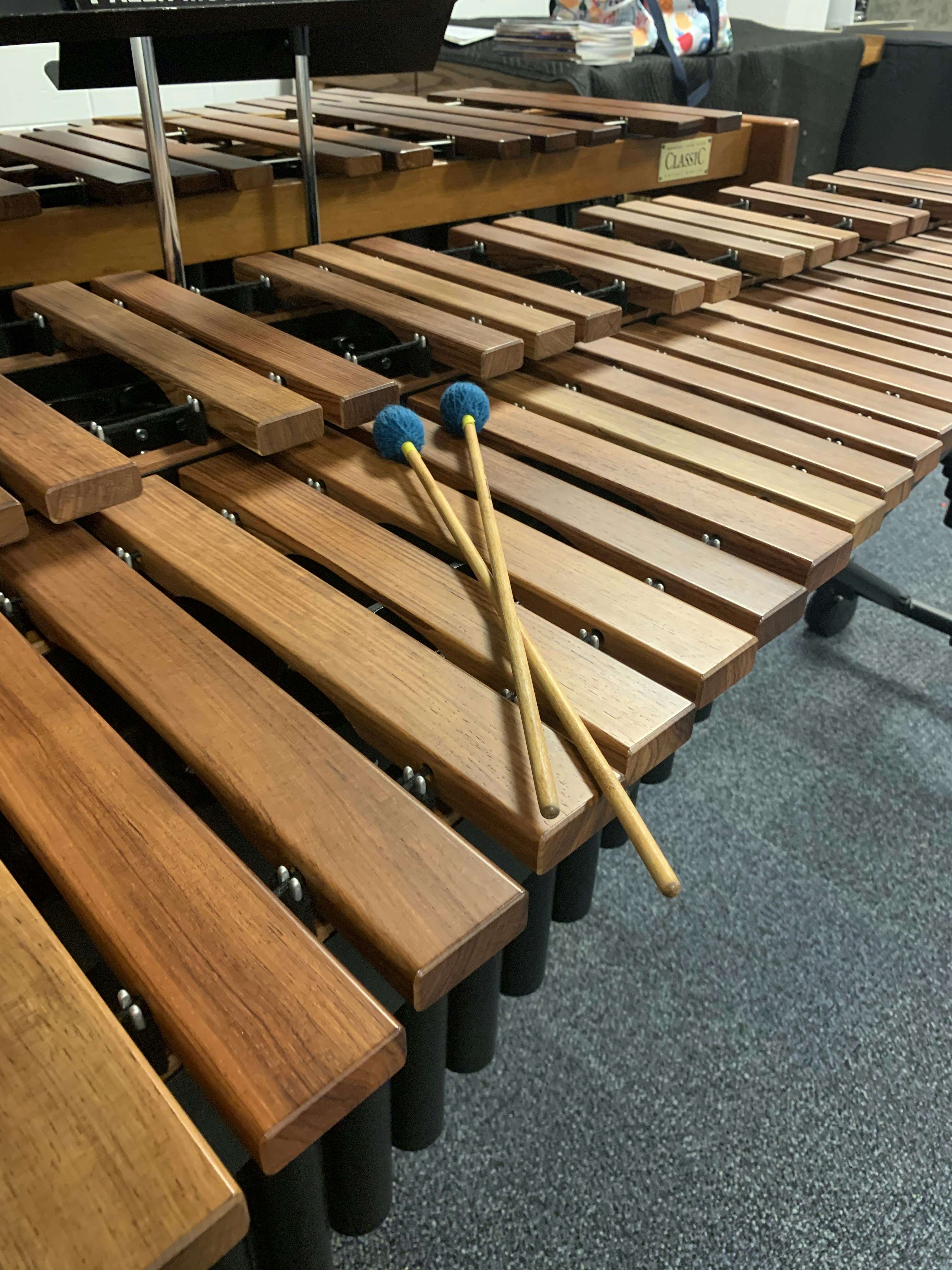
Instrumental music often relies on texture as much as on melody or harmony. Certain instrumental combinations naturally create particular atmospheres, and one of the most fascinating pairings in this respect is the combination of piano and vibraphone. When used carefully, these two instruments can produce a sound world that feels floating, repetitive, and almost hypnotic.
As a composer, I have explored this combination in several works, including Pink Space and Kaleidoscopic Movement. These pieces allowed me to experiment with the unique interaction between the percussive clarity of the piano and the shimmering resonance of the vibraphone.
The Sonic Character of the Vibraphone
The vibraphone is a particularly distinctive instrument. Unlike the piano, whose sound decays relatively quickly, the vibraphone can sustain tones thanks to its resonating tubes and motor-driven vibrato. When played with soft mallets and sustained pedaling, the instrument produces a gentle, luminous sound that can hover in the air.
This quality makes the vibraphone ideal for creating atmospheric layers. Rather than dominating the musical texture, it often functions as a sonic halo around the main musical ideas.
The subtle pulsation created by the rotating fans inside the resonators also adds a slow, breathing quality to the sound. This small movement in the timbre contributes significantly to the hypnotic effect of the instrument.
The Piano as a Structural Anchor
The piano plays a complementary role in this instrumental pairing. Its harmonic clarity and rhythmic precision provide a stable foundation for the texture.
While the vibraphone tends to blur and extend sounds, the piano articulates the harmonic structure more clearly. Chord progressions, rhythmic figures, and melodic patterns can be easily defined by the piano, giving the listener a sense of direction within the piece.
In many cases, the piano becomes the structural framework, while the vibraphone adds color, resonance, and atmosphere.
Repetition and Hypnotic Motion
One of the most effective ways to create hypnotic textures with these instruments is through repetition. Repeated figures, ostinatos, or gently evolving patterns allow the listener to settle into a sonic environment where small changes become meaningful.
The piano can introduce repeating harmonic patterns while the vibraphone highlights certain notes or expands the harmony through sustained tones. Because both instruments are percussive in nature, they can synchronize easily in rhythmic patterns, but their different resonance properties create an intriguing contrast.
Over time, these repeated gestures can gradually transform through subtle variations in harmony, register, or articulation.
Balance Between Clarity and Resonance
The hypnotic quality of this combination often emerges from the balance between clarity and resonance.
The piano provides clear attacks and well-defined harmonic structures. The vibraphone, on the other hand, extends these sounds into the surrounding acoustic space. When both instruments interact, the result is a texture that feels simultaneously precise and fluid.
Composers must carefully consider dynamics and register when writing for this duo. If the piano dominates too strongly, the vibraphone’s subtle resonance may be lost. Conversely, when both instruments occupy complementary registers, the resulting sound can feel remarkably transparent and immersive.
Creating Spatial Textures
Another interesting aspect of the piano–vibraphone pairing is its potential for spatial textures. Because the vibraphone’s sound spreads more diffusely than the piano’s, it can create a sense of distance or space within the music.
For example, a composer might place the vibraphone in a higher register to create a floating layer above the piano’s harmonic foundation. Alternatively, both instruments may share melodic material, passing fragments back and forth between them.
This dialogue between instruments adds depth and movement to the texture without requiring dense orchestration.
Examples from My Own Music
I have explored the relationship between piano and vibraphone in several compositions.
In Pink Space, the music develops through repeated harmonic patterns in the piano while the vibraphone adds sustained tones and shimmering accents. The interaction between the two instruments creates a calm and slightly melancholic atmosphere, where small rhythmic motions slowly reshape the texture.
Another example can be found in Kaleidoscopic Movement, where the instruments engage in a more dynamic exchange of gestures. Here the vibraphone emphasizes certain melodic fragments while the piano establishes the rhythmic momentum of the piece.
In both cases, the goal was not to create virtuosic contrast but rather to explore the subtle interplay of resonance, repetition, and color.
Why This Combination Works So Well
The effectiveness of the piano–vibraphone duo lies in the way their sonic characteristics complement each other.
Both instruments produce sound through striking surfaces, yet their resonance behaves differently. The piano offers harmonic solidity and rhythmic clarity, while the vibraphone introduces sustained brightness and gentle motion.
Together, they create textures that can feel both grounded and suspended at the same time.
This combination is particularly well suited for music that aims to evoke reflection, calmness, or dreamlike states. The listener becomes immersed in a slowly evolving sonic landscape where the boundary between rhythm and resonance begins to blur.
Final Thoughts
The pairing of piano and vibraphone opens a fascinating world of sonic possibilities. Through repetition, resonance, and careful balance, these instruments can create textures that feel immersive and hypnotic.
For composers interested in exploring atmospheric instrumental writing, this combination offers a rich palette of colors and expressive possibilities. Even simple harmonic ideas can transform into complex sonic environments when shaped by the interaction between these two instruments.
For me, working with piano and vibraphone has been an inspiring way to explore musical space, texture, and subtle emotional expression in instrumental music.
If you would like more information on these topics, explore the following related posts: