
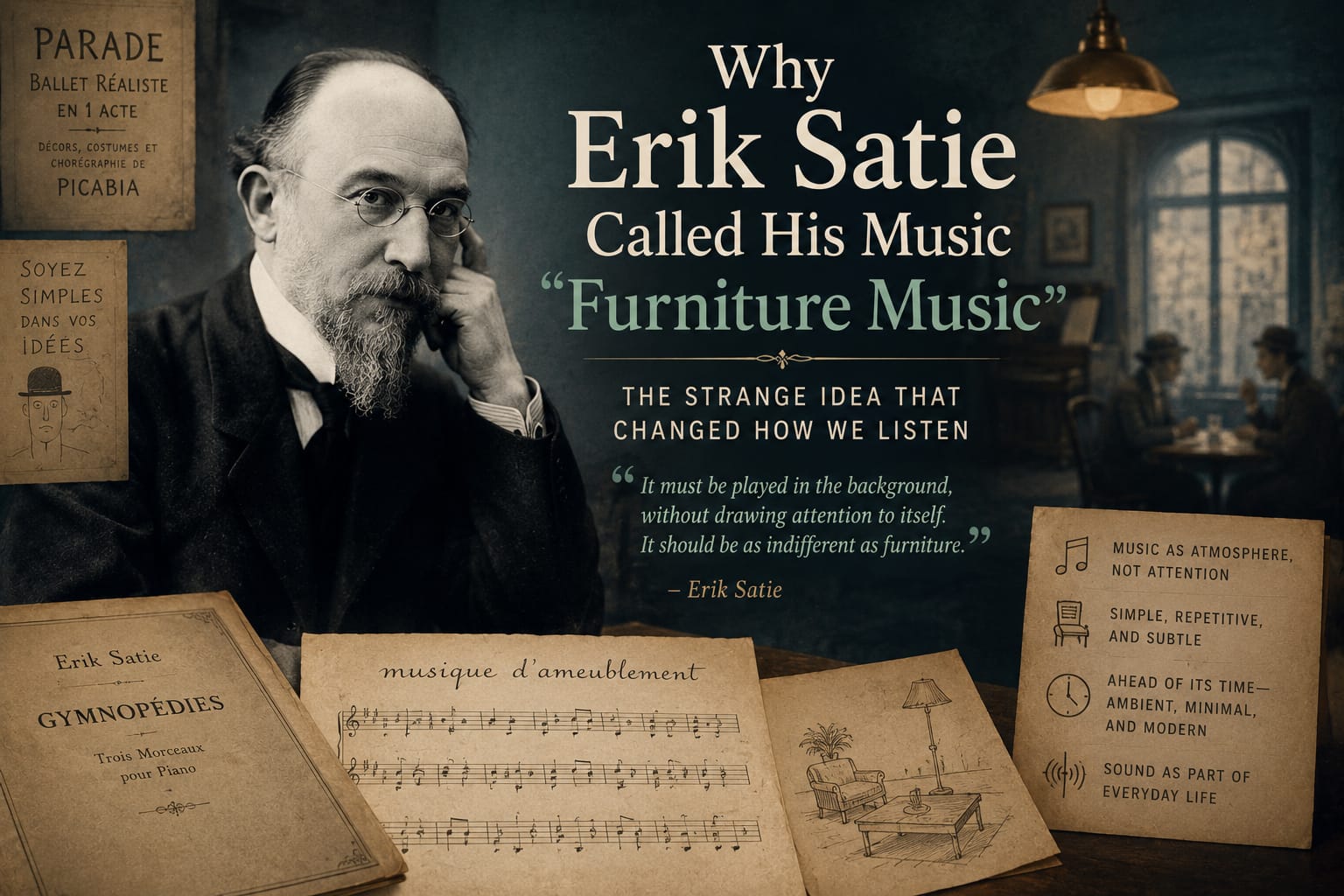
Erik Satie has long been one of the strangest and most unconventional figures in classical music. While many composers of the early twentieth century were expanding orchestral complexity or pushing harmonic innovation to dramatic extremes, Satie often moved in the opposite direction: simplicity, repetition, irony, and restraint.
Among his most curious ideas was something he called musique d’ameublement—usually translated as “furniture music.”
At first, the phrase sounds almost insulting. Why would a composer want his music compared to furniture?
But Satie’s idea was surprisingly modern, and in many ways, he anticipated entire categories of contemporary music decades before they existed.
What Was “Furniture Music”?
Satie introduced the concept around 1917. The basic idea was simple: music did not always need to demand attention. Instead of functioning as the center of an audience’s focus, it could exist in the background of everyday life, blending into the environment like lighting, architecture, or furniture.
This was radically different from the traditional concert mentality of the time.
Classical music was generally treated as something sacred:
- audiences sat silently
- performances demanded concentration
- music was considered a serious artistic event
Satie deliberately challenged that idea.
He imagined music that could accompany conversation, movement, and ordinary social activity without requiring emotional immersion.
In other words, he proposed ambient listening decades before ambient music formally existed.
The Famous Premiere
One of the most famous stories surrounding Satie’s furniture music occurred during a public performance in Paris.
The musicians began playing while people were moving through the room. But instead of treating the music as background sound, the audience stopped and listened attentively—as concert audiences normally would.
Satie reportedly became frustrated and urged people to continue talking and behaving naturally.
He did not want active listening.
That reaction reveals how unconventional the idea truly was at the time. Audiences simply did not know how to experience music that was not asking to be emotionally or intellectually “followed.”
Simplicity as a Radical Choice
Satie’s music often avoids the dramatic development associated with Romantic composers like Wagner or Mahler.
Instead, he frequently uses:
- short repeating figures
- static harmony
- minimal thematic transformation
- restrained emotional movement
- transparent textures
At first glance, this can appear deceptively simple. But that simplicity was intentional.
Satie understood that repetition and restraint could shape atmosphere just as effectively as large emotional climaxes.
In many ways, his approach anticipated:
- minimalism
- ambient music
- film underscoring
- loop-based composition
- environmental sound design
Composers like Brian Eno, Philip Glass, and even aspects of modern cinematic scoring owe something to this shift in perspective.
Why the Idea Was So Revolutionary
What made furniture music revolutionary was not merely the music itself, but the change in function.
For centuries, Western concert music had been built around focused listening. Satie questioned whether music always needed to occupy the foreground.
This transformed music from:
- narrative → atmosphere
- performance → environment
- emotional statement → spatial presence
That conceptual shift became enormously important in the twentieth century.
Today, we constantly encounter music functioning environmentally:
- cafés
- films
- video games
- galleries
- public spaces
- streaming playlists
- ambient electronic music
Satie anticipated this entire cultural relationship with sound long before technology made it commonplace.
The Strange Humor of Erik Satie
Part of what makes Satie fascinating is that irony and humor constantly coexist with genuine artistic innovation.
He often wrote absurd performance directions into his scores:
- “like a nightingale with a toothache”
- “open your head”
- “very white”
- “without pride”
His titles could be equally surreal.
At times, it becomes difficult to know where satire ends and serious experimentation begins.
But perhaps that ambiguity was part of the point. Satie rejected artistic pretension while quietly reshaping modern musical thinking underneath the surface.
Furniture Music and Modern Film Scoring
One reason Satie feels surprisingly contemporary today is that many cinematic techniques rely on the same principles.
Not every cue in film music aims for thematic dominance. Often, the score works atmospherically:
- sustaining mood
- shaping space
- influencing emotional tone subconsciously
- creating continuity beneath dialogue
This idea of music as environmental texture rather than overt narrative closely resembles Satie’s furniture music concept.
Even subtle repeating piano patterns used in modern emotional scoring can sometimes feel spiritually connected to Satie’s restrained aesthetic.
From Satie’s Furniture Music to Contemporary Instrumental Music
Satie’s idea also raises an interesting question for composers today: can instrumental music create a space rather than simply tell a story?
This is something I explore in some of my own compositions for Pilpil Music. Pieces such as Hidden Hut focus on stillness, suspended harmony, repetition, and gradual movement, aiming less to demand attention than to create an atmosphere the listener can inhabit.
The musical language is obviously very different from Satie’s, but the underlying idea is surprisingly close: sometimes music does not need to lead the listener somewhere. It can simply create a place to remain for a while.
A Personal Reflection
What I find especially interesting about Satie is his understanding that music does not always need to explain itself through complexity.
Sometimes atmosphere alone is enough.
In some of my own more ambient or introspective pieces, I often think less about dramatic development and more about creating a space the listener can inhabit. Repetition, silence, and restrained harmonic movement can sometimes communicate more effectively than constant change.
Satie understood that simplicity can create its own emotional gravity.
Final Thoughts
Erik Satie called his music “furniture music” because he imagined sound functioning as part of everyday space rather than as the center of attention.
At the time, the idea seemed bizarre. Today, it feels remarkably prophetic.
By challenging the traditional role of music itself, Satie helped open the door to ambient music, minimalism, cinematic underscoring, and modern environmental listening culture.
What once sounded eccentric now feels completely natural—which may be the clearest sign of how far ahead of his time he truly was.
If you would like more information on these topics, explore the following related posts: