
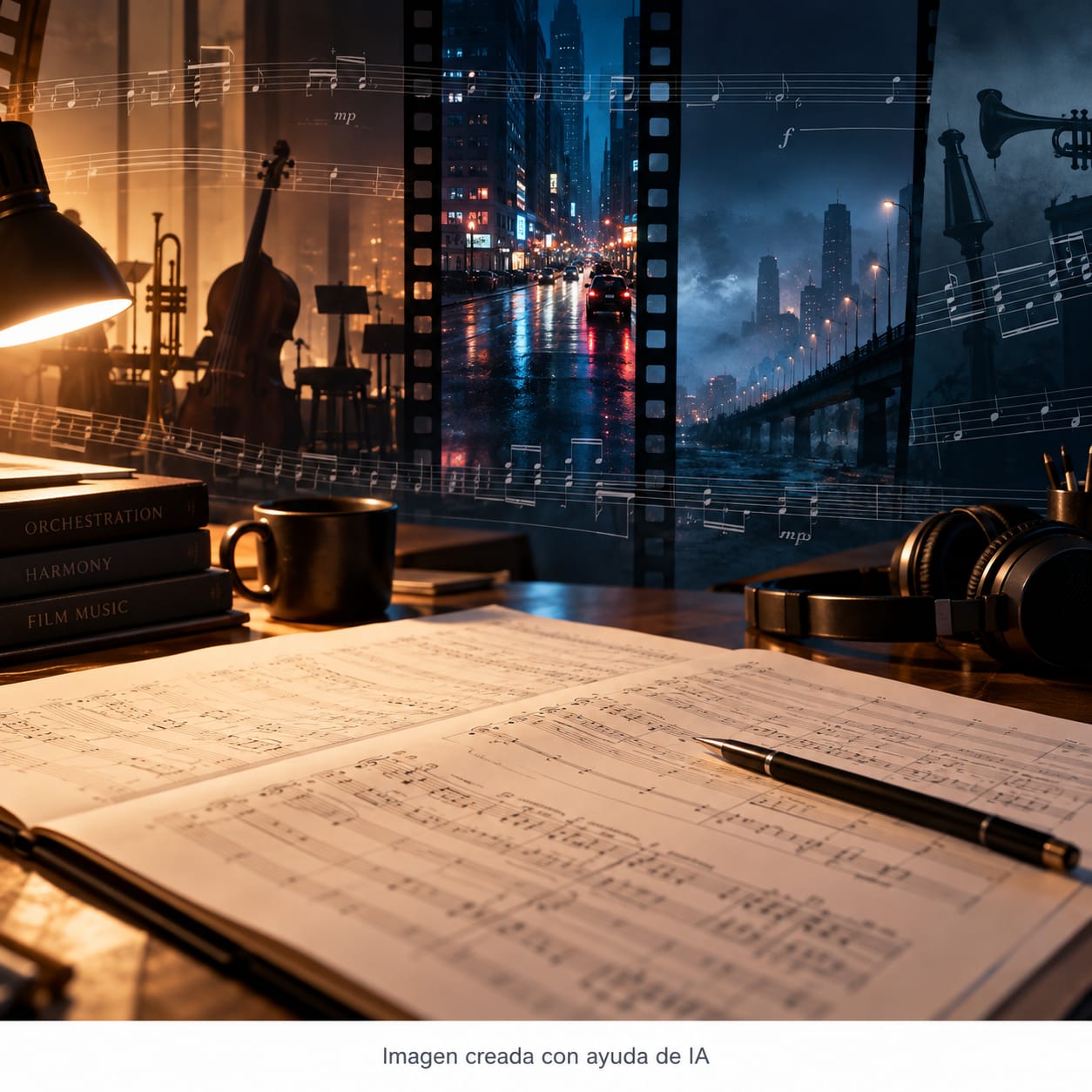
Film music does more than accompany an image. It can suggest a place, create movement, shape tension, reveal character and change the emotional meaning of a scene.
Orchestration plays an important role in all of these processes.
The choice of instruments, register, rhythm, harmony, articulation and texture can transform a simple musical idea into something that feels connected to a particular environment.
This is why cinematic orchestration is not simply about using a large orchestra.
It is about choosing the right musical elements for the moment.
In my own instrumental compositions, I often explore these ideas without writing specifically for film. My album Urban Nightlife Stories, for example, uses jazz-oriented instrumentation, harmonic colour, rhythm and texture to suggest different moments of life in a city after dark.
These pieces are not film scores, but they provide useful examples of how orchestration can create a cinematic sense of place and movement.
1. Start with the Scene, Not the Instrument
When composing for film, it is tempting to begin by choosing an instrument that sounds interesting. A more useful starting point is the scene itself.
What is happening? Where does it take place? Is the environment busy or empty? Is the character moving or standing still? Does the moment feel intimate, tense, mysterious or energetic? These questions can guide the orchestration.
A quiet nighttime scene may need very little instrumentation. A crowded street may require several rhythmic layers. A moment of suspense may benefit from sustained tones, unusual registers or slowly changing harmonies.
The instrumentation should therefore support the dramatic function of the scene, rather than simply filling the available space.
2. Use Instrumentation to Define a Place
One of the simplest ways to create a cinematic atmosphere is through instrumental choice.
The same melody can suggest very different environments depending on which instruments play it.
A muted brass section can suggest distance or mystery. Piano can create intimacy. Electric bass and drum set can introduce an urban or contemporary feeling. Woodwinds can add detail and movement, while sustained strings can create a sense of breadth.
There is no universal emotional meaning attached to any instrument. Context matters.
I explore this idea in Hidden Alleys, from Urban Nightlife Stories. The ensemble includes two trumpets, trombone, tuba and two five-string electric bass parts, creating a deliberately unusual low-register foundation.
The point is not that this particular combination is inherently “cinematic”. Rather, its distinctive colour helps establish the musical environment suggested by the title.
I also look at the compositional decisions behind the piece in Inside “Hidden Alleys”.
3. Build the Scene in Layers
Cinematic music often becomes more convincing when it is built from several independent layers rather than one large block of sound.
A useful way of thinking about those layers is:
- rhythmic foundation
- harmonic support
- main melody
- secondary lines
- sustained colour
- accents and transitions
Each layer can enter, disappear or change independently.
This creates movement without requiring constant harmonic change.
In City Awakens, piano, bass guitar and drums provide a foundation while soprano saxophone, trumpet and trombone gradually introduce additional activity. The opening begins softly, with different instruments occupying distinct roles before the texture becomes more active.
This kind of layering can be useful in film scoring because it allows the composer to control the apparent size and energy of a scene.
A scene does not always need a larger orchestra. Sometimes it simply needs more clearly differentiated layers.
4. Rhythm Can Create Movement
Not every cinematic scene needs a strong melody to feel alive.
Rhythm can create movement on its own.
Repeated figures, ostinatos, syncopation, accents and contrasting rhythmic patterns can suggest traffic, crowds, walking, machinery, pursuit or continuous activity.
This is particularly apparent in Nocturnal Bustling Streets. The piece begins at a fast tempo and uses recurring rhythmic patterns across several instrumental parts. Later sections include changes of tempo, including rallentando and acceleration, giving the music a changing sense of pace.
The important point for film scoring is that rhythm does not have to describe an action literally. It can create the physical sensation of movement.
5. Harmony Can Create Cinematic Colour
Harmony is another powerful way of suggesting a visual environment.
Film composers often use harmony not only to establish progression, but also to create colour, ambiguity or atmosphere.
Extended chords, suspended harmonies, modal relationships and unexpected shifts can help a scene remain emotionally open.
This approach appears in About the Blue Side of Neon Light. The score combines piano, five-string electric bass, soprano saxophone, trumpet, trombone and drum set, while its harmonic language includes extended and suspended sonorities such as Gm7/C, A♭m(maj7)/C and other colour-rich chords.
The harmony is therefore not just supporting a melody. It helps establish the atmosphere suggested by the idea of neon light at night.
I explain how those musical decisions developed in About the Blue Side of Neon Light – Inside the Composition.
6. Timbre Can Change the Emotional Meaning
A musical idea does not have one fixed emotional meaning. Changing its timbre can completely alter its character.
Consider a short melodic phrase. Played softly by a piano, it may feel intimate. Played by a trumpet, it may feel more exposed. Played by low brass, it may become heavier. A muted instrument can create a more distant or veiled colour.
Articulation is equally important. Glissandi, mutes, accents, sustained tones and changes in attack can transform how the listener perceives a passage.
In Crossroad Mood, the use of brass colour, including harmon mute and glissandi, contributes to the character of the piece. The composition also combines fast-moving material with repeated instrumental patterns, creating a sense of tension and activity. crossroad mood score
This illustrates an important principle of orchestration: The sound of an instrument is part of the storytelling. The same written material can imply a different scene when its timbre changes.
For a closer look at the piece, see Inside “Crossroad Mood”.
7. Use Space as Carefully as Sound
Cinematic orchestration is sometimes associated with dense textures and large ensembles. But space can be just as effective. Leaving instruments out can create intimacy. A sustained note can feel more powerful when surrounded by silence. A single melodic line can attract more attention when there is little competing material.
This is particularly useful for scenes involving solitude, reflection or anticipation. A good orchestration therefore does not ask: How much music can I add?
It asks: What does this moment actually need?
In Blue Hour Conversations, piano, bass, drums, soprano saxophone, trumpet and trombone are used in a jazz-oriented setting that allows individual voices to remain clear rather than creating a constantly dense texture. The result is a different type of cinematic atmosphere: less about scale and more about proximity and mood.
8. Contrast Creates a Sense of Narrative
A film score has to evolve. If every scene uses the same instruments, tempo, register and harmonic density, the music can quickly become predictable. Contrast can be created without completely changing the musical language.
For example:
A busy scene can be followed by a sparse one.
A bright register can move into a darker one.
A dense rhythmic texture can give way to sustained tones.
A recurring harmony can return with different instrumentation.
These changes help the listener perceive that something has changed in the narrative.
This is one reason an album such as Urban Nightlife Stories can explore the same broad environment from different perspectives. Urban Melancholy, for example, takes a more restrained and reflective approach, contrasting with the faster rhythmic energy of Nocturnal Bustling Streets.
The city remains the underlying subject, but the musical perspective changes.
9. Repetition Can Create Continuity
Repetition is one of the simplest ways to establish identity. A rhythmic figure, harmonic progression or melodic fragment can return several times while the surrounding orchestration changes. This creates continuity without requiring the composer to repeat an entire section unchanged.
In film scoring, this can be especially useful for characters, locations or situations that recur throughout a story. The same musical idea can become more tense, more intimate or more energetic simply because its orchestration has changed.
This is also useful in standalone instrumental music. A recurring idea can provide a point of reference while the surrounding textures continue to evolve.
The important thing is that repetition does not have to mean stasis. It can be a way of showing development.
10. Cinematic Does Not Necessarily Mean Symphonic
One of the misconceptions about cinematic music is that it automatically requires a large symphony orchestra. It does not.
A small ensemble can create a strong sense of place if the instrumentation is carefully chosen. Jazz-based ensembles, chamber groups, piano and strings, electronic textures or combinations of acoustic instruments can all create cinematic results.
What matters is the relationship between the musical elements.
In Urban Nightlife Stories, I work frequently with piano, bass, drums, saxophone and brass rather than relying exclusively on traditional symphonic scoring. The result is intended to suggest different aspects of urban life through a combination of rhythm, harmony, instrumentation and atmosphere.
Cinematic thinking is therefore more about musical perspective than orchestral size.
From Orchestration to Storytelling
The most useful way to understand film scoring orchestration is to think about how non-musical ideas can be translated into musical decisions.
A location can become an instrumental colour. Movement can become rhythm. Distance can become register and space. Tension can emerge from harmony, repetition or density. A change in atmosphere can come from articulation or timbre.
These decisions may be very subtle, but together they can make the listener imagine a situation without being told what to imagine.
That is one of the most interesting aspects of instrumental music.
The music can suggest the scene while leaving the scene to the listener.
A Simple Exercise for Composers
Take a short melody—perhaps only four or eight bars—and imagine that it accompanies three completely different scenes. Keep the melody unchanged. Then alter only:
instrumentation
register
harmony
rhythmic density
articulation
dynamics
Listen to the result.
You may find that the same melody can suggest a quiet evening, a crowded street or a tense nighttime journey without changing its basic shape.
This is a useful way to discover how much storytelling is contained not in the melody itself, but in the environment created around it.
Final Thoughts
Film scoring orchestration is not simply a matter of assigning different notes to different instruments. It is a way of shaping perception. Instrumentation creates identity. Rhythm creates movement. Harmony creates colour. Texture creates depth. Dynamics create direction. Timbre changes emotional perspective. And space allows important moments to breathe.
For me, the most interesting part is the possibility of creating a sense of place entirely through sound.
My Urban Nightlife Stories compositions explore that idea from an instrumental perspective, using the language of jazz, rhythm, harmony and orchestration to evoke different sides of city life.
They are not film scores, but they come from the same basic fascination: How can music make the listener see something that is not actually there?
Explore More of the Music
If you would like to hear some of these ideas in musical form, explore Urban Nightlife Stories and the individual compositions discussed throughout this article.
For a closer look at the creative process behind several of these pieces, visit the Inside the Music section, where I explore the harmony, rhythm, orchestration and structure behind individual compositions.