
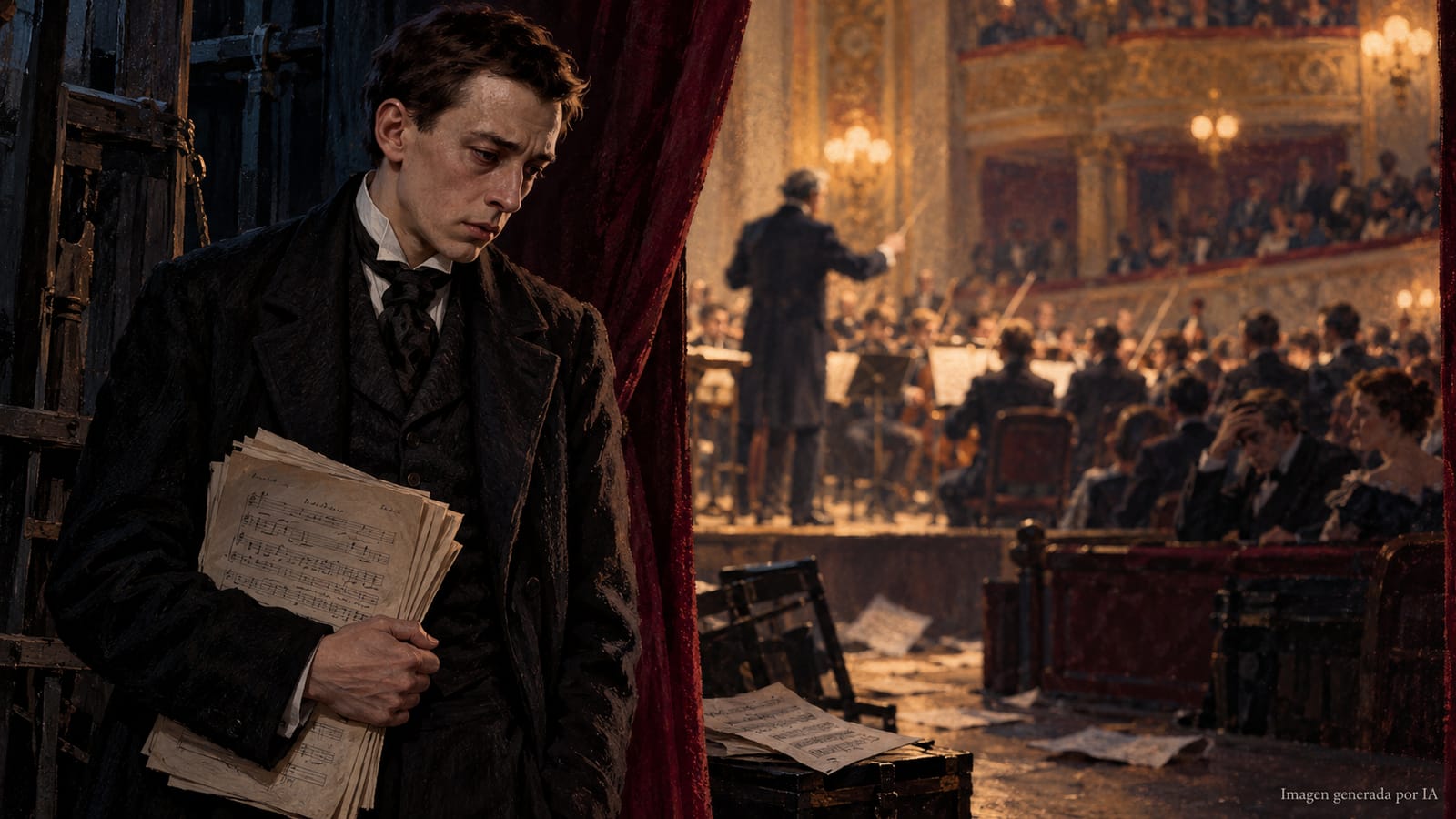
Sergei Rachmaninoff’s First Symphony received a hostile reception at its 1897 premiere. The performance became a painful turning point in the young composer’s life, though the full story is more complicated than one bad concert.
A bold new work
By 1895, Sergei Rachmaninoff had already made a promising start. His opera Aleko had earned praise, and he had completed his First Piano Concerto. He now turned to a more demanding challenge: a symphony.
Rachmaninoff spent much of that year composing his First Symphony in D minor, Op. 13. It was an ambitious work, filled with restless energy, dark orchestral colours and recurring musical ideas. The influential patron Mitrofan Belyayev accepted it for the Russian Symphony Concerts in St. Petersburg, an important series devoted to new Russian music. For the young composer, a performance there offered a chance to establish himself on a larger stage. Hyperion’s program notes describe the symphony as a bold work that Rachmaninoff believed opened “entirely new paths.”
A troubled premiere
The symphony was performed in St. Petersburg in late March 1897, conducted by Alexander Glazunov. The concert included two other premieres, leaving little time to prepare such a complex score. Glazunov was a highly regarded composer, though contemporary accounts and later assessments question his ability as a conductor. The performance was widely described as poor, and the reviews were severe. Hyperion’s account notes the inadequate rehearsals and reports that Glazunov may have been drunk, while treating that claim as uncertain.
That rumor has become inseparable from the story. Rachmaninoff’s wife later said Glazunov appeared drunk, but the claim cannot be established as fact. The documented problems with preparation and performance already offer a strong explanation for why the evening went so badly.
The symphony itself was also challenging for its first listeners. Its dramatic contrasts, dense orchestration and forceful musical language did not fit easily into the expectations of the musical establishment. The premiere’s failure therefore involved more than one person or one review.
The review that became infamous
The harshest verdict came from composer and critic César Cui. He compared the symphony to a depiction of the seven plagues of Egypt and imagined that it would delight the “inhabitants of Hell.” His words were so cutting that they came to symbolize the concert’s reception. The Hungarian National Philharmonic recounts Cui’s attack and notes that other critics also responded negatively.
Rachmaninoff had hoped the performance would mark an important step forward. Instead, he left with his confidence badly shaken. In a later recollection, he described the aftermath with the words “something within me snapped.” He continued to work as a pianist and conductor, but for a period he struggled to compose substantial new music.
The effect on Rachmaninoff
The premiere is often presented as the single cause of Rachmaninoff’s depression and creative silence. His correspondence suggests a more complex history. A study hosted by UCLA concludes that the symphony’s reception contributed to his difficulties, while later reflection, physical illness and other events also played a part. The UCLA study cautions against reducing those years to one disastrous evening.
In 1900, Rachmaninoff began regular sessions with physician Nikolai Dahl. The treatment included hypnosis and repeated suggestions that he would compose again. Rachmaninoff later said the treatment helped him return to work. He went on to write his Second Piano Concerto, dedicating it to Dahl in gratitude. The concerto’s success became an important part of his recovery, though it came after a long and difficult period. The Des Moines Symphony’s program notes include Rachmaninoff’s own account of his treatment.
A symphony lost and rediscovered
Rachmaninoff never substantially revised the First Symphony, and it was not performed again during his lifetime. After he left Russia in 1918, the full score disappeared. The orchestral parts survived and were rediscovered in 1944, allowing the work to be reconstructed and performed again in Moscow in 1945. Hyperion’s notes describe its rediscovery and return to the concert hall.
That later revival gave listeners a chance to hear the symphony on its own terms. The piece is still uneven in places, but it also reveals a young composer willing to take risks: its recurring themes bind the movements together, while its dramatic sweep points toward the powerful orchestral writing that would mark his later music.
Hearing the First Symphony today
The story of Rachmaninoff’s First Symphony is about a painful performance, a brutal critical response and the years it took the composer to regain confidence. It is also the story of a work that outlived its premiere. Heard today, the symphony feels less like a failed experiment than an ambitious early statement whose first audience never had the chance to hear it at its best.