
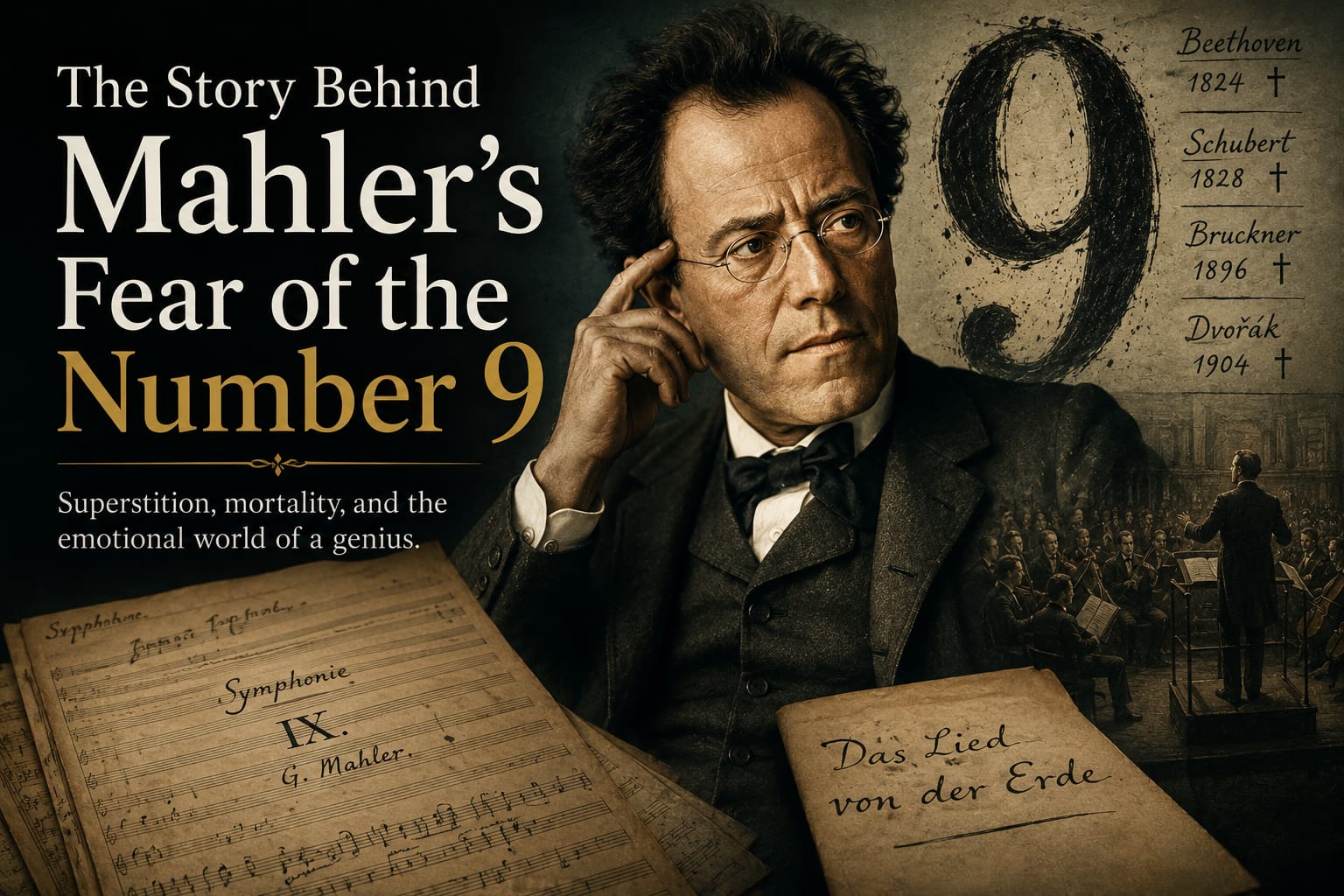
Gustav Mahler’s music often confronts mortality, emotional fragility, and the overwhelming scale of human existence. His symphonies move constantly between triumph and collapse, intimacy and catastrophe. Yet beyond the emotional intensity of the music itself, Mahler also carried a deeply personal anxiety that has fascinated musicians and historians for decades: his fear of the number 9.
At first glance, it sounds almost irrational—a superstition attached to a single number. But for Mahler, the fear was connected to a pattern he could not ignore. Several great composers he admired appeared to die after completing their ninth symphony.
The coincidence haunted him.
The “Curse” of the Ninth Symphony
By the late nineteenth century, Beethoven’s nine symphonies had already become monumental within classical music. Beethoven’s Ninth was seen not simply as another symphony, but as the summit of the genre itself.
Then something strange happened.
Franz Schubert died after completing his Ninth Symphony. Anton Bruckner also left his Ninth unfinished at the time of his death. Later, Antonín Dvořák’s final symphony would also reinforce the growing mythology surrounding the number.
For Mahler, who deeply admired these composers, the pattern felt ominous.
He reportedly became convinced that the “Ninth Symphony” represented a kind of invisible threshold—a final boundary composers could not cross.
Mahler’s Attempt to Escape the Curse
Mahler’s response to this fear is one of the most fascinating episodes in music history.
After completing his monumental Eighth Symphony, he composed another large orchestral work: Das Lied von der Erde (“The Song of the Earth”). Structurally and emotionally, the piece functions very much like a symphony. It contains multiple large movements, orchestral architecture, and the emotional scope typical of Mahler’s symphonic writing.
But Mahler deliberately avoided calling it Symphony No. 9.
Many historians believe this was an attempt to outsmart the curse.
By not officially numbering the work, Mahler may have hoped he could “skip” the dangerous ninth position entirely.
Afterward, he composed what he officially titled Symphony No. 9.
He survived its completion.
But the story does not end there.
The Tragic Irony
Following the Ninth Symphony, Mahler began work on a Tenth Symphony. Before he could finish it, he died in 1911.
For many people, this seemed to confirm the superstition.
Mahler had technically managed to complete a Ninth Symphony—but not to move fully beyond it.
Whether coincidence or psychological obsession, the story became permanently attached to his legacy.
Even today, the so-called “curse of the ninth” continues to fascinate composers, conductors, and audiences alike.
Why Mahler’s Fear Matters Musically
What makes this story compelling is not simply the superstition itself, but how closely it aligns with the emotional atmosphere of Mahler’s late music.
The Ninth Symphony in particular feels deeply aware of mortality. The work constantly alternates between resistance and surrender, intensity and fading silence. Its final movement dissolves slowly into near stillness, as if the music itself is disappearing.
Many listeners interpret the piece as a farewell to life.
Whether or not Mahler consciously composed it that way, the emotional weight surrounding the symphony is undeniable.
His awareness of death seems embedded within the structure of the music.
Anxiety and Artistic Awareness
Mahler’s fear of the number 9 also reveals something broader about artistic psychology.
Composers are often highly sensitive to symbolism, patterns, and emotional associations. Even rational artists can become psychologically affected by recurring ideas, especially when those ideas involve mortality or legacy.
For Mahler, the “curse” was not just superstition—it represented the terrifying awareness of artistic finitude.
How do you continue after reaching what many considered the highest level of symphonic achievement?
How do you move beyond Beethoven?
These questions likely carried enormous psychological weight for him.
The Emotional Language of Mahler’s Late Works
One reason Mahler’s music remains so powerful today is that it embraces uncertainty rather than hiding it.
His late symphonies do not project confidence in a heroic Romantic sense. Instead, they often feel fragile, questioning, and emotionally exposed.
This appears in:
- dissolving orchestral textures
- unstable harmonic movement
- abrupt emotional contrasts
- long fading endings
- moments of near silence
Rather than resisting vulnerability, Mahler transforms it into musical expression.
That emotional honesty may be one reason modern listeners still connect so deeply with his work.
A Personal Reflection
What I find especially inspiring about Mahler is his ability to turn existential tension into sound.
His music rarely feels emotionally simple. Even moments of beauty often carry unease beneath the surface. That balance between intensity and fragility is something I often think about in my own more atmospheric or cinematic compositions.
Sometimes emotional depth comes not from resolution, but from allowing uncertainty to remain present inside the music.
Mahler understood this extraordinarily well.
Final Thoughts
Mahler’s fear of the number 9 has become one of classical music’s most famous superstitions, but the story resonates because it reflects something larger than numerology.
It reflects the anxiety of artistic legacy, mortality, and the fear of reaching an ending that cannot be escaped.
Whether the “curse” was real or not ultimately matters less than what it reveals about Mahler himself: a composer profoundly aware of life’s fragility, and capable of transforming that awareness into some of the most emotionally powerful orchestral music ever written.
If you would like more information on these topics, explore the following related posts: