
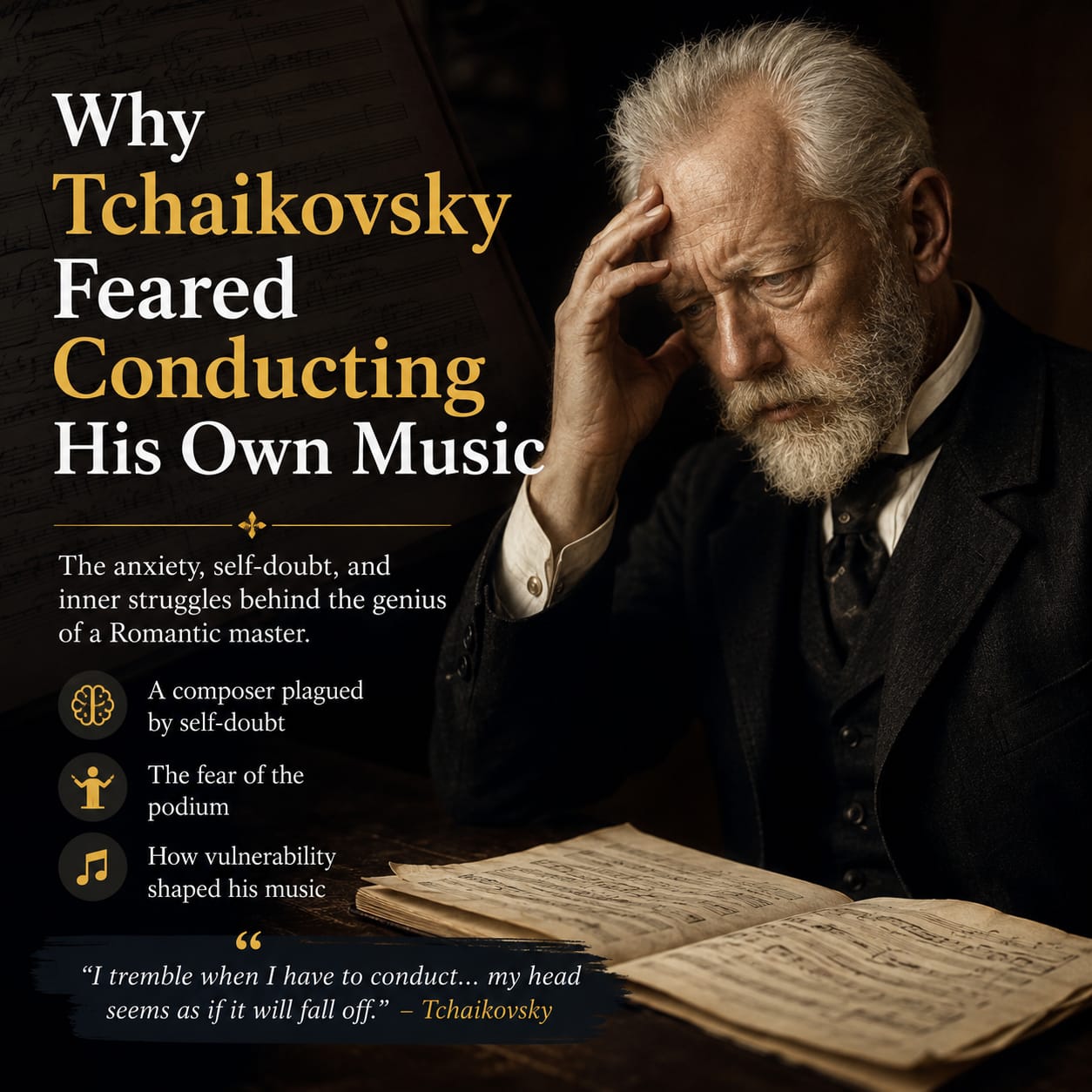
Pyotr Ilyich Tchaikovsky is remembered today as one of the most emotionally expressive composers in classical music history. His symphonies, ballets, and concert works continue to define the Romantic orchestral tradition. Yet behind the confidence and grandeur of his music was a composer who often struggled with insecurity, anxiety, and intense self-doubt—especially when standing in front of an orchestra.
One of the lesser-known aspects of Tchaikovsky’s life is his deep discomfort with conducting his own music. Although he eventually conducted several important performances, he frequently described the experience as physically and emotionally distressing.
For a composer whose music feels so powerful and direct, this contradiction is fascinating.
Tchaikovsky’s Fear of the Podium
Unlike composers such as Mahler or Wagner, who were naturally authoritative conductors, Tchaikovsky did not initially see himself as someone capable of controlling an orchestra. He often feared losing concentration during performances and worried that his nervousness would become visible to musicians and audiences alike.
In letters and personal writings, he admitted experiencing overwhelming anxiety before concerts. He reportedly feared that his head might suddenly fall off during conducting due to nervous tension—a dramatic image that reveals the level of psychological pressure he felt.
This was not theatrical exaggeration. Tchaikovsky genuinely struggled with stage anxiety.
For many years, he preferred to let other conductors perform his works rather than face the emotional burden himself.
Why Conducting Felt So Difficult for Him
Part of the problem was Tchaikovsky’s personality. He was highly introspective and emotionally sensitive, traits that deeply shaped his music but also made public performance psychologically exhausting.
Conducting requires external projection: authority, clarity, decisiveness. Tchaikovsky’s creative world, however, was often internal and vulnerable. The emotional intensity found in works like the Pathétique Symphony or Swan Lake came from introspection rather than outward control.
This tension between inner sensitivity and public exposure may explain why conducting became such a source of fear.
At the same time, Tchaikovsky lived in an era where public reputation carried enormous pressure. A failed performance could seriously damage a composer’s standing. For someone already prone to self-criticism, the podium became a place of immense psychological risk.
The Irony Behind His Music
What makes this story especially compelling is the contrast between the man and the music.
Tchaikovsky’s orchestral writing often sounds confident, dramatic, and emotionally overwhelming. His climaxes feel inevitable. His melodies unfold with remarkable assurance.
Yet the composer himself frequently questioned his own abilities.
This contradiction may actually explain why his music feels so human. Beneath the sweeping orchestration lies vulnerability. His emotional sincerity comes not from perfection, but from tension between strength and fragility.
Even today, listeners often connect to Tchaikovsky because his music feels emotionally exposed in a way that many composers do not.
How His Conducting Improved Over Time
Despite his fears, Tchaikovsky gradually became more comfortable conducting later in life. International tours exposed him to larger audiences and increased his confidence. He eventually conducted performances in Europe and the United States, where his music was received enthusiastically.
Critics noted that while he was not the most technically commanding conductor, his interpretations carried authenticity and emotional understanding.
He may never have loved conducting, but he learned to survive it.
That evolution mirrors something many artists experience: fear does not necessarily disappear, but experience can make it manageable.
The Connection Between Vulnerability and Musical Expression
One reason Tchaikovsky’s music continues to resonate is that emotional vulnerability is built into the structure of his compositions.
His harmonic pacing, lyrical phrasing, and orchestral surges often feel like emotional confession rather than formal display. Moments of triumph are frequently shadowed by melancholy or instability.
This emotional duality appears throughout his music:
- passionate climaxes interrupted by collapse
- lyrical themes surrounded by darker orchestral textures
- tension between intimacy and grandeur
In many ways, the same sensitivity that made conducting difficult may also have been the source of his extraordinary expressive power as a composer.
A Personal Reflection
What I find particularly inspiring about Tchaikovsky is that his artistic voice did not emerge from confidence alone. It emerged from emotional complexity.
As a composer, I often think about how vulnerability can shape musical atmosphere more effectively than technical perfection. In some of my own works, especially those built around introspective or cinematic moods, I’m less interested in virtuosic display than in creating emotional spaces that feel honest and psychologically alive.
That connection between fragility and expression is something I strongly associate with Tchaikovsky’s music.
Final Thoughts
Tchaikovsky’s fear of conducting reminds us that artistic greatness does not always come from certainty or confidence. Sometimes it emerges from sensitivity, doubt, and emotional exposure.
The irony is striking: a composer capable of creating some of the most emotionally powerful orchestral music ever written often felt deeply uncomfortable presenting it himself.
Yet perhaps that vulnerability is exactly what gives his music its enduring emotional force.
If you would like more information on these topics, explore the following related posts: