
Orchestral composition process
What does a night in the city sound like when everything is in motion? This article explores my orchestral composition process through the piece “About the Blue Side of Neon Light”.
About the Blue Side of Neon Light, from the album Urban Nightlife Stories, captures the energy and brightness of a night in the city—where movement, light, and rhythm define the atmosphere.
At the same time, the piece introduces contrast: beneath the surface of activity, moments of ambiguity and mystery emerge before returning to a more open and joyful state.
This article explores my orchestral composition process through this piece.
Listen while reading and follow how the piece evolves:
The Core Idea
The piece is built on groove-driven motion with harmonic color and contrast.
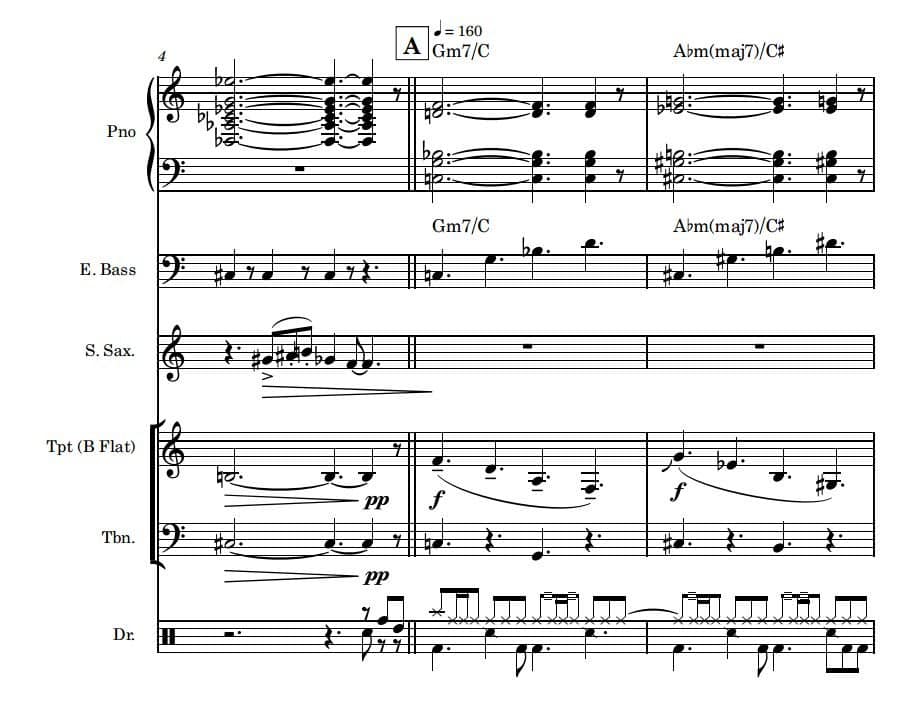
From the opening (♩ ≈ 140–160) :
- rhythm section establishes a steady, forward-moving pulse
- harmonic cycles repeat with variation (Gm7 → C → Am(maj7) → C)
- melodic fragments emerge gradually
This creates:
- a sense of movement
- a light, animated character
- a stable rhythmic foundation
The music moves forward with clarity and energy.
The A Section — Energy and Continuity
The A section defines the main identity of the piece.
As seen in the early pages :
- repeated harmonic cycles create structural continuity
- rhythm section (piano, bass, drums) maintains groove
- brass and saxophone introduce melodic gestures
Key characteristics:
- repetition with variation
- stable harmonic rhythm
- clear forward motion
This section reflects:
- urban activity
- brightness
- social energy
The music does not aim for tension—it aims for flow and vitality.
Harmonic Language
Harmony creates continuity through looping cycles rather than directional progression, combining jazz vocabulary with non-functional movement.
Across the A section:
- Gm7 → C → Am(maj7) → C
- chromatic reinterpretations (Abm(maj7)/C#, Bb6(add9))
- extended chords (maj7, add9, m11)
These progressions:
- create color rather than direction
- avoid strong resolution
- allow continuous looping
Harmony acts as a color field, not as a narrative driver.
Rhythmic Behavior
Rhythm is central to the piece.
- drum set establishes a consistent groove
- bass reinforces harmonic grounding
- piano supports with rhythmic comping patterns
This produces:
- stability
- propulsion
- dance-like continuity
Unlike tension-driven pieces, here rhythm is inviting rather than forcing.
The B Section — Contrast and Mystery
The B section introduces a clear contrast (♩ ≈ 90) :
- tempo slows down
- texture becomes more open
- harmonic language shifts (Cm11, Am11, extended voicings)
Here:
- melodic lines are more sustained
- space becomes more present
- dynamics soften
This section reflects:
- introspection
- ambiguity
- the hidden side of the night
The contrast is not abrupt—it feels like entering a different space within the same environment. Also shifts the listener’s focus from rhythm to space.
Return (A1) — Reaffirmation of Energy
When the A material returns (♩ ≈ 120–160) :
- rhythmic energy is re-established
- harmonic cycles resume
- texture becomes denser again
This creates:
- a sense of return
- renewed clarity
- restored movement
The piece reconnects with its initial character, now perceived with more depth after the contrast.
Texture and Orchestration
The ensemble combines jazz and orchestral elements:
- piano and bass define harmonic structure
- drums provide rhythmic continuity
- saxophone and brass carry melodic material
The interaction between sections creates:
- layered textures
- dynamic contrast
- continuous variation
No single voice dominates—the music is built through ensemble interaction.
Structural Design
The structure follows a clear ABA form:
- A — groove and energy established
- B — contrast through reduction and harmonic change
- A1 — return to the original material
This design supports:
- clarity
- balance
- perceptual contrast
Compositional Approach
In this piece, I focused on:
- building structure through harmonic cycles
- maintaining rhythmic continuity
- introducing contrast through tempo and texture
- combining jazz harmony with cinematic structure
The goal was to create a piece that feels:
- alive
- fluid
- and emotionally varied
Compositional Techniques in About the Blue Side of Neon Light
This work combines jazz harmonic cycles, groove-based rhythm, and sectional contrast. The interaction between repetition and variation creates a coherent structure where movement and color define the musical experience.
Final Thought
About the Blue Side of Neon Light is not only about energy—The piece does not simply celebrate the night, it reveals its dual nature.
Through groove, harmonic color, and structural contrast, the piece captures both the brightness and the ambiguity of a night in the city.
Listen to the piece and focus on how the groove sustains continuity while harmony and texture introduce variation.
If you would like more information on these topics, explore the following related posts: