
Orchestral Composition Process
What does urgency sound like when it never accelerates?
The Machine That Was in a Hurry explores tension built through continuous motion rather than speed. It uses continuous arpeggiation to create tension through repetition and harmonic instability.
Originally written for piano and vibraphone (2021), and later adapted for string quartet in the album Tied Strings (2022), the piece translates mechanical acceleration into musical behavior.
This article explores my compositional process through this piece.
Listen while reading (two versions of the same piece):
In the piano–vibraphone version, the arpeggiation is more centralized. In the string quartet version, the same material is distributed, creating a more complex and unstable texture.
The Core Idea
The piece is built on continuous arpeggiated motion under increasing tension.
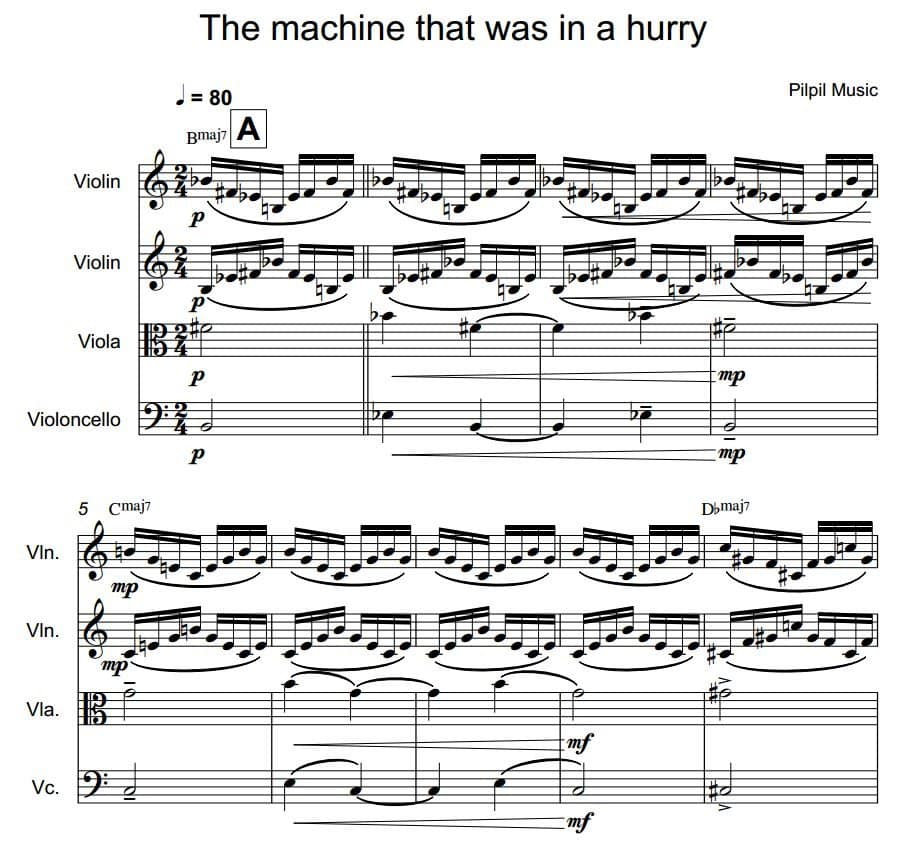
From the opening (♩ = 80) :
- arpeggiated figures are introduced immediately
- patterns repeat with minimal variation
- harmonic shifts occur beneath a constant rhythmic surface
This creates a perception of:
- urgency
- forward pressure
- lack of rest
The music behaves like a system that cannot slow down.
The A Section — Accumulation of Tension
The first section (A) establishes the core mechanism.
As seen in the opening pages (1–2) :
- continuous broken-chord figures dominate all voices
- harmonic movement progresses through shifting sonorities (Bmaj7, Cmaj7, Dbmaj7…)
- dynamics increase gradually (p → mf → f)
Key characteristics:
- repetition without release
- increasing density
- harmonic instability
The arpeggiated texture functions as a mechanical engine, generating constant motion while gradually intensifying tension.
The piece does not accelerate in tempo—it accelerates in perceived pressure.
This is the central mechanism of the work.
Harmonic Language
Harmony contributes directly to the sense of urgency.
Across the A section:
- extended chords (maj7, altered dominants)
- chromatic shifts between tonal centers
- non-functional transitions
These elements:
- avoid resolution
- create continuous displacement
- reinforce instability
Harmony does not resolve tension—it feeds it.
Rhythmic Behavior
Rhythm is structurally rigid.
- continuous subdivision across all voices
- absence of rhythmic contrast
- consistent flow of arpeggios
This produces:
- mechanical continuity
- temporal compression
- sustained intensity
The listener is not given space to breathe.
The B Section — Release and Reconfiguration
The B section introduces contrast (page 2 onward) :
- texture becomes more open
- articulation changes (sul ponticello, later sul tasto)
- harmonic motion stabilizes
Although arpeggiation remains, its function changes:
- from tension generator → to structural support
- from density → to clarity
This creates:
- partial release
- sense of reorientation
- reduced pressure
The system does not stop—but it becomes more transparent. The release is not harmonic, but textural.
Density decreases, articulation changes, and the listener perceives more space between events.
Return (A1) — Intensified Motion
When the A material returns (page 4) :
- dynamics increase further
- harmonic tension is reintroduced
- texture becomes more saturated
This is not repetition, but amplification.
The same mechanism now feels:
- heavier
- more urgent
- less stable
Texture and Orchestration
The string quartet version redistributes the original piano/vibraphone material:
- arpeggios are shared across instruments
- lines interlock to maintain continuity
- articulation (ord., sul pont., sul tasto) adds variation
This produces:
- a distributed mechanical system
- continuous motion without a central voice
- controlled density
Structural Design
The piece follows an expanded ABA form:
- A — tension through accumulation
- B — partial release and textural clarity
- A1 / A2 — return with increased intensity
- Coda — gradual deceleration (tempo reduction at the end)
The final slowing (♩ = 75 → 70 → 65 → 60) introduces:
- controlled release
- dissipation of energy
- delayed resolution
Compositional Approach
In this piece, I focused on:
- using arpeggiation as a structural engine
- creating tension through repetition and density
- avoiding early resolution
- controlling release through texture rather than harmony
The goal was to simulate urgency—not through speed, but through continuous pressure.
Compositional Techniques in The Machine That Was in a Hurry
This work combines continuous arpeggiated figures, chromatic harmonic shifts, and gradual dynamic expansion. The interaction between repetition and harmonic instability creates a sense of mechanical urgency typical of contemporary cinematic and minimalist-influenced writing.
Final Thought
The Machine That Was in a Hurry is not about movement—it is about pressure. The piece does not rush—it traps itself in motion. Only at the end does the system begin to lose energy.
Through continuous arpeggiation and harmonic tension, the piece creates a system that pushes forward without rest, until it finally begins to release at the very end.
Listen to the piece and focus on how the arpeggiated patterns generate tension without changing tempo.
If you would like more information on these topics, explore the following related posts: