
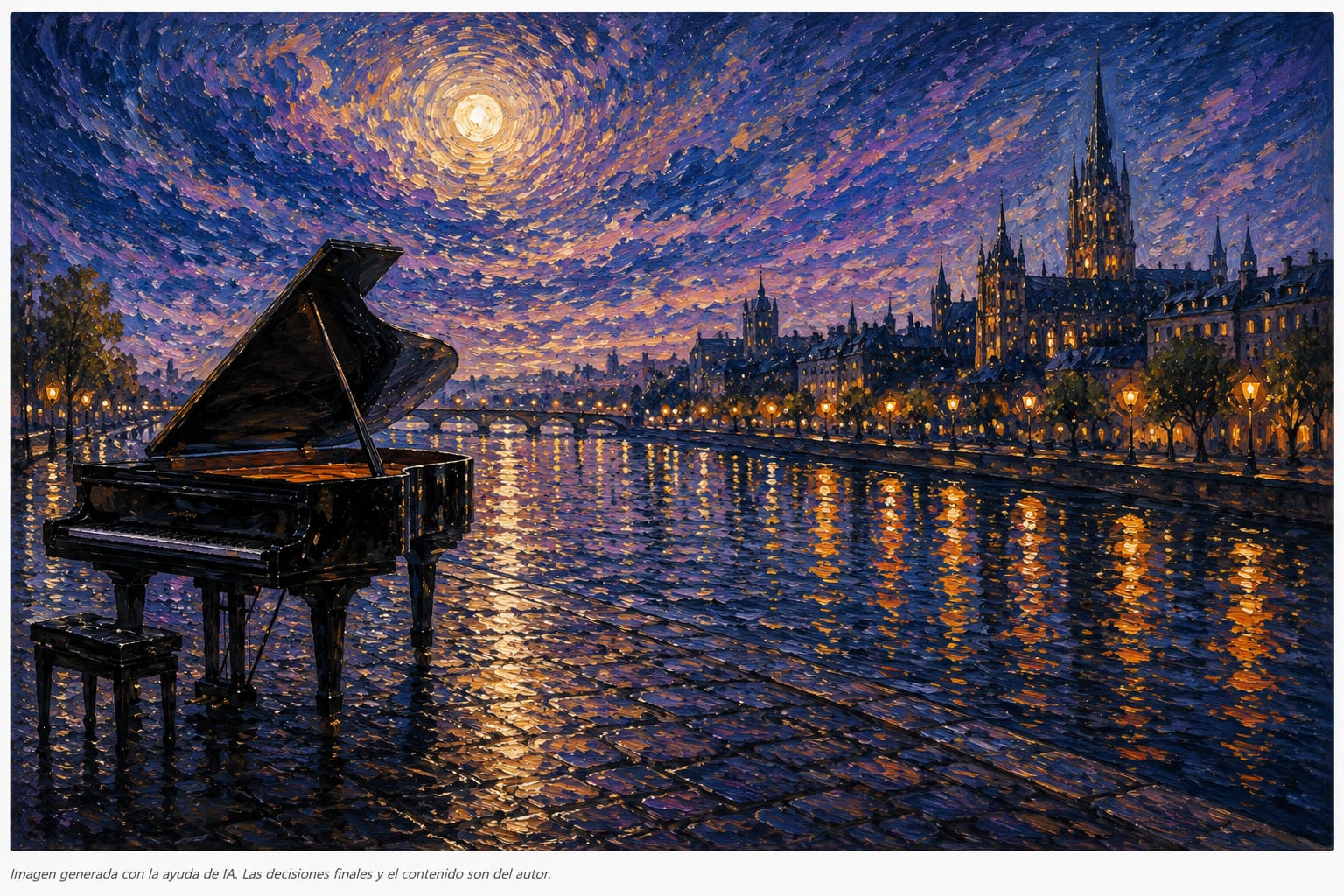
Understanding Debussy’s Harmonic Language
Claude Debussy’s approach to harmony significantly diverged from the conventions established by his predecessors, marking a crucial shift in the evolution of Western music. Central to his unique harmonic vocabulary is the concept of non-functional harmonies, which eschew traditional cadences and progressions that dominate classical Western music. Instead of relying on a series of phrases that create a sense of tension and resolution, Debussy’s harmonies unfold more freely, allowing for a fluid expression of emotion and color.
Another essential element of Debussy’s harmonic language is the use of modal scales. By drawing from various modes, such as Dorian and Mixolydian, he crafted melodies that possess a distinctive character and tone. This modal approach enables a broader palette of sound, shifting away from the major-minor dichotomy that had long prevailed. Traditional harmony typically informs a piece’s trajectory, while Debussy’s modal exploration provides a more timeless quality, enhancing the listener’s experience of atmosphere.
The whole-tone scale is yet another hallmark of Debussy’s innovative harmonic techniques. This scale, comprised entirely of whole steps, creates a uniform sound that evokes an ethereal quality. By employing subtle shifts and chromaticism, Debussy was able to conjure vivid imagery through his music, inviting listeners to experience a range of emotions. This use of unconventional scales and harmonies paved the way for contemporary composers to explore new thematic and tonal territories.
In conclusion, Debussy’s radical divestment from traditional harmonic structures has had a profound impact on contemporary composition. His unique harmonic vocabulary—characterized by non-functional harmonies, modal scales, and whole-tone scales—has opened avenues for modern composers to break free from conventional musical constraints and craft innovative works that emphasize color and atmosphere.
Try This: Harmony as Color: Take a short melodic phrase and keep the melody unchanged. First place it over a conventional functional progression. Then repeat it using several non-functional or modal sonorities. Listen to how the same melody changes emotionally even though the notes of the melody remain identical.
This is one of the most useful ways to understand harmonic color: the harmony can change the perceived meaning of the melody without changing the melody itself.
The Influence of Impressionism on Modern Composition
The legacy of Impressionism, a significant artistic movement that flourished in the late 19th and early 20th centuries, continues to shape the landscape of contemporary music. Claude Debussy, often regarded as the father of Impressionism in music, pioneered a new approach to harmony, texture, and timbre that resonates profoundly with modern composers. This section explores how the principles established during the Impressionist era are evident in the works of today’s composers, highlighting the enduring influence of Debussy’s innovative techniques.
One of the hallmarks of Impressionistic music is its emphasis on color and atmosphere over traditional melodic line and structure. For instance, modern composers such as John Adams and Eric Whitacre draw from Debussy’s exploration of sonority and texture. They employ rich harmonic palettes and subtle timbral contrasts that evoke vivid imagery and emotions, similar to how Debussy painted soundscapes in pieces like “Prélude à l’après-midi d’un faune.” Through their works, Adams and Whitacre have successfully integrated Impressionistic elements into contemporary genres, reflecting Debussy’s vision while innovatively applying these concepts.
Furthermore, the fluidity and non-traditional harmonic structures that define Impressionism have inspired a plethora of contemporary composers. Jennifer Higdon, renowned for her orchestral and choral compositions, often utilizes lush textures and inventive harmonies reminiscent of Debussy’s unique vocabulary. Her piece, “blue cathedral,” exemplifies how the exploration of mood and imagery can convey a narrative similar to that of Impressionistic works. This connection illustrates how contemporary music continues to embrace and expand upon the harmonic color and expressive potential laid down by the Impressionist masters.
Analyzing Contemporary Works Inspired by Debussy
In the realm of contemporary composition, the influence of Claude Debussy is palpable, particularly in the harmonic language adopted by modern composers. Several contemporary works exhibit Debussyan harmonic colors by skillfully integrating his techniques, such as extended chords, unconventional chord progressions, and innovative textural approaches. One notable work is Ghosts of the Mississippi by composer Michael Gordon, which employs rich harmonic textures reminiscent of Debussy’s style. Gordon utilizes layered sonic effects and fluid chord changes that reflect the impressionistic quality Debussy championed.
Another exemplary piece is Chansons d’un siècle by Gabriel Kahane. This work adapts Debussy’s penchant for subtle harmonic shifts within a modern context. Kahane’s composition often features extended chords that create an ethereal atmosphere, resonant of Debussy’s own harmonic explorations. The use of unconventional progressions allows for a narrative depth, startling the listener with unexpected shifts, much as Debussy intended.
Certain works by contemporary jazz musicians also showcase Debussy’s influence. Pianist and composer Brad Mehldau embraces the concept of lush harmonies and coloristic effects in pieces like Reincarnation. The integration of Debussyan harmonic colors enables Mehldau to create a fluid and improvisatory feel throughout, capturing the essence of spontaneity akin to Debussy’s method of composition.
Moreover, Anna Thorvaldsdottir’s Aeriality showcases how contemporary artists have adapted Debussy’s innovations. The piece extensively uses textural changes and extended harmonic frameworks that transform standard approaches within contemporary classical music. Through these works, the impact of Debussy’s harmonic language is evident, as modern composers draw inspiration from his techniques to craft unique musical narratives that resonate with today’s audiences.
From Debussy’s Harmonic Color to My Own Compositional Practice
Debussy’s approach to harmony also offers a useful way of thinking about contemporary instrumental composition: harmony does not always need to function primarily as a mechanism of tension and resolution. It can instead alter the color, atmosphere and perceived emotional temperature of a passage.
This idea is present in some of my own compositions. In Stained Glass, for example, harmonic sonorities such as B♭maj7, E♭m7 and Dm7 are used less as functional destinations than as changes of harmonic color. The rhythmic texture continues while the harmonic environment shifts, creating the sensation of changing light rather than traditional harmonic progression.
A similar principle appears in Faces & Places, although in a very different instrumental context. Written primarily for string quintet, pieces such as Salt Air Memories and Isobel use gradual harmonic changes together with contrasting string textures to transform the character of the music without relying on dramatic harmonic resolution. In Isobel, shifting tonal centers and changes between pizzicato, arco, sul tasto and other string techniques further demonstrate how harmonic color and timbre can work together as structural elements.
Another example from Faces & Places is Intersections, where expressive melodies, evolving string textures and subtle harmonic shifts interact to create a sense of continuous motion. Here, harmony is not simply used to establish a sequence of tension and resolution; it becomes part of the changing emotional and atmospheric character of the music.
This is where Debussy’s legacy becomes particularly useful to a contemporary composer: harmonic color can become part of the compositional structure itself. A chord does not necessarily have to “go somewhere”; its function may simply be to change what the listener perceives.
Future Directions: Debussy’s Legacy in Today’s Music Scene
The influence of Claude Debussy’s unique approach to harmony continues to resonate profoundly in the realm of contemporary music. His innovative techniques, characterized by unconventional chord progressions and the rich use of chromaticism, have set the stage for modern composers to explore new harmonic landscapes. Today, many artists draw inspiration from Debussy’s harmonic color, infusing their compositions with atmospheric soundscapes that echo his Impressionistic style.
Current trends among composers indicate a resurgence of interest in modal harmony and the exploration of non-traditional scales that Debussy effectively employed. Composers are increasingly incorporating elements such as altered chords and polychords, reflecting Debussy’s legacy in their works. This shift towards a broader understanding of harmonic possibilities has encouraged the development of new genres, blending classical techniques with contemporary styles to create music that is both innovative and rooted in historical context.
Moreover, educational institutions are recognizing the significance of Debussy’s techniques in their curricula, incorporating his methodologies into music theory and composition courses. This pedagogical approach nurtures a new generation of composers who seek to understand and develop their harmonic language through the lens of Debussy’s principles. Workshops and seminars focusing on his music’s analytical aspects reveal the depth of his influence and encourage students to experiment with similar harmonic explorations.
Looking ahead, the evolution of music inspired by Debussy is set to continue. As composers push the boundaries of traditional harmony, we may witness the emergence of innovative forms that reflect Debussy’s timeless impact. Through ongoing explorations of rhythm, texture, and color, the integration of Debussy’s harmonic vision into contemporary music will remain a dynamic and vital force, guiding composers in their artistic pursuits.
If you would like more information on these topics, explore the following related posts: