
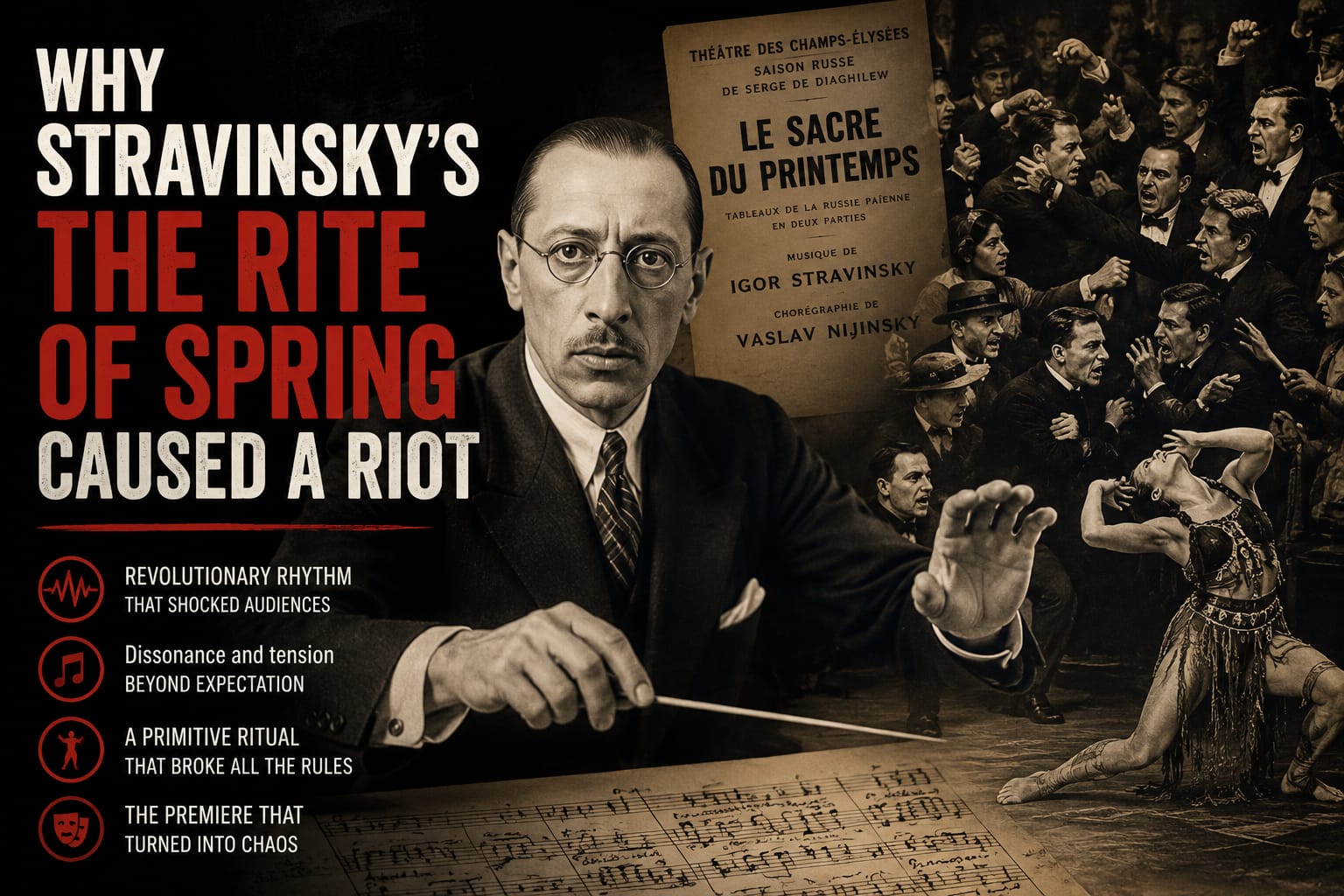
Few premieres in music history have become as legendary as the first performance of Igor Stravinsky’s The Rite of Spring in Paris on May 29, 1913. What began as a ballet performance quickly turned into chaos: shouting, insults, arguments, and near physical fights erupted inside the theater.
Today, the story is almost mythical. But the riot was not simply caused by audiences “not understanding modern music.” The deeper reason is more interesting: The Rite of Spring attacked nearly every expectation listeners had about rhythm, harmony, movement, and beauty itself.
Even more than a century later, the work still feels aggressive, unstable, and strangely modern.
A Ballet That Rejected Elegance
Before The Rite of Spring, ballet audiences were accustomed to refinement and grace. Ballet music was expected to support elegant movement and lyrical beauty.
Stravinsky and choreographer Vaslav Nijinsky deliberately moved in the opposite direction.
The ballet portrayed an imagined pagan ritual in ancient Russia in which a young woman dances herself to death as a sacrificial offering to nature. Instead of aristocratic elegance, the audience saw heavy stomping, angular gestures, bent bodies, and primitive group movement.
The choreography itself already shocked many viewers before the orchestra had fully revealed its intentions.
For Parisian audiences of the early twentieth century, this felt almost violent.
The Opening That Changed Everything
One of the most famous moments in the piece happens immediately.
The ballet opens with a high bassoon solo played in an extremely unusual register. At the time, many listeners reportedly did not even recognize the instrument. Instead of a warm orchestral introduction, Stravinsky presents something fragile, tense, and unfamiliar.
From the very beginning, the audience loses its sense of stability.
This was intentional.
Stravinsky wanted the music to feel ancient, raw, and unpredictable—not polished in the Romantic tradition of composers like Tchaikovsky or Wagner.
The sound world itself was unsettling.
Rhythm as a Source of Violence
What truly made The Rite of Spring revolutionary was rhythm.
Instead of smooth phrasing and predictable meter, Stravinsky built the piece around:
- irregular accents
- layered ostinatos
- shifting meters
- repeated rhythmic cells
- abrupt orchestral attacks
The famous “Augurs of Spring” section demonstrates this perfectly. Repeated chords hammer relentlessly while accents constantly shift underneath. The listener cannot settle into a comfortable pulse.
The music feels physical rather than lyrical. Rhythmic layering does not always have to produce Stravinsky’s sense of violence or confrontation. In my own chamber composition Salt Air Memories, from Faces & Places, recurring rhythmic figures are layered and subtly varied across the string quintet. The effect is much more restrained, but the underlying principle is similar: repetition and superimposed rhythmic activity can create a sense of continuous movement without relying on a conventional melodic climax.
This was radically different from the flowing Romantic orchestral language audiences expected at the time.
Today these techniques influence film music, minimalism, progressive music, and even some electronic genres. But in 1913, they sounded almost barbaric.
Harmony Without Comfort
The harmony also contributed to the scandal.
Stravinsky often stacked dissonant chords together without resolving them traditionally. Rather than moving toward emotional release, the music accumulates tension and keeps the listener suspended.
One famous example is the “Augurs chord,” where two unrelated harmonies are superimposed at the same time. The effect is dense, harsh, and rhythmically explosive.
For audiences raised on nineteenth-century harmonic language, this sounded chaotic.
But Stravinsky was not trying to create chaos randomly. The tension is carefully controlled. Every rhythmic layer and orchestral color contributes to an overwhelming sense of ritual energy.
Why the Audience Reacted So Strongly
The riot itself has sometimes been exaggerated over the years, but contemporary accounts confirm that the atmosphere became genuinely hostile.
Some audience members laughed during the performance. Others shouted insults back at them. Arguments spread across the theater. The noise became so intense that dancers reportedly struggled to hear the orchestra.
Several factors contributed:
- the shocking choreography
- the violent rhythmic language
- the dissonant harmony
- the rejection of traditional beauty
- the tension already surrounding avant-garde art in Paris
The audience was not reacting to one strange chord or one unusual dance step. They were reacting to an entirely new artistic language.
The Irony of Modern Ears
What is fascinating today is that modern audiences often experience The Rite of Spring very differently.
Many of Stravinsky’s ideas have become part of mainstream cinematic music:
- rhythmic ostinatos
- aggressive brass writing
- layered percussion
- tension through repetition
- asymmetrical accents
Repetition can also become a structural device in much more intimate instrumental writing. In Unfolding Memory, another composition from Faces & Places, recurring rhythmic and melodic figures gradually change through variations in texture, articulation and register. The result is not the explosive rhythmic confrontation of The Rite of Spring, but it demonstrates the same broader compositional possibility: repetition can generate movement when the material is continuously transformed.
Film composers like John Williams, Hans Zimmer, and many contemporary orchestral writers inherited techniques that Stravinsky helped popularize.
What once sounded outrageous now feels surprisingly familiar.
That may be the clearest sign of how influential the piece became.
A Composer’s Perspective: Rhythm, Repetition and Controlled Instability
What I find most inspiring about The Rite of Spring is not simply its complexity, but its physical energy. Stravinsky understood that rhythm alone could drive emotional tension without relying heavily on melody. The interaction between repeated patterns, shifting accents, and orchestral texture creates movement that feels almost architectural.
This idea also appears in some of my own compositions. In Castilian Harvest, from Faces & Places, recurring rhythmic figures and cyclical patterns help shape the sense of movement, while changes in articulation, harmony and texture prevent the repetition from becoming static. The musical language is very different from Stravinsky’s, but the underlying idea of using repetition as a source of energy and structural continuity is something I find equally compelling.
That tension between repetition and unpredictability remains incredibly powerful.
Stravinsky understood that rhythm alone could drive emotional tension without relying heavily on melody. The interaction between repeated patterns, shifting accents, and orchestral texture creates movement that feels almost architectural.
Final Thoughts
The Rite of Spring caused a riot because it challenged audiences at every possible level. It rejected elegance, disrupted rhythmic expectations, destabilized harmony, and presented music as something primitive, physical, and emotionally overwhelming.
More than a century later, the piece still feels alive because its energy comes from tension itself.
Stravinsky proved that rhythm could become the central force of musical drama—and in doing so, he permanently changed the future of orchestral music.
If you would like more information on these topics, explore the following related posts: