
Orchestral composition process
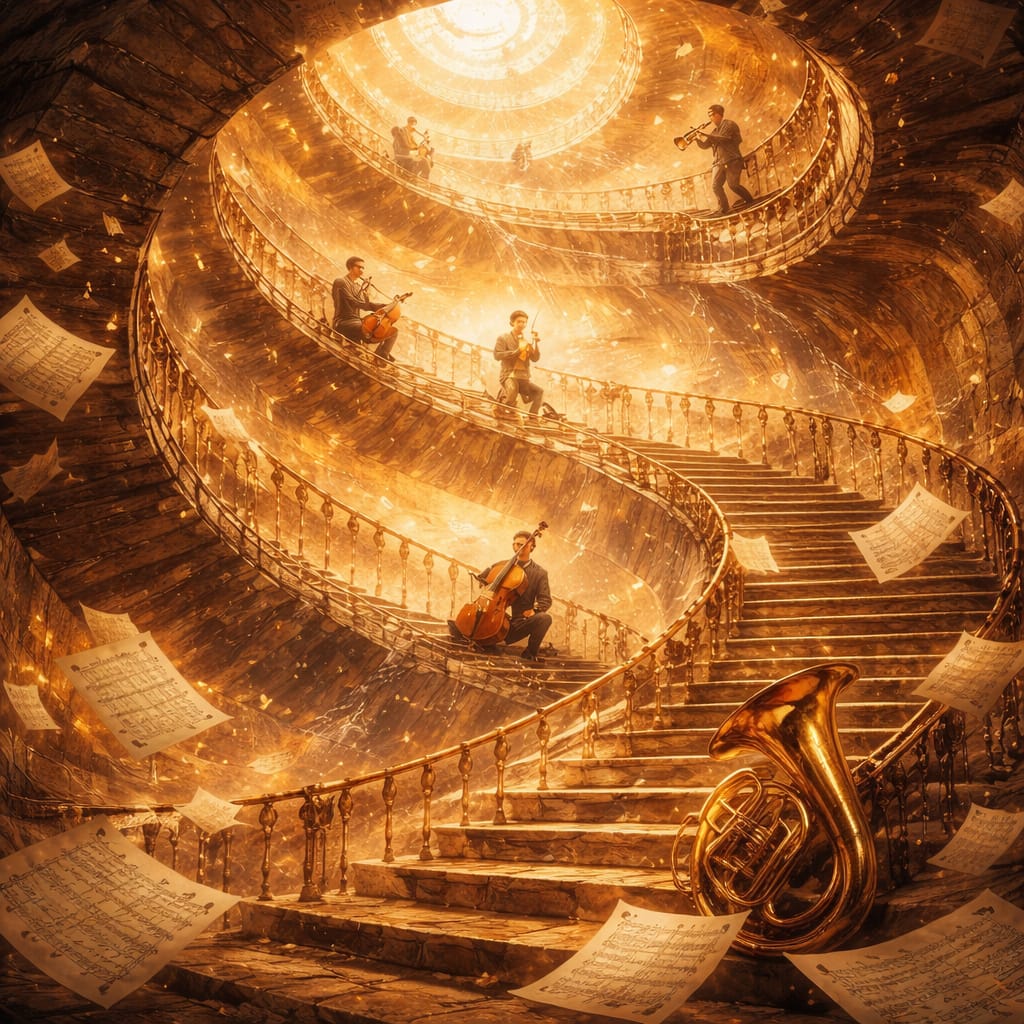
This article explores my orchestral composition process through the piece “Spiral Stairway”.
Spiral Stairway explores the idea of circular movement: not linear progression, but continuous ascent without a clear beginning or end. Originally written for piano and cello, and later arranged for brass quintet in Brassing Reflections, the piece translates a visual concept—spiral motion—into musical structure.
The music behaves like a spiral: always moving, but constantly returning to the same point from a different angle.
The piece sits between minimalism and cinematic orchestral writing, where repetition defines structure instead of harmony.
Listen while reading (two versions of the same piece):
The Core Idea
The piece is built on rotational motion.
From the opening (♩ = 65) , the material is introduced gradually:
- low instruments establish a grounded harmonic base
- upper voices enter with short, connected gestures
- phrases feel circular rather than directional
This creates a perception of movement around a center, rather than toward a destination.
Similar approaches are also present in pieces like The Discovery or September…
The A Section — Establishing the Spiral
The first section (A) defines the main behavior of the piece.
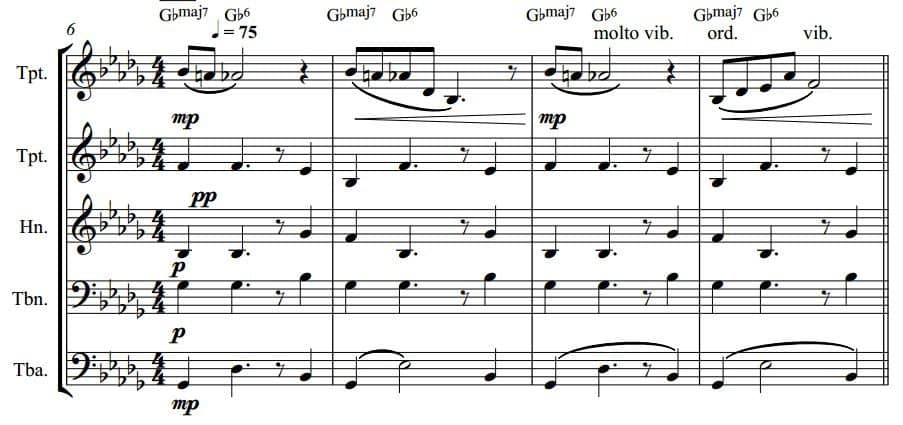
As seen in the opening pages :
- harmonic oscillations (e.g., G♭maj7 ↔ G♭6) repeat persistently
- melodic fragments move in small intervals
- articulation remains smooth and connected (legato, vib.)
The key characteristics are:
- repetition with slight variation
- continuous motion without resolution
- balance between stability and movement
Rather than developing themes, the music rotates around a harmonic field.
Harmonic Language
Harmony plays a central structural role.
Throughout the piece, we see recurring sonorities:
- G♭maj7 / G♭6 (opening)
- D♭maj7 / D♭6
- A♭maj7 / A♭6
- E♭maj7 / E♭6
These shifts do not function as traditional progressions. Instead:
- they create parallel harmonic planes
- they maintain color while avoiding resolution
- they reinforce cyclic perception
Harmony here is not directional—it is rotational.
Rhythmic Behavior
The rhythmic language supports this circular motion. Rhythm does not create direction—it reinforces circular continuity.
- repeated patterns appear across all voices
- accents are subtle, avoiding strong metric hierarchy
- phrasing overlaps between instruments
This produces:
- a sense of continuity
- lack of clear cadential points
- fluid temporal perception
The listener does not perceive clear beginnings or endings—only ongoing motion.
The B Section — Contrast Through Reduction
The B section (♩ = 60) introduces contrast .
Here:
- texture becomes lighter
- rhythmic density decreases
- articulation becomes more separated
The material is simplified:
- shorter gestures
- clearer spacing between voices
- reduced harmonic saturation
This section does not break the spiral—it slows it down, allowing the listener to perceive its structure more clearly.
Return (A1) — Recontextualized Motion
When the A section returns (A1), the original material is reintroduced.
However:
- dynamics are expanded
- orchestration becomes more active
- density increases
The same harmonic and rhythmic ideas now feel:
- more intense
- more present
- more directional (even if structurally they are not)
This is not a literal repetition, but a recontextualization of the spiral.
Texture and Orchestration
The brass quintet version emphasizes:
- timbral contrast (trumpets vs low brass)
- sustained resonance vs articulated figures
- use of vibrato and articulation changes (ord., vib.)
The result is a texture where:
- lines interlock
- no single voice dominates
- motion is distributed across the ensemble
In the original piano–cello version, this effect is achieved through register and articulation rather than timbre.
Structural Design
The piece follows a clear ABA structure:
- A — Circular motion established
- B — Reduction and temporal expansion
- A1 — Return with increased intensity
This structure reflects the concept:
- repetition without stasis
- return without exact duplication
- movement without final resolution
Compositional Approach
In this piece, I focused on:
- translating a visual concept (spiral) into musical behavior
- using harmonic oscillation instead of progression
- avoiding cadential closure
- distributing motion across the ensemble
The goal was to create continuous rotation in sound.
Compositional Techniques in Spiral Stairway
This work combines harmonic oscillation (maj7–6 sonorities), repetitive rhythmic cells, and distributed orchestration. The result is a non-linear musical structure where repetition and variation generate movement without traditional development.
Final Thought
Spiral Stairway is not about reaching a destination, but about the experience of movement itself.
Through circular harmony, overlapping rhythms, and continuous motion, the piece creates a space where time feels suspended—like ascending a staircase that never quite ends.
Listen to Spiral Stairway and focus on how harmonic oscillation replaces traditional progression.
If you would like more information on these topics, explore the following related posts: