

Orchestral composition process
What does the beginning of autumn sound like? September explores the subtle shift between cycles, using repetition and low-register rhythm to represent the passage of time. Originally written for piano, cello, and clarinet, and later arranged for woodwind quintet in Woodwinds Blowing, the piece explores the idea of cyclical time—how seasons return, but never in exactly the same way.
The piece sits between minimalism and cinematic writing, where repetition defines time rather than development.
Rather than depicting autumn directly, the music reflects the feeling of entering a new cycle.
Listen while reading (two versions of the same piece):
The Core Idea
The piece is built around a grounded rhythmic motif in the low register, introduced at the very beginning. This low-register motif acts as a temporal anchor, reinforcing the idea of cyclical time.
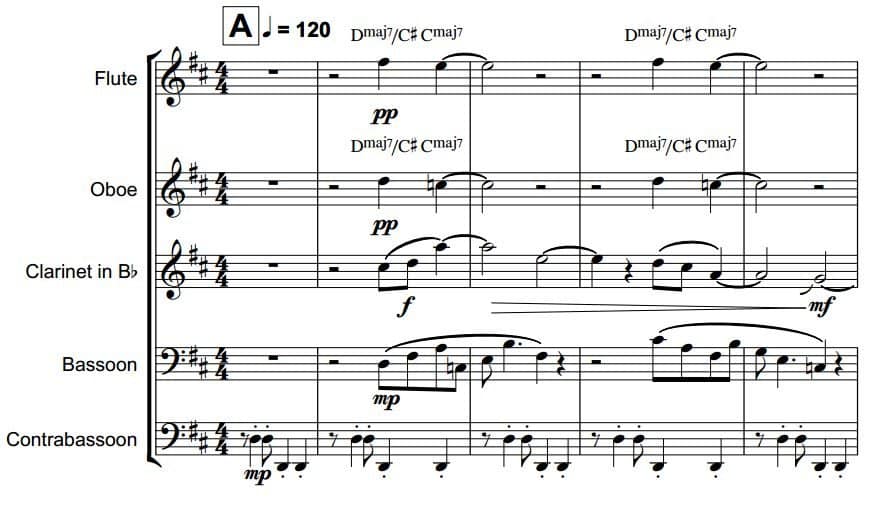
As seen in the opening bars of the score :
- bassoon and contrabassoon establish a steady, repetitive pattern
- the rhythm is simple but persistent
- the register is deliberately low and stable
This motif functions as a foundation:
- it suggests continuity
- it anchors the harmonic space
- it represents the inevitability of seasonal change
Unlike more directional music, this does not push forward—it settles into a cycle.
Building the Texture
Above this low-register foundation, the upper instruments gradually introduce:
- sustained tones
- small melodic gestures
- soft dynamic layers (pp–mp in the opening)
The result is a layered texture where:
- the bass defines time
- the upper voices define atmosphere
This separation is key: rhythm and expression operate independently but remain connected.
Harmonic Language
The harmonic language is stable but subtly shifting. Harmony here does not resolve—it circulates.
Early sonorities such as Dmaj7/C# and Cmaj7 create:
- a sense of openness
- a lack of strong resolution
- smooth transitions between harmonic areas
Later progressions (Bm7, Am7, Em7, F#7 visible throughout the score) maintain this approach:
- harmony moves
- but never forces direction
This reinforces the idea of cycles rather than goals.
Rhythmic Identity
Unlike pieces driven by complexity, September uses repetition as structure.
The rhythmic motif:
- repeats consistently in the lower voices
- is not heavily transformed
- acts as a temporal reference point
Meanwhile, upper lines introduce:
- slight rhythmic variations
- displaced entries
- expressive phrasing
This creates a contrast between:
- stability (low register)
- variability (upper voices)
The B Section — Temporal Reflection
The central section (B1), marked by a slower tempo (♩ ≈ 100) , introduces a clear shift.
Here:
- the motion relaxes
- phrases become longer
- vibrato and sustained tones become more prominent
This section represents reflection.
Instead of continuing the cycle, the music pauses to observe it. The harmonic rhythm slows, and the texture opens, allowing space for a more introspective sound.
This is not contrast for its own sake—it is a change in perception of time.
Development and Return
After the reflective section, the piece gradually returns to the initial material.
- rhythmic activity increases again
- the low-register motif regains presence
- texture becomes denser
However, the return is not identical.
The listener now perceives the material differently, having experienced the slower, reflective section. The cycle continues, but with altered awareness.
This approach is similar to what I explore in pieces like Parade or Hourglass…
Structural Design
The piece follows a cyclical form:
- A — Establishment of the rhythmic foundation
- A1 — Expansion and layering
- B — Slower, reflective section
- A2 — Return with renewed perception
- Coda — Gradual release and dissipation
This structure mirrors seasonal change: repetition with variation.
Compositional Approach
In this piece, I focused on:
- building from a low-register rhythmic anchor
- separating rhythmic stability from melodic expression
- using harmony as a smooth, non-directional field
- introducing contrast through tempo rather than material
The goal was not development, but continuity with transformation.
Compositional Techniques in September
This work combines a persistent low-register ostinato with non-functional harmonic movement and layered orchestration. The contrast between stable rhythmic grounding and flexible upper voices places the piece within contemporary neoclassical and cinematic composition, where texture and time perception are central.
Final Thought
September is not about autumn itself, but about the experience of entering it.
Through repetition, harmonic fluidity, and temporal contrast, the piece reflects a broader idea: time does not simply pass—it returns, reshaped by perception.
Listen to September and focus on how the low-register motif remains constant while the upper voices reshape its meaning.
If you would like more information on these topics, explore the following related posts: