
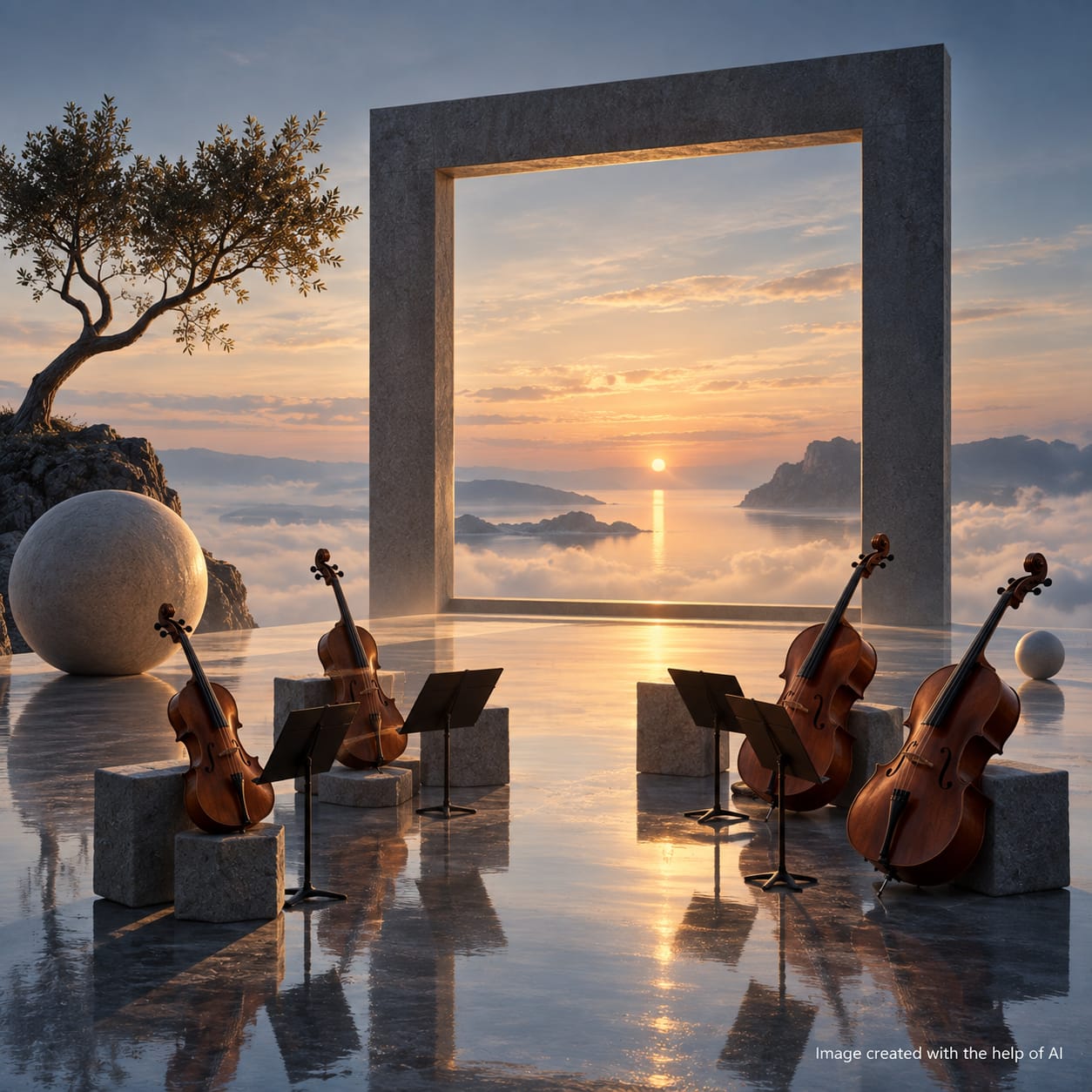
The quiet ending of Faces & Places
Every album has a final moment. Sometimes it is a conclusion; sometimes it is simply the point at which the music stops.
With Silent Frame, the closing piece of Faces & Places, I wanted the ending to feel different: not dramatic, not conclusive, but quietly hopeful. After the memories, people and places explored throughout the album, the music gradually turns its attention away from the past and toward what might come next.
Silent Frame is therefore a kind of musical pause — a space in which everything that has happened can settle, leaving room for the future.
Listen to Silent Frame while reading and focus on how the recurring harmonic and rhythmic material changes each time it returns:
A different ensemble
There is an important difference between Silent Frame and the other works on Faces & Places.
The album is built around the sound of a string quintet, but Silent Frame is written for string sextet: two violins, two violas and two cellos. The score explicitly identifies these six voices and is marked at ♩ = 65.
This was not simply a matter of adding another instrument.
I wanted the additional voice because the harmonic language of the piece required a greater number of simultaneous colours. With six independent string parts, chords can contain more extensions and internal movement while still allowing each voice to breathe.
The result is a denser harmonic palette than in the other pieces on the album, but the music itself remains deliberately restrained.
That contrast is at the heart of the piece: more harmonic complexity, but less apparent movement.
Beginning with openness
The piece begins extremely softly, at ♩ = 65, with dynamics around ppp and mp. The six instruments sustain long tones that gradually move between harmonic colours rather than establishing a conventional melodic statement.
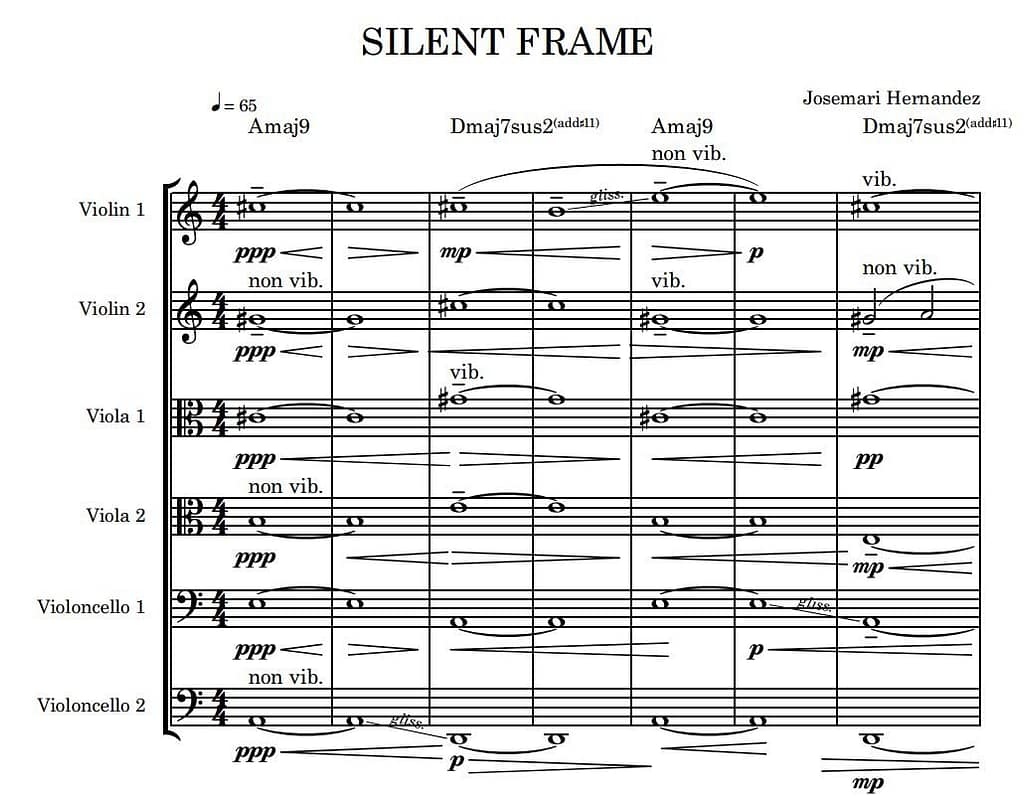
The opening alternates between sonorities such as:
Amaj9 → Dmaj7sus2(add11) → Amaj9 → Dmaj7sus2(add11)
These are not chords that demand a strong traditional resolution. Their extensions — ninths, suspended seconds and added elevenths — create a spacious, floating quality.
This was important to the emotional character I wanted.
The music should feel as though it is looking forward without knowing exactly what lies ahead.
There is no urgent destination.
There is simply space.
Vibrato and non vibrato
One of the most expressive aspects of the score is the alternation between vibrato and non vibrato.
The two approaches are not used merely as technical variations. They change the perceived distance and warmth of the sound.
The opening combines sustained notes with both non vib. and vib., while glissandi occasionally connect one sonority to another.
The effect is subtle.
A note with vibrato seems to breathe and become more human. A non-vibrato note can feel more still, almost suspended in space.
By moving between these two colours, the six instruments can sound simultaneously intimate and distant.
Harmony as atmosphere
The harmonic progression becomes increasingly interesting as the piece unfolds.
After the opening A-major and D-major sonorities, the music moves through colours including:
- F♯m11
- Dmaj9(add11)
- C♯m9
- F♯m11
- Bmaj13
- Em11
The progression does not behave like a conventional tonal journey toward a dominant-tonic resolution. Instead, each chord seems to open another harmonic window.
This is one of the reasons the sextet was necessary.
With six voices, I could retain several common or neighbouring tones while changing the extensions and harmonic colour around them. The harmony can therefore evolve continuously without requiring large melodic gestures.
The music moves, but it moves internally.
A composition built from sustained gestures
Unlike several other pieces in Faces & Places, Silent Frame does not depend on rhythmic propulsion.
The score is dominated by long notes, sustained dynamics and gradual crescendos and diminuendos. Even the occasional glissandi are slow transitions between harmonic states rather than dramatic effects.
This creates an almost static surface.
But underneath that surface, the harmony is constantly changing.
That is the central compositional idea of the piece: stillness does not mean immobility.
Sometimes the most significant movement happens when almost nothing appears to be moving.
The middle section — expanding the harmonic space
Around the middle of the piece, the harmonic vocabulary expands further.
The score introduces Cmaj9(add11), Bm11 and B♭maj13sus2, before returning to Amaj9.
The movement from C major to B minor and then to B♭ major is particularly interesting because these areas are not presented as conventional destinations. They function more like changing perspectives.
The harmonic environment becomes broader while the expressive intensity remains controlled.
There are also subtle changes in articulation and colour: sul tasto, vibrato, non vibrato and glissando appear at different points, allowing the same basic idea to acquire different shades.
The sextet becomes almost like a single, slowly breathing instrument.
Why “Silent Frame”?
The title Silent Frame refers to the idea of a frame around something that cannot be completely expressed.
A frame defines a space, but what happens inside it may remain open to interpretation.
That seemed appropriate for the final piece of an album called Faces & Places.
The album is concerned with memories, people and locations — things that shape us but can never be completely reconstructed. Silent Frame leaves those memories behind without attempting to explain them.
The silence is not emptiness.
It is the space left after the story has been told.
Looking toward the future
As the piece approaches its final section, the harmonic language gradually returns toward the sonorities established at the beginning.
The final progression includes:
Dmaj7sus2(add11) → Amaj9 → Dmaj7sus2(add11) → Amaj9(add11)
The score then calls for an allargando, with the dynamics falling toward pp and finally ppp.
There is no dramatic final cadence.
Instead, the six instruments slowly withdraw from the sound.
The final harmony remains open and luminous rather than emphatically resolved.
That was intentional.
After an album built around memories of people and places, I did not want the final musical statement to say, this is where everything ends.
I wanted it to suggest:
this is where something new can begin.
The final frame
The last pages bring back the opening harmonic world, but the listener now hears it differently.
Amaj9 and Dmaj7sus2(add11), which appeared at the beginning, return near the end. The musical circle is therefore complete, but the emotional meaning has changed.
The music slows.
The dynamics diminish.
The six voices become increasingly delicate until the final ppp leaves the sound almost suspended.
There is no need to close the door completely.
The frame remains open.
Composing the ending of Faces & Places
Silent Frame occupies a particular place within Faces & Places.
The album began with the idea of exploring people, places and memories through individual musical pieces. This final work takes a step back from those individual images.
Instead of looking at another person or another location, it creates a moment of reflection after the journey.
The decision to use a sextet was part of that idea. The additional voice allowed me to explore a more complex harmonic language while keeping the musical surface calm, spacious and contemplative.
In this sense, the piece is both an ending and a transition.
The memories remain, but they no longer need to be revisited.
There is now room to look ahead.
Final thought
Silent Frame is perhaps the quietest way I could have ended Faces & Places.
It does not try to summarise the album.
It simply lets it breathe one last time.
The harmony remains open, the strings gradually disappear, and the final silence does not feel like an ending imposed on the listener.
It feels like a possibility.
Sometimes the most hopeful ending is the one that leaves a little space for whatever comes next.