
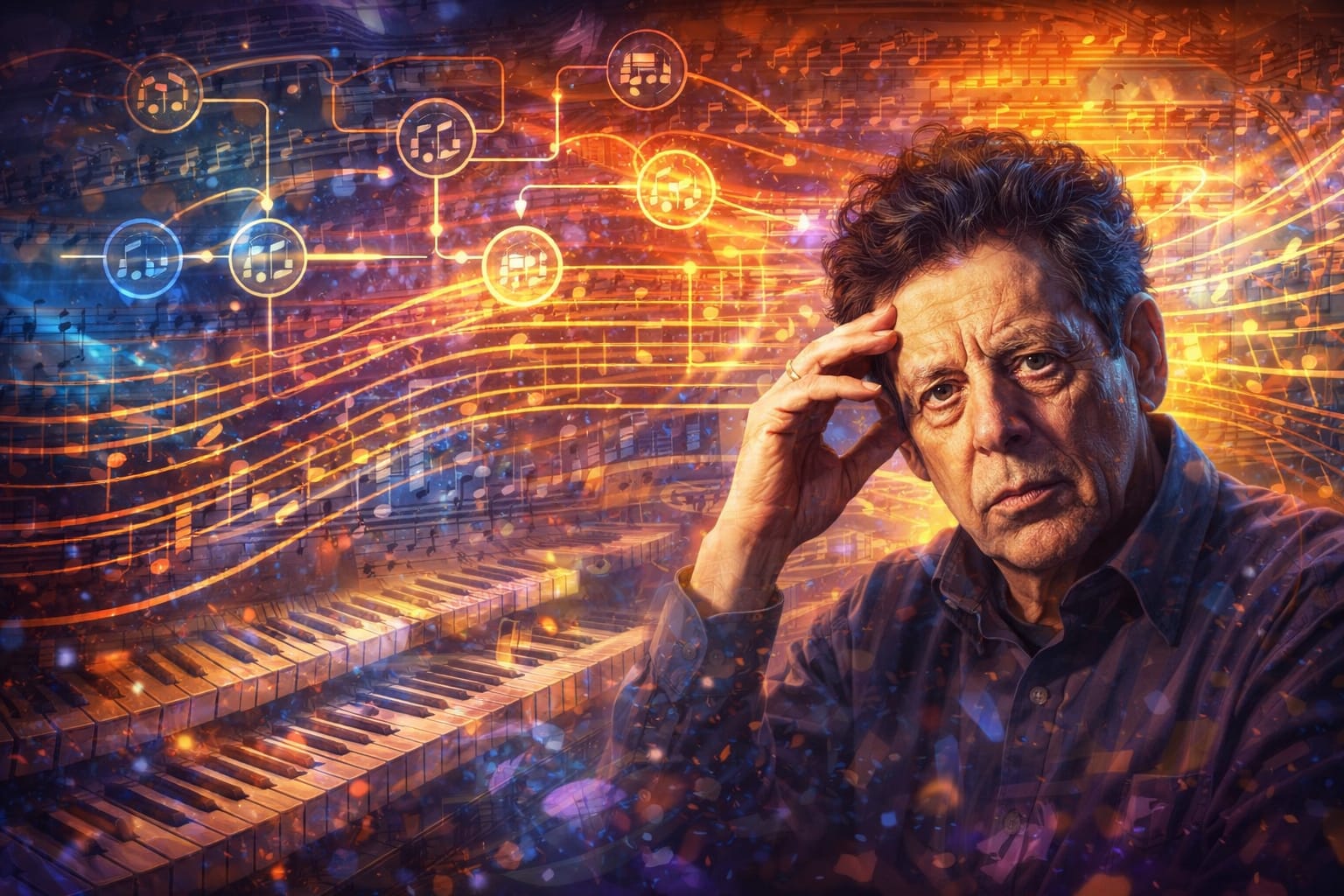
Few composers have shaped contemporary music as profoundly as Philip Glass. His work redefined how we understand musical development, shifting the focus from melody and harmonic progression to process, repetition, and perception.
For composers working today—especially in cinematic, neoclassical, and textural music—his influence is both unavoidable and deeply practical.
Repetition as a Structural Tool
One of the most distinctive aspects of Philip Glass composition technique is his use of repetition. But this is not simple looping.
Instead, repetition becomes a structural mechanism:
- small patterns are repeated
- slight variations are introduced
- changes accumulate gradually
The listener does not follow a narrative in the traditional sense. Instead, they experience transformation over time.
This approach shifts the role of the composer:
- from “telling a story”
- to designing a system that evolves
Additive Process and Musical Growth
Glass often builds material using what is known as an additive process:
- a short motif is introduced
- notes are gradually added or reconfigured
- the pattern expands without losing identity
This creates a sense of continuity where:
- nothing abruptly changes
- but everything slowly transforms
For composers, this is a powerful alternative to traditional thematic development.
Harmony Beyond Function
Although often perceived as tonal, Glass’s harmonic language is not driven by classical functional harmony.
Instead:
- harmony acts as a static or slowly shifting field
- chords are sustained or looped
- movement comes from rhythm and pattern, not resolution
This approach allows music to feel:
- stable, yet evolving
- grounded, yet open
Rhythm as Perception
In Glass’s music, rhythm is not just a pulse—it is the primary driver of perception.
Through:
- constant subdivision
- interlocking patterns
- subtle displacement
the listener perceives motion even when harmony remains static.
This idea is central to many contemporary compositional approaches, especially those focused on texture and flow rather than direction.
Influence on Contemporary Composition
Glass’s influence extends far beyond minimalism. His ideas are present in:
- film music
- neoclassical composition
- ambient and electronic music
- textural orchestral writing
Many composers today adopt:
- repetition as structure
- pattern-based development
- harmonic stasis
while adapting these ideas to new contexts.
Connecting These Ideas to My Own Music
In my own compositions, similar principles often appear—but with a different emphasis.
Rather than using repetition to create a continuous harmonic flow, I tend to:
- fragment patterns across instruments
- distribute rhythmic cells instead of centralizing them
- use harmony as color rather than as a stable field
For example:
- in Stained Glass, repetitive rhythmic cells are constantly redistributed across the ensemble, creating a kaleidoscopic texture rather than a linear process
- in Hourglass, repetition creates a sense of circular time, where small variations alter perception without clear progression
In this sense, the influence is not direct imitation, but a shared approach to composition as process.
Repetition vs. Development
A key distinction emerges when comparing traditional composition with process-based approaches:
- Traditional: development through contrast and resolution
- Process-based: transformation through continuity and variation
Glass’s work demonstrates that music does not need:
- dramatic contrasts
- strong cadences
- clear tonal goals
to remain engaging.
Instead, interest can arise from how material changes over time.
Why This Matters Today
In a context where listeners are exposed to a wide range of musical languages, process-based composition offers:
- clarity
- coherence
- a strong identity
It allows composers to build music that is:
- immersive rather than narrative
- perceptual rather than structural
- evolving rather than goal-oriented
Final Thought
Philip Glass’s music is not about what happens next—it is about how what is happening changes over time.
For composers, this represents a fundamental shift:
from writing music as a sequence of events
to designing systems of transformation.
Understanding this approach opens the door to new ways of composing—where repetition, variation, and perception become the core of the musical experience.
If you would like more information on these topics, explore the following related posts: