
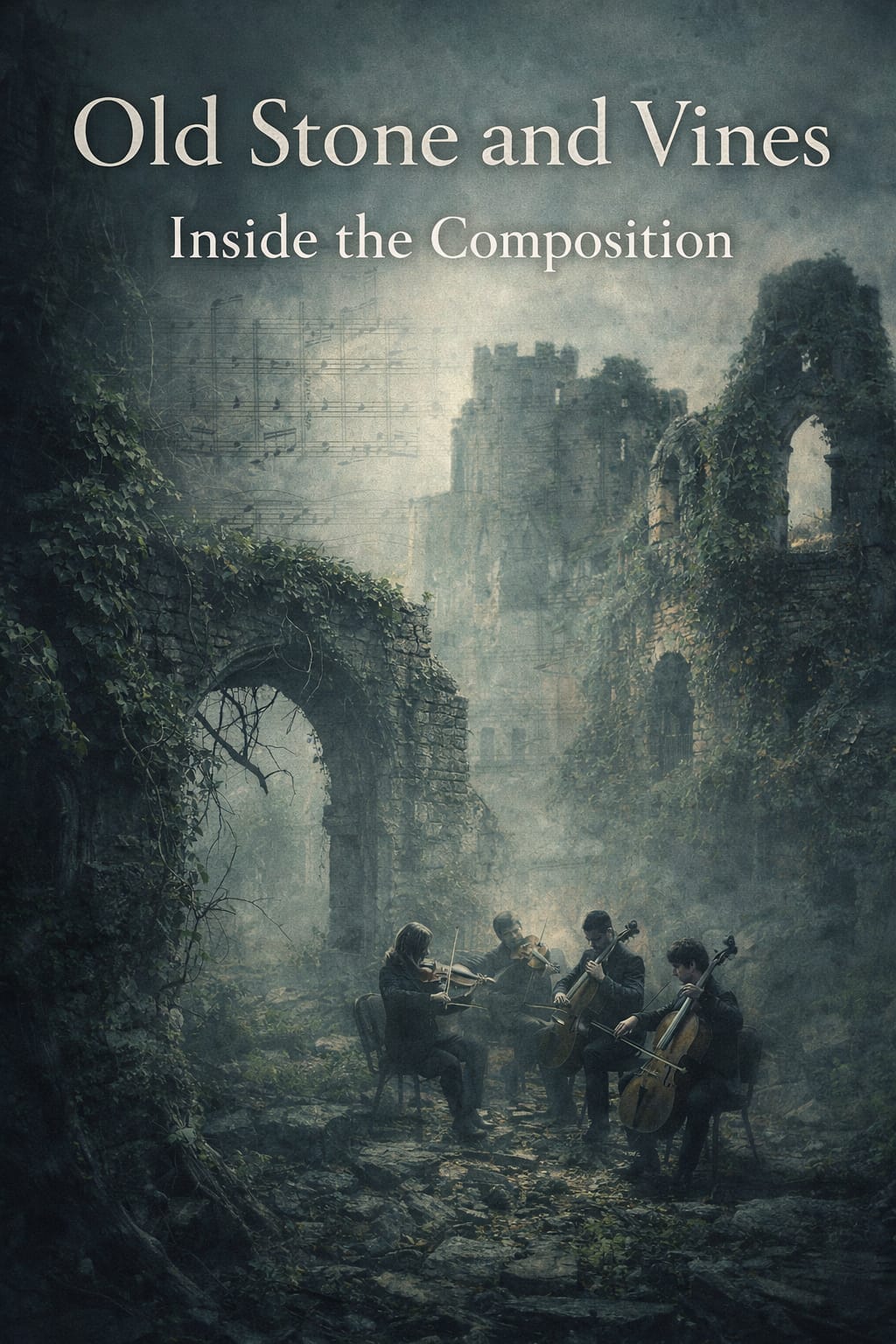
Orchestral composition process
I tried to remove harmonic direction completely. But every progression I wrote kept pulling the music forward.
The challenge in Old Stone and Vines was not how to move — but how to avoid moving, while still changing.
Part of the album Forgotten Castle, the piece reflects the present state of the castle: silent, eroded, and slowly reclaimed by nature.
Instead of depicting activity or history, the focus is on what remains — fragments, stillness, and transformation.
Listen while reading:
The Problem I Faced
Every time I used even a simple progression, the music immediately created expectation.
Even subtle harmonic movement introduced:
- tension
- direction
- a sense of arrival
That completely broke the atmosphere.
I didn’t want the listener to feel where the music was going — I wanted them to feel that it wasn’t going anywhere.
The real problem was:
how to keep harmonic change without creating functional meaning.
The Core Idea
The piece is built around harmonic transformation instead of functional progression.
Rather than moving toward a goal, the harmony shifts gradually, creating continuity without resolution. The underlying system is influenced by neo-Riemannian relationships, where chords are connected through minimal changes rather than tonal function.
This allows the music to feel alive, but not directional.
The Harmonic Language
From the opening bars, the harmonic sequence establishes this approach:
Cm → Ab/C → Fm7/Eb → Dm → Csus → Cm → Gm → F
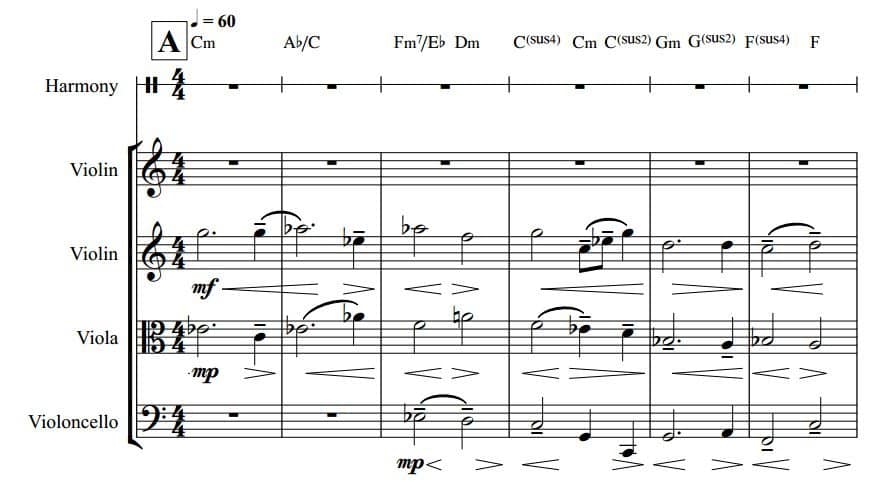
What mattered here was not the chords themselves, but how little they needed to change. I deliberately avoided:
- dominant relationships
- functional cadences
- strong root motion
Instead, I focused on:
- keeping common tones between chords
- moving voices by the smallest possible intervals
- allowing chords to “slide” into each other
At one point, I tried reinforcing the progression with a clearer bass movement — it immediately created direction, so I removed it.
The final result is a harmonic field where:
- change is constant
- but nothing feels like it is leading anywhere.
Rhythm and Time
The piece begins at a slow tempo (♩ = 60)
Rhythm is deliberately understated:
- long note values dominate
- there is no persistent pulse driving the music
- silence and sustain play a structural role
This creates a suspended sense of time, reinforcing the contemplative character.
In contrast, a later section introduces a faster tempo (♩ = 120), but without becoming rhythmically dominant. The change acts more as contrast than as propulsion.
Texture and Orchestration
The piece is written for string quartet, but I avoided treating it as four independent voices.
Early versions had clearer roles — melody, accompaniment, bass — but that created hierarchy and direction.
So I removed that distinction.
Instead, I approached the quartet as a single evolving texture:
- the viola and second violin handle most of the internal movement
- upper voices sustain tones to blur harmonic definition
- the cello avoids reinforcing roots consistently
I tested stronger bass grounding in several passages — each time, the harmony started to feel functional, so I reduced it.
Articulation changes (like pizzicato in later sections of the score) are used carefully, not to add rhythm, but to slightly redefine the texture without breaking the stillness.
Development
The piece does not develop through themes, but through continuous transformation.
As it progresses:
- harmonic material reappears in altered contexts
- register and spacing change the perception of the same chords
- texture becomes slightly denser or thinner
The faster central section introduces fragmentation, but the underlying harmonic logic remains intact.
When the opening material returns (A1), it is perceived differently — less as a beginning and more as a residue.
Structural Design
The structure follows a simple but effective arc:
Initial section (A) — slow harmonic transformations, establishing atmosphere
Contrast section (B) — increased tempo and more fragmented gestures
Return (A1) — original material, now perceived as decay
Closing — gradual dissolution of texture
Rather than building toward a climax, the piece maintains a controlled dynamic range and focuses on continuity.
Compositional Approach
In this piece, I focused on:
- avoiding functional harmony
- using minimal voice-leading as a structural tool
- creating motion through texture instead of rhythm
- maintaining a consistent atmosphere throughout
The goal was to remove direction while preserving change.
Compositional Techniques in Old Stone and Vines
This piece is based on neo-Riemannian harmonic transformations, where chords are connected through shared tones and minimal pitch displacement rather than tonal hierarchy. Combined with slow tempi, sustained textures, and subtle orchestration shifts, this creates a static yet evolving musical environment typical of contemplative cinematic and post-tonal writing.
Final Thought
Old Stone and Vines is built on a contradiction: constant harmonic change without real movement.
By removing functional relationships and reducing directional cues, the music no longer progresses — it transforms in place.
What remains is not development, but persistence: a structure that still exists, even after its function has disappeared.