
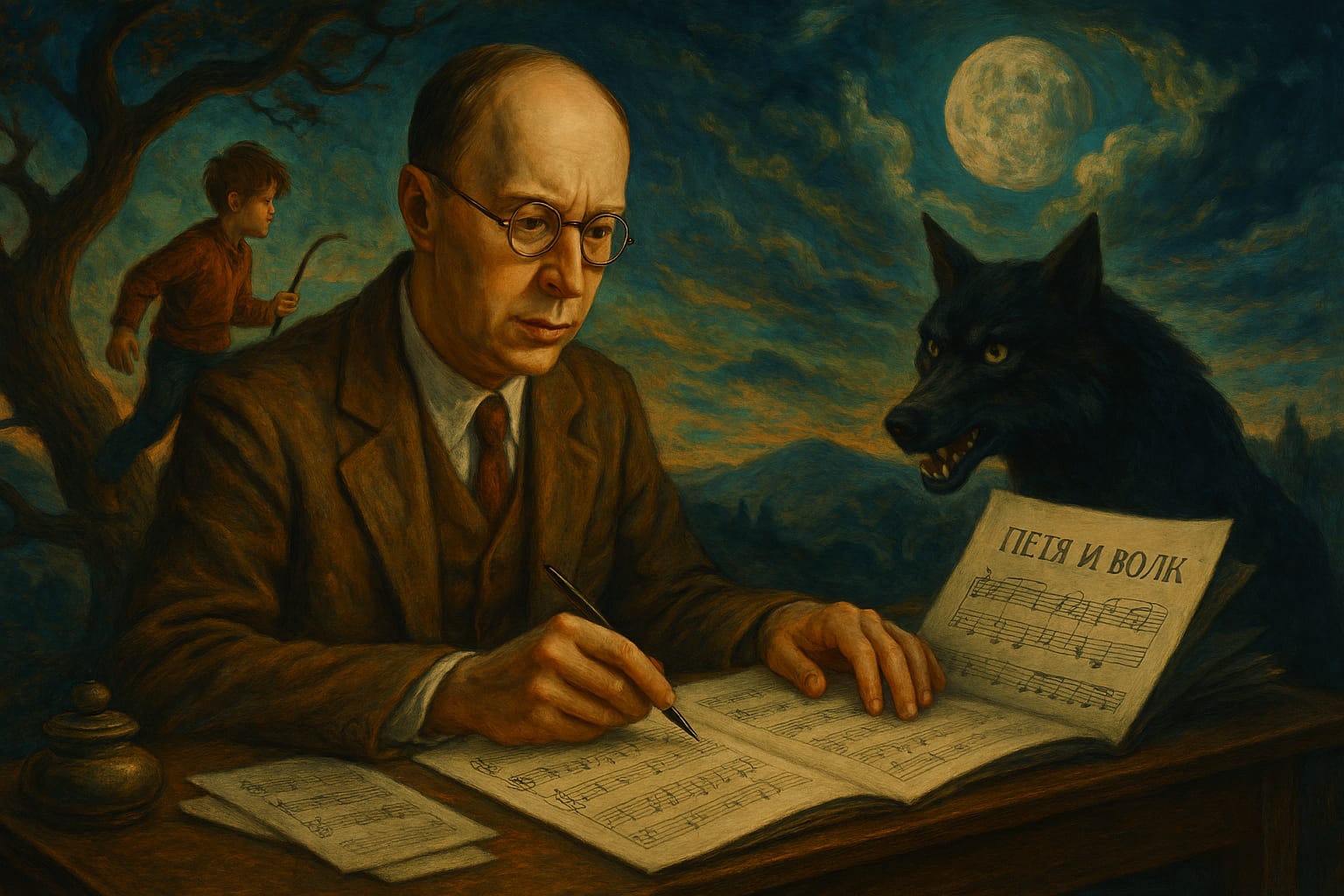
The Narrative Power of Peter and the Wolf
How can music tell a story without words?
Sergei Prokofiev answered this question masterfully in Peter and the Wolf, where each instrument becomes a character and each motif drives the narrative forward.
This approach to musical storytelling is not only a hallmark of early 20th-century composition — it remains one of the foundations of modern cinematic music.
Sergei Prokofiev’s composition, Peter and the Wolf, stands as a remarkable example of program music, where the orchestra serves as the storyteller, conveying narrative depth through a rich interplay of sounds and characters. In this piece, each character is represented by a specific instrument, cleverly chosen to embody their personality and role within the story. For instance, Peter himself is depicted by the string instruments, embodying his bold and adventurous spirit, while the bird is represented by the flute, illustrating a sense of lightness and freedom.
The wolf, a crucial antagonist in the tale, is characterized by the menace of the French horns, with their low, growling tones creating an atmosphere of tension and fear. This orchestration method not only highlights the individuality of each character but also enables listeners to follow the narrative arc with ease, making the experience engaging for audiences of all ages.
Prokofiev’s innovative use of thematic motifs plays a significant role in enhancing the narrative structure of Peter and the Wolf. Each character’s theme is introduced clearly at the beginning of the piece, allowing listeners to associate specific melodies with particular actions and developments in the story. This technique fosters a deeper understanding of the plot, as the audience can anticipate characters’ movements and intentions through their musical representations.
Additionally, the combination of narration and music in this work culminates in a captivating experience. As the narrator articulates the story, the music underscores the emotional landscape of the narrative, weaving together moments of joy, fear, and resolution. The integration of these elements results in a harmonious synergy that not only tells a story but also evokes profound emotional responses from the listener, ensuring that Peter and the Wolf remains a timeless classic in the realm of musical storytelling.
Quick connection to my work
I explore similar storytelling techniques in my own compositions, where musical motifs represent emotional states and narrative progression. You can listen to some of these pieces here:
Prokofiev’s Techniques and Their Impact on the Audience
Sergei Prokofiev’s ‘Peter and the Wolf’ is a quintessential example of musical storytelling, utilizing a range of compositional techniques that significantly enhance its emotional impact on the audience. Primarily, Prokofiev employs orchestration to represent each character through distinct instruments, thereby allowing listeners to identify and connect with the narrative on a deeper level. For example, the bird is characterized by the flutes, the duck by the oboe, and the wolf by the French horns, each selection fostering an auditory image that aligns with the nature of the characters.
The use of melody in ‘Peter and the Wolf’ serves as a powerful tool for conveying moods and intentions. Prokofiev crafts memorable motifs that correspond to each figure in the story, creating a musical lexicon that echoes throughout the piece. This melodic differentiation not only aids in storytelling but also evokes specific emotional responses from the listener. The cheerful theme associated with Peter contrasts starkly with the menacing motif of the wolf, infusing the narrative with a palpable tension that captivates the audience.
Rhythm, too, plays a pivotal role in Prokofiev’s work. The varied rhythmic patterns contribute to the pacing of the story, enhancing moments of action or introspection. For instance, lively rhythms during scenes of adventure juxtapose with softer, slower tempos that reflect moments of fear or contemplation. This careful manipulation of tempo and rhythm not only keeps listeners engaged but also guides them through the unfolding drama.
Through these carefully crafted techniques, Prokofiev constructs an auditory experience that resonates emotionally with audiences, making ‘Peter and the Wolf’ a timeless piece that continues to captivate listeners across generations. The integration of orchestration, melody, and rhythm invites audiences into a vivid narrative universe, where music speaks as eloquently as words.
A practical way to explore this narrative technique is to assign each instrument a short thematic motif and let them interact as characters.
Connecting Prokofiev to My Own Works
Prokofiev’s Peter and the Wolf is a masterclass in musical storytelling, where each instrument represents a character and drives the narrative. This approach has strongly influenced my own compositional work.
In Gateway, I develop themes that evolve across sections, reflecting an internal emotional journey. Each motif acts as a narrative element, guiding the listener through changing states.
In Forgotten Castle, I focus on atmosphere and orchestral texture, building a sense of place through gradual musical transformation.
In Urban Nightlife Stories, I explore rhythm and motif to represent urban movement and contemporary life.
Across these works, I apply storytelling techniques inspired by Prokofiev, using musical structure to create narrative meaning.
👉 Listen here: https://pilpilmusic.com/category/album-releases/
The Legacy of Program Music in Today’s Composition
Prokofiev’s ‘Peter and the Wolf’ exemplifies the enduring influence of program music, which intertwines narrative and musical expression to create immersive experiences. This art form transcends mere melodies by establishing a narrative framework that resonates deeply with listeners. Contemporary composers often draw inspiration from such techniques to craft compelling stories within their scores, reflecting the universal human experience through sound.
In examining Prokofiev’s legacy, it becomes evident that the elements of storytelling he masterfully integrates in his compositions remain vital to the evolution of music today. Modern compositions frequently leverage thematic development and character motifs, mirroring the intentional structures established by Prokofiev. The ability to depict characters or emotions through distinct musical ideas serves not only to engage the audience but also to create memorable auditory narratives.
Furthermore, today’s composers can learn from Prokofiev’s approach to juxtaposition and dynamic shifts in mood to maintain listener interest. By employing contrasting musical styles or instrumentation, contemporary works can invoke a wide array of emotions, further enriching the storytelling aspect of the music. The challenge, however, lies in balancing these elements with innovation, seeking to capture the attention of a diverse audience in an age where competition for engagement is ever-increasing.
As the realm of program music continues to evolve, composers are encouraged to embrace their unique perspectives while integrating established techniques. This synthesis not only honors the foundations laid by predecessors like Prokofiev but also propels the genre forward, inviting listeners into new and exciting narratives woven through sound.
If you want further insights into orchestration and compositional approaches, explore these related techniques and musical analyses: