
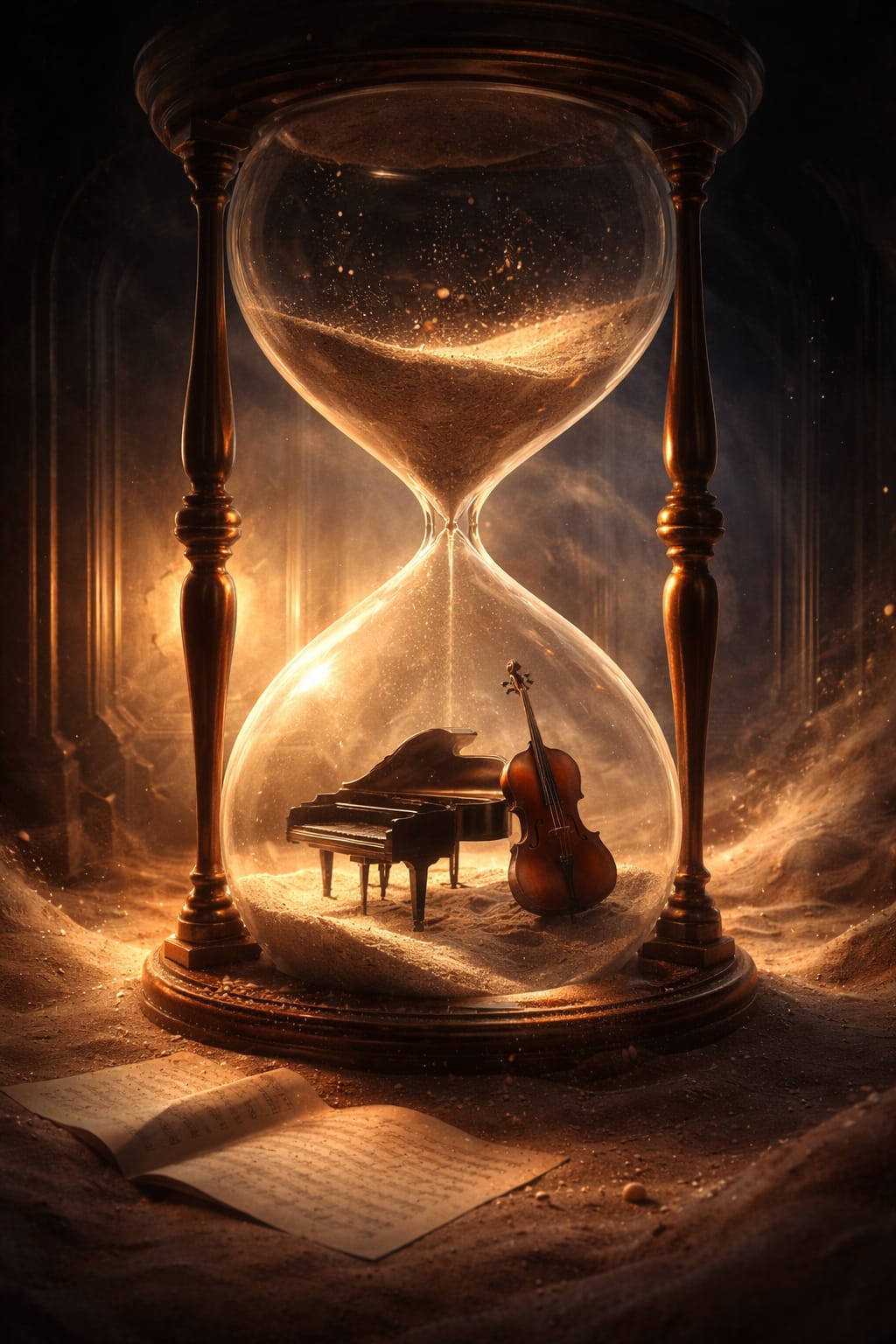
Hourglass is built around a simple idea: time that doesn’t move forward, but loops endlessly. Instead of a clear beginning and destination, the piece explores repetition, subtle change, and suspended motion—like sand continuously falling inside an hourglass.
- Hourglass (Piano & cello version – 2021), focused on intimacy and chamber interaction
- Houglass (Strings version – 2022), expanding the harmonic texture and dynamic range
The Core Idea
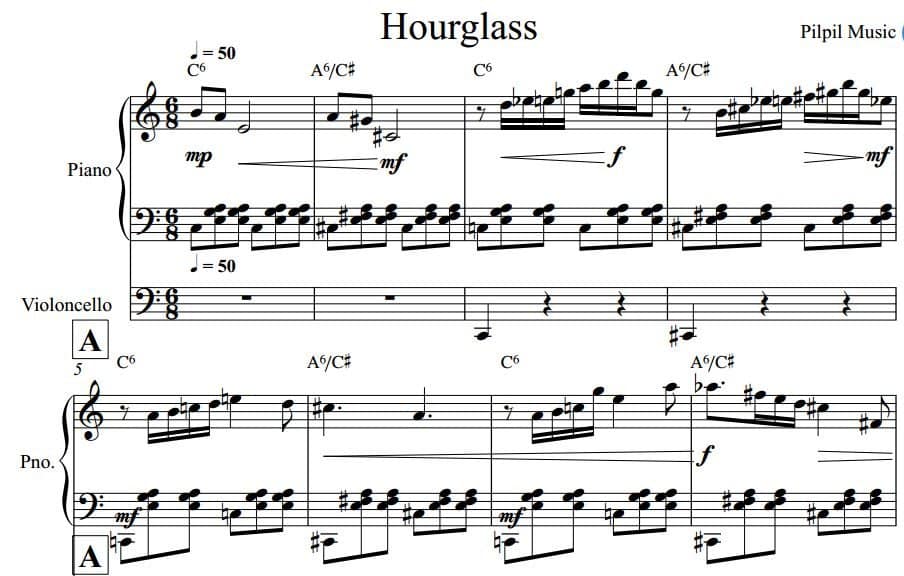
From the very first bars, the piano establishes a continuous ostinato in 6/8. This pattern remains almost unchanged throughout the piece, creating a sense of mechanical continuity. Rather than driving the music forward, it keeps it in place.
The goal was not progression, but perception—how small variations can alter the listener’s sense of time.
Building the Piece
The entire structure grows from this initial pattern:
- The left hand maintains a harmonic loop
- The right hand introduces fragmented melodic gestures
- The harmony shifts in color rather than function
Chords such as C6, A6/C#, Bm7, and C(add6/9) are used not for resolution, but for atmospheric transformation. Even moments of tension, like Dø7 or G7(#5), do not resolve in a traditional sense—they simply redirect the flow.
Structure
The piece follows a clear but restrained form:
- A — Introduction of the core texture
- A1 — Variation with subtle harmonic and dynamic changes
- B — Increased movement and contrast
- A2 — Return with altered balance and reduced intensity
Each section reuses the same material, but shifts its weight slightly. The structure is less about contrast and more about reframing repetition.
The Role of the Cello
The cello enters as a contrast to the piano’s mechanical nature.
- It introduces longer, more expressive lines
- It reacts rather than leads
- In the central section, it shifts to pizzicato, adding rhythmic definition
This creates a dialogue between:
- mechanical time (piano)
- human expression (cello)
The Central Shift
The B section briefly breaks the static atmosphere:
- Increased rhythmic density
- More active interaction between instruments
- Stronger dynamic presence
However, this is not a true climax. It functions as a disturbance within the loop, not an escape from it.
Compositional Approach
In this piece, I deliberately avoided:
- strong cadences
- clear tonal goals
- large structural contrasts
Instead, I focused on:
- sustained tension
- minimal variation
- harmonic color over function
The result is a controlled, circular system where nothing fully resolves. The harmonic language avoids functional resolution, relying instead on modal interchange and color-based transitions.
Final Thought
Hourglass is less about development and more about perception. Through repetition and subtle variation, the piece invites the listener to experience time not as a line, but as a loop—constant, shifting, and unresolved.
Listen to the full piece and explore the albums Piano & cello colors and Tied strings to hear how this compositional approach develops across different works.
If you would like more information on these topics, explore the following related posts: