
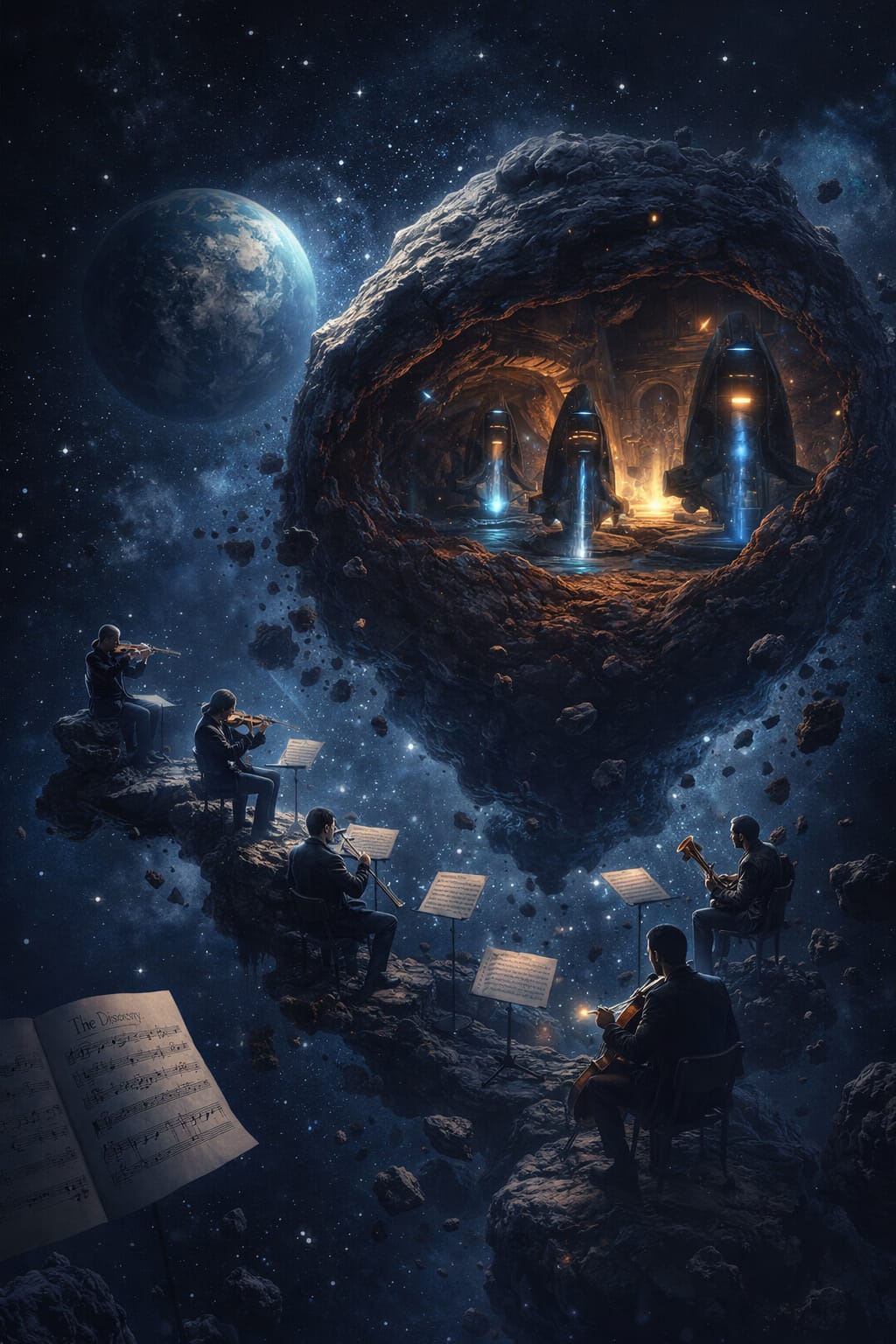
The Discovery opens the album Gateway, a Psychological Introspection and represents a decisive moment: the encounter with the unknown. Inspired by the novel Gateway by Frederik Pohl, the piece reflects the discovery of an asteroid containing alien transportation technology—something both fascinating and deeply unsettling.
The Core Idea
This piece is built around instability and tension. From the beginning, the music avoids any sense of grounding, creating an atmosphere of uncertainty.
The choice of a 7/8 time signature is central to this effect. Instead of a predictable pulse, the rhythm constantly feels slightly off-balance, reinforcing the idea of entering unfamiliar territory.
Building the Texture
The work is written for a pocket orchestra, using a single instrument per section rather than full orchestral groups. This creates:
- transparency in texture
- clarity in individual lines
- a sense of isolation between instruments
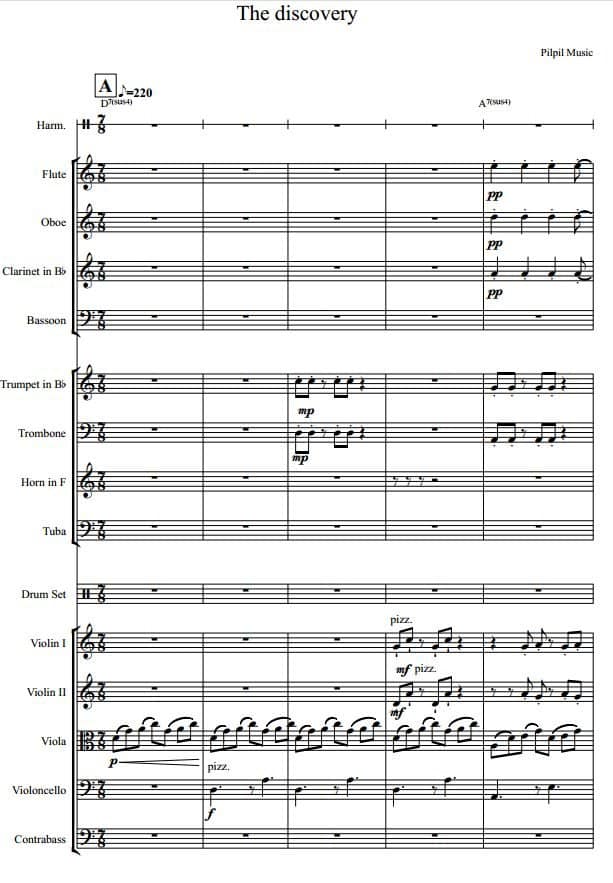
At the opening, most instruments remain silent while small gestures begin to appear, gradually constructing the sonic space. As seen in the first page of the score, the material emerges sparsely, with isolated entries and soft dynamics (pp–mp), rather than a full orchestral statement .
Rhythmic Language
The rhythmic identity of the piece is defined by repetitive asymmetric patterns.
Short motifs are distributed across the ensemble, often displaced between instruments. This creates:
- a fragmented perception of rhythm
- a continuous but unstable flow
- a sense of mechanical behavior without regularity
Rather than driving forward, rhythm here functions as a field of tension.
Harmonic Approach
The harmonic language is deliberately ambiguous.
The piece revolves around suspended sonorities such as D7(sus4) and A7(sus4), which appear early in the score . These chords avoid clear resolution, maintaining a constant state of expectation.
Later sections introduce shifts (e.g., G7(sus4), extended harmonic colors), but always without establishing a stable tonal center. Harmony is used as color and pressure, not direction.
Development and Contrast
As the piece progresses, density increases:
- more instruments enter
- articulation becomes more defined (including pizzicato in strings)
- dynamics expand toward stronger contrasts
In central sections, the texture becomes more active and rhythmically insistent, with repeated accented figures across multiple instruments. This creates a collective mechanical motion, as if the system discovered is beginning to operate.
Structural Design
The piece follows a process-based structure rather than a traditional form:
- Initial state — sparse, exploratory, undefined
- Activation — rhythmic and textural accumulation
- System behavior — repetitive, mechanical interaction
- Dissolution — reduction and loss of energy
This trajectory reflects the narrative: discovery, interaction, and the realization that the system operates beyond human control.
Compositional Approach
In this piece, I focused on:
- asymmetric rhythm (7/8) as a structural driver
- non-resolving harmonic fields
- distributed motifs across instruments
- gradual textural accumulation
Rather than thematic development, the piece evolves through density, interaction, and instability.
The absence of a clear tonal center reinforces the psychological uncertainty that defines the piece.
Compositional Techniques in The Discovery
This work combines asymmetric meter with a loop-based distribution of short motifs across a chamber ensemble. The use of suspended dominant chords and non-functional harmony places it within contemporary cinematic and neoclassical composition, where rhythm and texture shape the musical narrative more than traditional tonal progression.
Final Thought
The Discovery is not about understanding the unknown, but about encountering it. Through irregular rhythm, fragmented texture, and harmonic suspension, the piece captures the moment when curiosity turns into unease—when discovery reveals something far more complex than expected.
Listen to The Discovery and explore the full album Gateway, a Psychological Introspection to experience how this idea unfolds across the entire work.
If you would like more information on these topics, explore the following related posts: