How do you translate light into music?
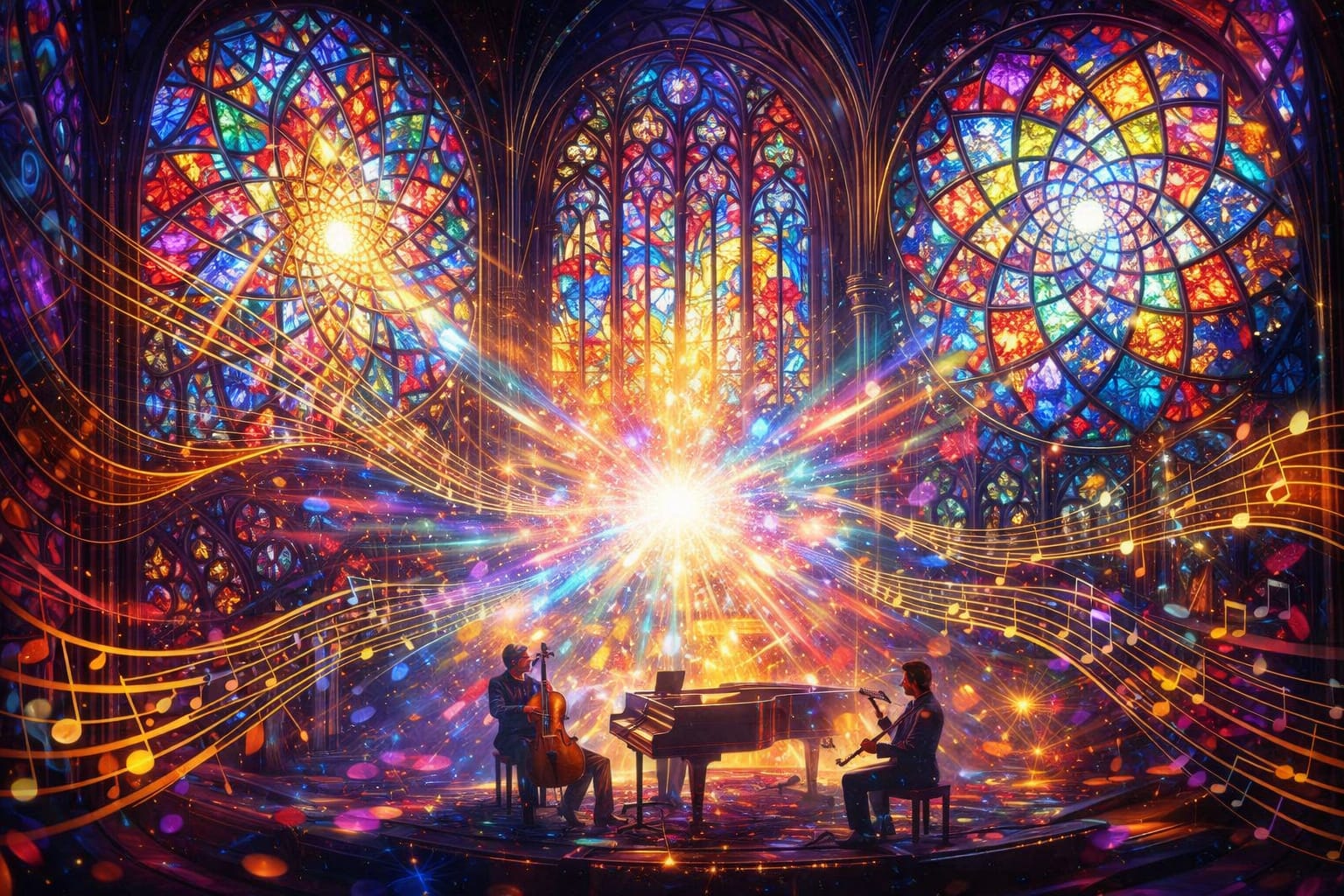
Stained Glass is built as a constantly shifting texture, where rhythm and harmony behave like fragments of colored light. It explores a visual idea translated into sound: the experience of looking at stained glass windows from inside a church. Light passes through shifting colors and shapes, constantly transforming—never static, always evolving.
This piece attempts to capture that sensation through rapid rhythmic motion, harmonic color, and continuous variation.
Two versions of the piece are available:
- Piano, cello & clarinet (Volume 9)
- Woodwind ensemble (Woodwinds Blowing)
Listen while reading. See 2 versions above (Piano, cello & clarinet – Woodwind chamber)
The Core Idea
The piece is built around motion without stability.
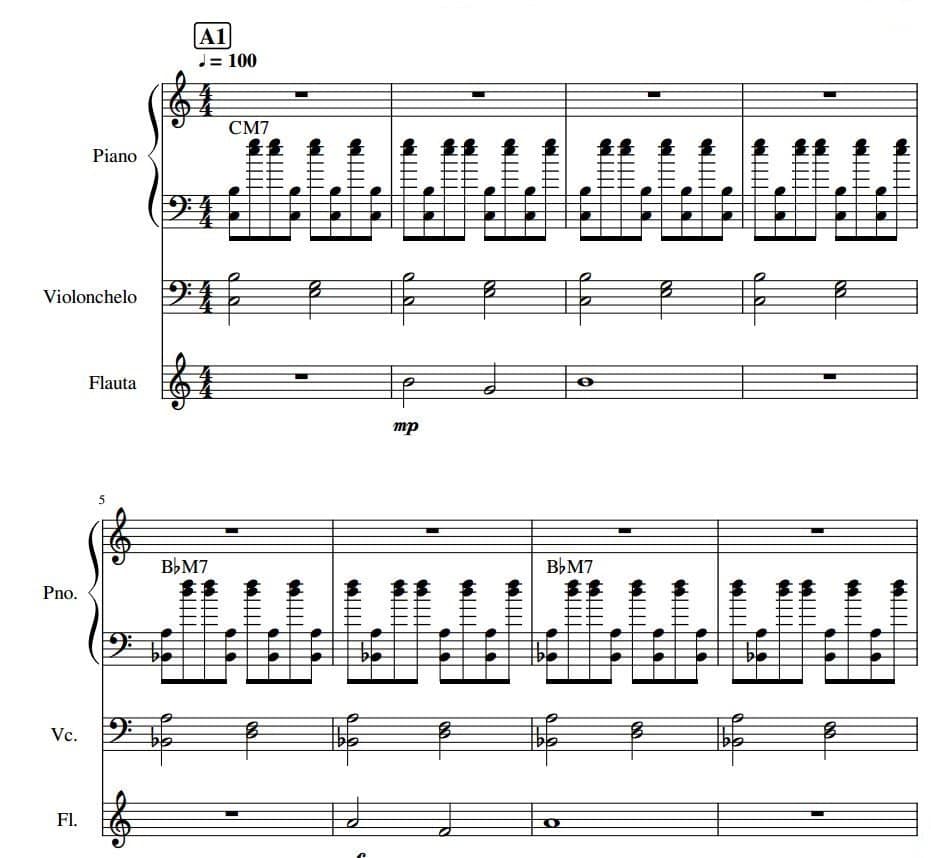
From the very beginning, small rhythmic cells are repeated and slightly varied across the ensemble, creating a constantly shifting surface. As seen in the opening bars of the score , short articulated figures appear in flutes and oboes while the bassoons provide a soft harmonic base.
Rather than presenting a theme, the music establishes a textural mechanism.
Rhythmic Language
The defining element of Stained Glass is its persistent rhythmic activity.
- short, repeated motifs
- continuous subdivision
- subtle displacement between voices
These figures act like fragments of light:
- never identical
- constantly recombined
- always in motion
The result is a kaleidoscopic texture, where rhythm becomes the primary driver of perception.
Harmonic Color
Harmony functions as light filtering through color.
The piece moves through sonorities such as:
- B♭maj7
- E♭m7
- Dm7
(as seen in early sections of the score )
These chords are not used for functional progression, but for color transformation. Each harmonic shift subtly changes the “tint” of the texture without interrupting the flow.
Texture and Orchestration
This piece exists in two versions:
Despite the different instrumentation, the compositional approach remains the same: distributed motion.
In the woodwind version:
- rapid figures are shared between flutes and oboes
- clarinet often acts as a connecting voice
- bassoons provide harmonic grounding
In the chamber version:
- the piano absorbs much of the rhythmic activity
- cello and clarinet sustain and reshape the texture
The key idea is not the instrument itself, but the circulation of motion across the ensemble.
Development
As the piece progresses, density increases:
- more voices participate simultaneously
- rhythmic layers overlap
- harmonic regions shift more frequently
Sections such as A1 and later returns (visible in the score structure ) do not introduce new material, but reframe existing patterns.
This reinforces the idea of looking at the same object from different angles, with constantly changing light.
Structural Design
The structure is based on variation through continuity:
- Initial texture — introduction of rhythmic cells
- Expansion — layering and increased density
- Reframing (A sections) — same material, different balance
- Dissolution — reduction and stabilization
There is no clear contrast in the traditional sense. Instead, the piece evolves through intensity and redistribution.
Compositional Approach
In this piece, I focused on:
- building the entire work from small rhythmic cells
- using harmony as color rather than function
- distributing motion across instruments
- maintaining constant activity without saturation
The goal was not to develop themes, but to create a living texture.
Compositional Techniques in Stained Glass
This piece uses loop-based rhythmic cells combined with non-functional harmonic shifts. The continuous redistribution of short motifs across the ensemble creates a dynamic texture typical of contemporary cinematic and neoclassical composition.
Final Thought
Stained Glass is not about melody or narrative. It is about perception.
Through rapid rhythmic motion and shifting harmonic color, the piece transforms a visual experience into sound: a constantly changing field of light, where no moment is exactly the same as the previous one.
If you want to explore how these ideas translate into sound, listen to the full piece and compare both versions of Stained Glass:
The piece sits stylistically between post-minimalism and contemporary neoclassical composition, where repetitive structures, harmonic color, and textural transformation define the musical language. Its approach to repetition and texture connects with composers such as Philip Glass or John Adams, while maintaining a more fragmented and color-driven orchestral writing.
If you would like more information on these topics, explore the following related posts: