
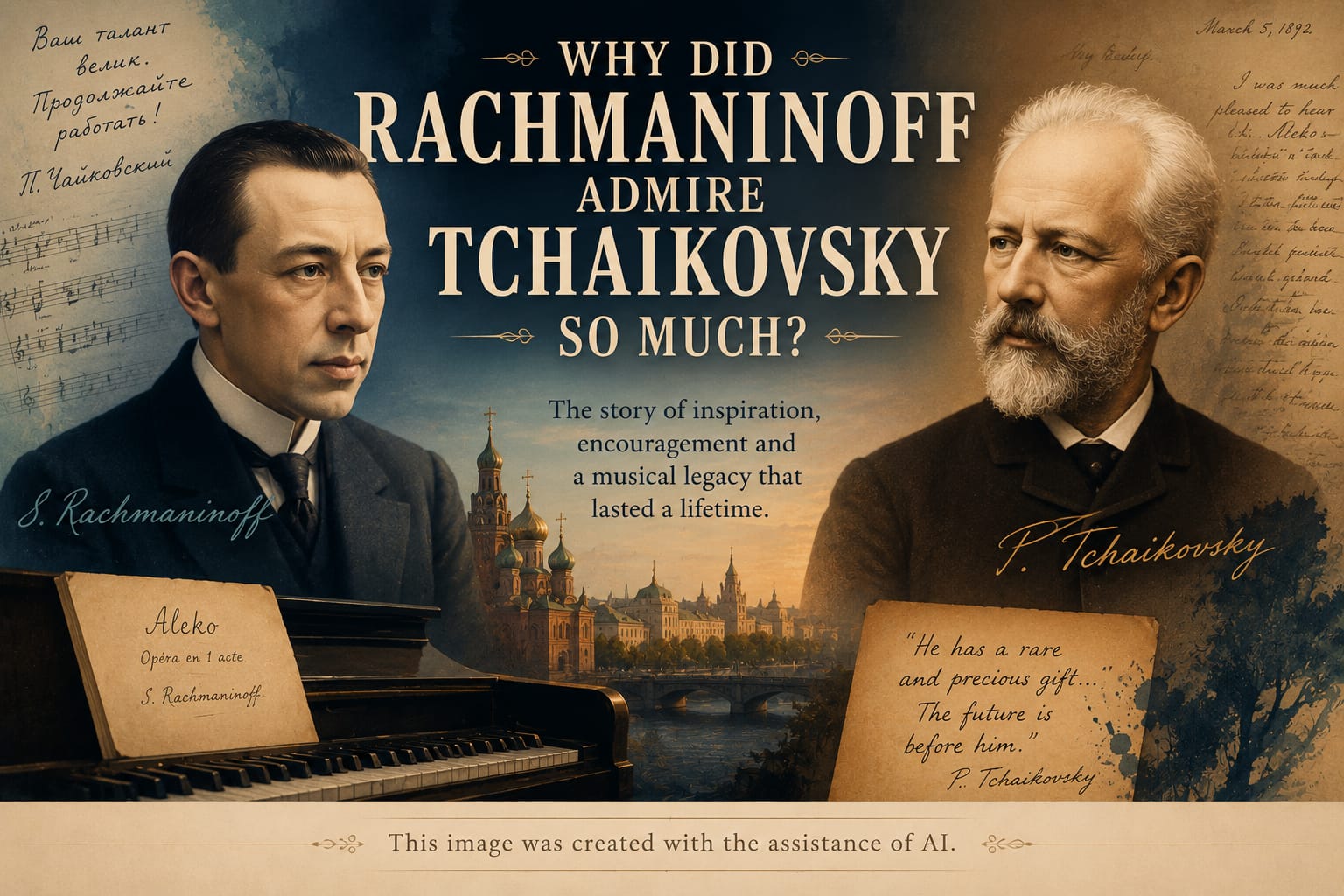
Few composers shaped Sergei Rachmaninoff’s musical life as profoundly as Pyotr Ilyich Tchaikovsky. Although their lives overlapped for only a short time, Tchaikovsky’s encouragement left a lasting impression on the young composer and pianist. Long after Tchaikovsky’s death, Rachmaninoff continued to speak of him with admiration, and traces of his influence can be heard throughout Rachmaninoff’s music.
Unlike many artistic relationships that become clouded by rivalry or disagreement, the connection between Tchaikovsky and Rachmaninoff was built on respect, generosity, and shared musical ideals.
How this influences my own music: Tchaikovsky’s lyrical development and emotional orchestration have influenced several of my own instrumental works, particularly those exploring memory and atmosphere.
Listen to: Faces & Places
Read: How I Compose
A Young Composer Meets His Hero
Sergei Rachmaninoff was born in 1873, when Tchaikovsky was already becoming one of Russia’s leading composers. As a student at the Moscow Conservatory, Rachmaninoff naturally grew up immersed in Tchaikovsky’s music.
For a talented young musician, Tchaikovsky represented everything one could aspire to become: an internationally respected composer whose works combined emotional depth with exceptional craftsmanship.
Meeting him was therefore an unforgettable experience.
Although they were separated by more than thirty years in age, Tchaikovsky treated the young Rachmaninoff with kindness rather than condescension.
The Premiere of Aleko
One of the defining moments came in 1892.
Rachmaninoff completed his one-act opera Aleko as his graduation project at the Moscow Conservatory. The work impressed the faculty so much that it received the institution’s highest distinction—the Great Gold Medal.
Tchaikovsky attended a rehearsal and expressed genuine enthusiasm for the young composer’s achievement.
Even more importantly, he supported the idea that Aleko should receive a professional performance.
For a nineteen-year-old composer, such encouragement from Russia’s most celebrated musician was invaluable.
The opera was successfully premiered at the Bolshoi Theatre later that year, launching Rachmaninoff’s professional career.
Tchaikovsky’s Encouragement
Historical documents suggest that Tchaikovsky viewed Rachmaninoff as one of the most promising composers of the younger generation.
He appreciated the young man’s natural melodic gift and encouraged him to continue composing.
At a time when many established artists were reluctant to support younger colleagues, Tchaikovsky demonstrated remarkable generosity.
This had a profound psychological effect on Rachmaninoff.
Throughout his life, he remained deeply grateful for the confidence that Tchaikovsky had shown in him.
A Sudden Loss
Only one year later, tragedy struck.
In November 1893, Tchaikovsky died unexpectedly at the age of fifty-three.
The news shocked the entire musical world.
For Rachmaninoff, who was only twenty years old, the loss was deeply personal.
He had not simply lost a musical idol.
He had lost a mentor who believed in his talent before the rest of the world fully recognized it.
The Trio élégiaque No. 2
Rachmaninoff’s grief found expression in music.
Soon after Tchaikovsky’s death, he composed the Trio élégiaque No. 2 in D minor, dedicating it “To the Memory of a Great Artist.”
The dedication deliberately echoed Tchaikovsky’s own Piano Trio in A minor, which had been written in memory of Nikolai Rubinstein.
This was far more than a tribute.
It was Rachmaninoff’s way of continuing a musical tradition established by the composer he admired most.
The work remains one of his earliest masterpieces and reveals extraordinary emotional maturity for such a young composer.
Musical Influence
It is easy to hear Tchaikovsky’s influence in Rachmaninoff’s music.
Both composers possessed an exceptional gift for melody.
Their works often unfold in long, singing phrases that resemble the human voice.
Both also shared a remarkable ability to combine lyrical beauty with dramatic intensity.
Yet Rachmaninoff never became an imitator.
Instead, he absorbed Tchaikovsky’s expressive language while gradually developing a distinctive musical personality.
His harmonic vocabulary became richer.
His textures grew more complex.
His piano writing reached unprecedented levels of virtuosity.
But beneath these innovations, listeners can still hear the emotional sincerity that characterized Tchaikovsky’s music.
Similarities Between the Two Composers
Several artistic qualities unite Tchaikovsky and Rachmaninoff.
Both valued emotional honesty over intellectual complexity.
Both believed melody should remain central to musical expression.
Both preferred clear formal structures while allowing emotion to shape the musical narrative.
Perhaps most importantly, both rejected the idea that beautiful music was somehow less sophisticated than experimental music.
This shared philosophy explains why audiences continue to love both composers more than a century after their deaths.
Important Differences
Despite these similarities, their musical languages are clearly distinct.
Tchaikovsky belonged to the late Romantic generation.
His orchestration often emphasizes transparency, elegance, and classical balance.
Rachmaninoff, by contrast, pushed Romantic harmony to its limits.
His works feature denser textures, richer chromaticism, and broader pianistic sonorities.
His music also reflects the influence of Russian Orthodox chant and the darker emotional atmosphere of the early twentieth century.
Rather than copying Tchaikovsky, Rachmaninoff expanded the tradition he inherited.
Carrying the Romantic Tradition Forward
By the beginning of the twentieth century, European music was changing rapidly.
Debussy explored impressionism.
Stravinsky revolutionized rhythm.
Schoenberg abandoned traditional tonality.
Amid these transformations, Rachmaninoff remained committed to the Romantic tradition.
Critics sometimes accused him of being conservative.
Yet he believed artistic sincerity mattered more than fashion.
In many respects, he became the natural successor to Tchaikovsky’s emotional world.
His music preserved the expressive ideals that had inspired him as a student while giving them a uniquely personal voice.
Did Tchaikovsky Influence the Piano Concertos?
Many scholars hear echoes of Tchaikovsky in Rachmaninoff’s famous piano concertos.
The sweeping orchestral introductions, expansive lyrical themes, and dramatic climaxes all reflect a tradition that Tchaikovsky helped define.
However, Rachmaninoff transformed these elements into something unmistakably his own.
His concertos demand extraordinary virtuosity while maintaining an emotional immediacy that continues to captivate audiences worldwide.
The influence is therefore one of inspiration rather than imitation.
Respect That Lasted a Lifetime
Even after leaving Russia following the Revolution of 1917, Rachmaninoff continued performing Tchaikovsky’s music.
He frequently included works by his former mentor in his concert programmes and spoke respectfully about him in interviews.
Unlike many composers who distance themselves from earlier influences, Rachmaninoff openly acknowledged his admiration.
He never viewed this influence as a weakness.
Instead, he regarded it as part of his artistic identity.
The Legacy of Their Relationship
Although Tchaikovsky and Rachmaninoff knew each other for only a short period, their relationship illustrates the importance of encouragement in the arts.
A few words of confidence from an established composer helped strengthen the self-belief of a young musician who would later become one of the greatest composers of the twentieth century.
Without Tchaikovsky’s support, Rachmaninoff would almost certainly still have become an important musician.
Yet that early recognition undoubtedly gave him confidence during the fragile beginning of his career.
If you’re curious how these ideas appear in contemporary music, you may enjoy:
- Silent Frame – transparent string writing
- Night Walk in the Forest – gradual textural development
- Where Did They Go? – motivic transformation
- Gateway – orchestral storytelling
Conclusion
Sergei Rachmaninoff admired Tchaikovsky for many reasons.
He admired him as a composer of extraordinary melodic genius.
He admired him as a generous mentor who encouraged young talent.
And he admired him as the musical figure who showed that emotional sincerity and artistic excellence could coexist.
Their relationship was brief but deeply significant.
Rather than simply inheriting Tchaikovsky’s musical language, Rachmaninoff transformed it into something uniquely his own.
In doing so, he ensured that the Romantic tradition did not end with Tchaikovsky but continued into the twentieth century through one of its greatest champions.
Today, when audiences hear the soaring melodies of Rachmaninoff’s piano concertos or the emotional depth of his symphonic works, they are also hearing the enduring legacy of the composer who first inspired him: Pyotr Ilyich Tchaikovsky.