

Some compositions begin with a clear melodic idea, while others emerge from a more abstract musical gesture. “Night Walk in the Forest” belongs to the latter. The piece, originally composed in 2021 for piano and oboe, started from a rhythmic and harmonic idea that immediately suggested a sense of urgency and movement.
From the very beginning, the goal was to create a musical atmosphere that felt tense, slightly anxious, and in constant motion—like walking alone through a dark forest at night.
This piece is built on a rhythmic-harmonic motif that drives both tension and structural development.
“Night Walk in the Forest” is an example of how instrumental music can create narrative without lyrics.
The Initial Idea: Rhythm and Harmony
As in many of my compositions, the starting point was not a melody but a harmonic progression combined with a rhythmic pattern. This pattern became the core of the piece.
The repetition of this rhythmic-harmonic figure creates a continuous pulse that drives the music forward. It is not aggressive, but it carries a subtle sense of urgency, as if something is pushing the movement ahead.
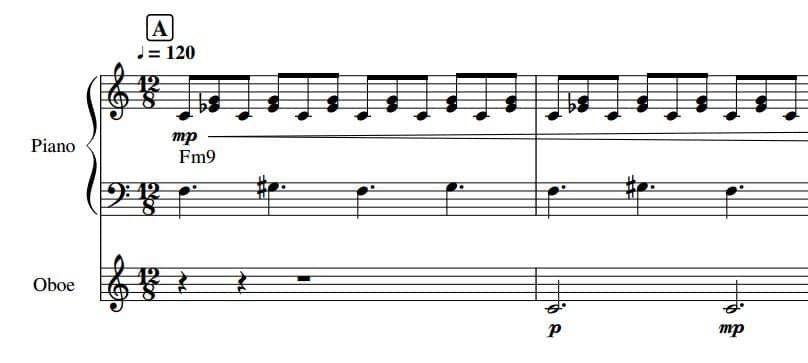
This underlying pattern functions as the foundation of the entire composition. Rather than changing constantly, it evolves gradually, maintaining coherence while allowing space for melodic development.
Building the Melody
Once the harmonic and rhythmic framework was established, the melody began to take shape above it. The idea was to create a melodic line that would contrast with the repetitive motion of the accompaniment while still being closely connected to it.
The melody unfolds in a fluid and expressive way, but it never completely escapes the tension created by the harmonic base. Instead, it moves within that framework, reinforcing the atmosphere of unease and forward motion.
This relationship between repetition and melodic development is central to the identity of the piece.
This approach is common in instrumental composition, where repetition and harmony define the musical structure.
A Clear Structure: ABA Form
Structurally, Night Walk in the Forest follows a clear ABA form.
- The A section introduces the main rhythmic-harmonic pattern and the primary melodic material. It establishes the atmosphere of tension and movement.
- The B section provides contrast. While it maintains some of the underlying characteristics, it explores different harmonic colors and slightly alters the intensity of the music.
- The return to the A section reinforces the original idea, bringing the piece back to its initial atmosphere.
This structure helps organize the musical narrative while keeping the listener oriented within the piece.
The First Version: Piano and Oboe
The original version for piano and oboe defines much of the character of the work. The piano provides the rhythmic and harmonic foundation, maintaining the continuous pulse that drives the piece forward.
The oboe, on the other hand, carries the melody. Its timbre plays a crucial role in shaping the atmosphere.
The oboe has a distinctive sound that can feel both expressive and slightly fragile. In this context, it contributes to a colder and darker sonic environment. The melodic line, when played by the oboe, acquires a certain distance and tension that reinforces the idea of solitude within the forest.
The contrast between the steady motion of the piano and the expressive line of the oboe creates a sense of dialogue, even though the overall mood remains introspective. Besides, contrast between piano and oboe creates a clear separation between rhythmic structure and melodic expression.
The String Quartet Version
In 2022, the piece was reworked and included in the album Tied Strings in a version for string quartet.
This adaptation required more than a simple transfer of material. The goal was to preserve the identity of the piece while exploring the expressive possibilities of a completely different ensemble.
In the string quartet version, the musical material is distributed among four instruments, allowing for greater flexibility in texture and articulation.
A Different Emotional Perspective
One of the most interesting aspects of this transformation is the change in emotional character.
While the original version with oboe creates a colder and more distant atmosphere, the string quartet version introduces a wider range of expressive nuances. Strings are capable of continuous dynamic shaping and subtle articulation changes, which allows the music to breathe in a different way.
The tension is still present, but it becomes more fluid and less sharply defined. The sound is generally warmer, even when the music remains dramatic.
The Role of Articulation in Strings
The string quartet version also benefits from the variety of articulations available to string instruments.
Techniques such as:
- legato
- staccato
- subtle dynamic shaping
- bow pressure variations
allow the same musical material to be presented with greater detail and variation.
These articulations enrich the texture and provide additional layers of expression that are not as easily achievable in the original piano and oboe version.
Maintaining the Core Identity
Despite these differences, the essential identity of “Night Walk in the Forest” remains unchanged across both versions.
The rhythmic-harmonic pattern continues to drive the music, and the ABA structure provides a clear framework for the piece. The melody retains its role as a contrasting yet integrated element within the texture.
What changes is not the musical idea itself, but the way it is expressed through different instrumental colors.
Final Thoughts
“Night Walk in the Forest” is an example of how a simple musical idea—a repeated harmonic and rhythmic pattern—can generate a complete composition.
By building the piece from this foundation, adding a melodic layer, and organizing the material into a clear structure, the music develops a strong internal coherence.
The existence of two different versions of the piece also highlights how instrumentation can significantly influence the emotional perception of the same musical material.
In both cases, the piece aims to evoke a sense of movement, tension, and introspection, inviting the listener to imagine a quiet but uneasy walk through a dark forest.
This composition process reflects my approach to writing instrumental music based on harmony, structure, and texture.
If you would like more information on these topics, explore the following related posts: