
Turning the slow movement of jellyfish into a string quintet
Some musical ideas begin with a story, a person or a specific place. Others begin with an image.
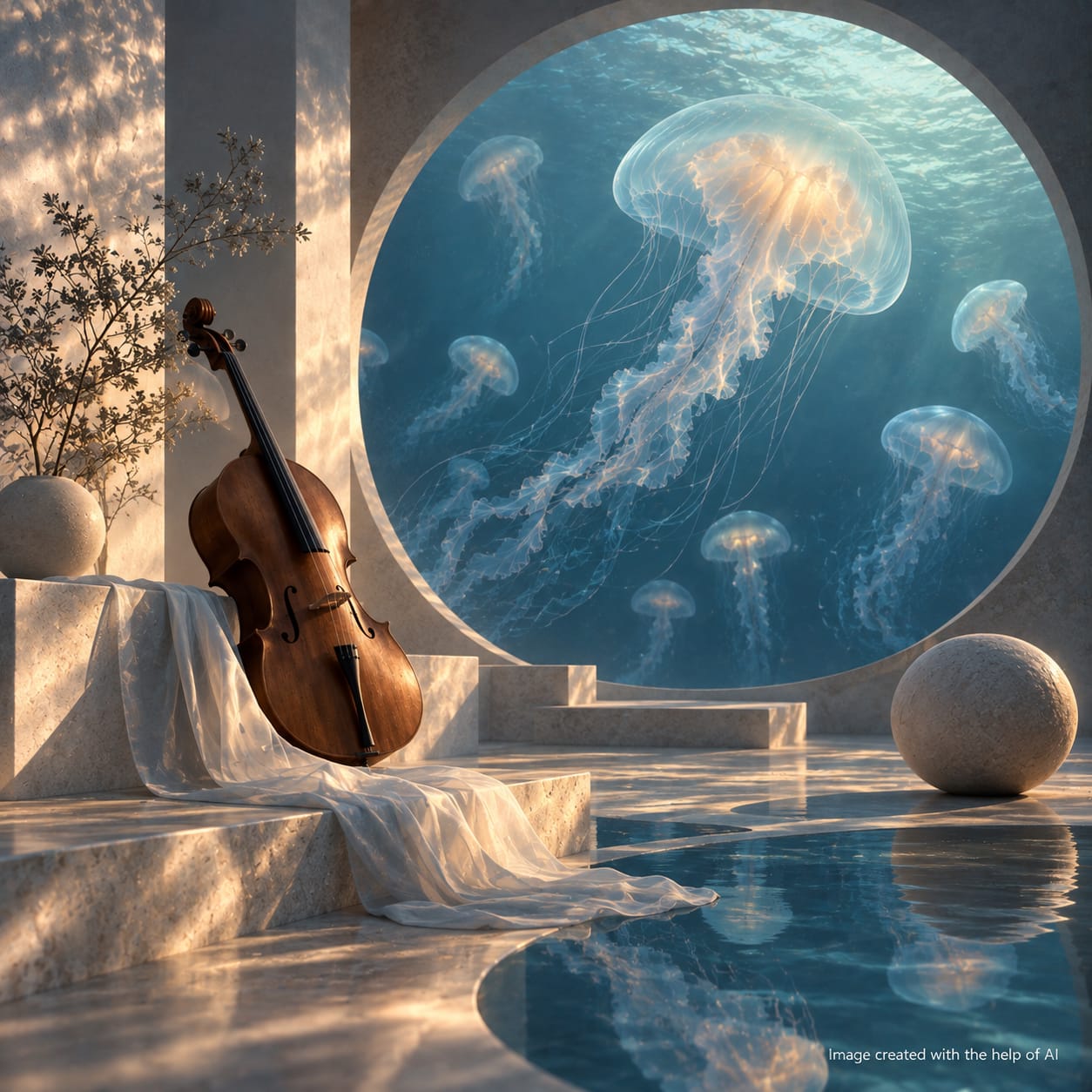
Jellyfish Waltz, from Faces & Places, began with the latter: the almost weightless movement of jellyfish drifting through water.
The image is simple, but translating it into music presented an interesting compositional challenge. Jellyfish do not move with a conventional pulse or obvious direction. Their movement is continuous, fluid and suspended between stillness and motion.
I wanted the music to capture that sensation without attempting to imitate the sea literally.
Instead, Jellyfish Waltz uses flowing melodic lines, recurring rhythmic gestures, changing harmonic colours and transparent string textures to create a sense of slow movement without urgency. The piece is written for violin I, violin II, viola, cello and double bass.
The result is one of the more playful and dreamlike pieces on Faces & Places.
Listen to both versions of Jellyfish Waltz while reading — from the intimate 2023 soft piano version to the flowing 2026 string quintet arrangement — and discover how the same musical idea takes on a different character through new textures, colours and harmonic movement:
From visual movement to musical movement
The first compositional decision was to avoid trying to reproduce the physical sound of water. There is no attempt to create literal wave effects or an underwater soundscape. Instead, I focused on the quality of movement.
Jellyfish appear to move almost effortlessly. They rise, fall, expand and contract, and change direction without abrupt gestures. Their movement has rhythm, but it does not feel mechanical.
That led naturally to a musical language based on short flowing figures, pauses, sustained tones and gradual changes in dynamics.
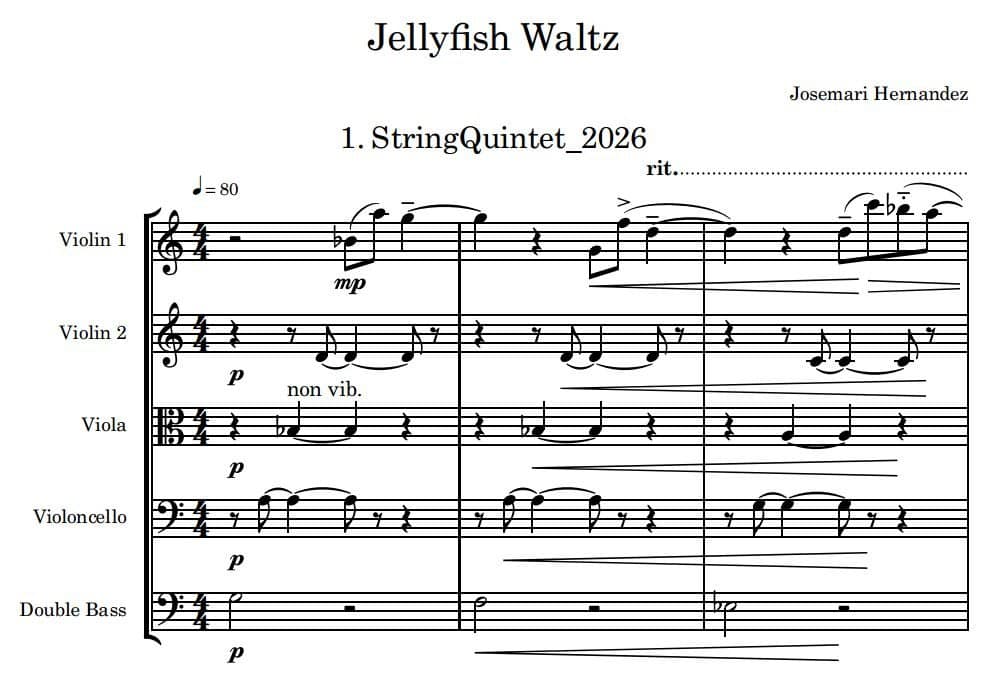
The opening establishes this character immediately. The tempo is marked at ♩ = 80, while the instruments enter with relatively light rhythmic gestures and soft dynamics. The first violin introduces the principal melodic material while the other strings create a gently moving background.
The music is already moving, but it never feels as though it is rushing toward a destination.
Why “Waltz”?
The word Waltz is important, but this is not a conventional ballroom waltz.
The title refers more to the swaying quality of the movement than to a strict dance form.
The music repeatedly creates the sensation of a body moving through space, with accents and rhythmic patterns that gently shift the listener’s perception of the pulse.
The score also uses changes of metre and rhythmic grouping to prevent the movement from becoming mechanically regular. At several points, the music combines repeated figures with triplets and contrasting subdivisions, producing a flexible sense of motion.
This was important to the image behind the piece.
A jellyfish does not move like a metronome.
Its movement is rhythmic, but organic.
A melody that floats
The principal melodic material is carried mainly by the upper strings, particularly the first violin.
Rather than constructing a long, conventionally developmental melody, the music uses relatively compact gestures that can be repeated and transformed.
These gestures frequently rise and fall, often with expressive slurs and small ornamental movements.
The effect is almost visual.
The melody seems to float above the harmonic foundation.
The lower strings provide a quieter structural role, establishing the harmonic ground while allowing the upper voices to move more freely.
This creates a layered texture in which different parts of the ensemble appear to move at different speeds.
That is particularly useful for representing the underwater image: there is no single movement, but several simultaneous movements interacting with one another.
Harmony as changing water
The harmonic language of Jellyfish Waltz is another important part of the concept.
The opening progression moves through sonorities including:
Gm(add9) → B♭maj7/F → A♭m7(♭5)/E♭ → D7sus4 → D7
and subsequently through related harmonic colours.
These chords provide a sense of direction without behaving like a simple traditional tonal progression.
The added ninth, major seventh, suspended fourth and altered dominant colours give the harmony a shifting quality.
The listener can sense that the harmonic environment is changing, but the music does not constantly announce those changes as strong cadential events.
This is important because the harmonic language needs to behave like the visual environment suggested by the title.
The water is never completely still.
But it is never violently changing either.
Repetition and transformation
The piece is structured around recurring material.
The score identifies the main section as A, followed later by A1, a contrasting B section and a subsequent A2 return.
This structure gives the music a recognisable identity while allowing the same musical material to appear in different forms.
The return of A does not simply mean that the music starts again.
The orchestration, articulation, dynamics and rhythmic density have changed.
This is one of the compositional ideas I use frequently in Faces & Places: a musical memory can return without being exactly the same as it was before.
In Jellyfish Waltz, that principle also mirrors the visual inspiration.
The jellyfish returns to a familiar area of the water, but its movement is never identical.
The pizzicato section
One of the clearest changes of character occurs when the strings move into pizzicato.
The A1 section begins with pizzicato gestures in the upper strings, creating a more articulated and buoyant texture than the preceding material.
This is a particularly useful orchestral colour for the concept.
The pizzicato does not sound heavy or percussive in this context. Instead, it produces small points of movement within the larger flow.
The musical texture becomes almost visual:
small impulses appear, move through the ensemble and disappear.
The effect is similar to watching a group of jellyfish drifting together, with individual movements becoming visible inside the larger motion of the group.
From pizzicato back to arco
The piece continually moves between different string colours.
Pizzicato provides articulation and lightness, while arco allows the sound to become more continuous.
The score also uses non vibrato, vibrato, sul tasto and glissando, each contributing a different degree of warmth, clarity or fluidity.
The alternation is not merely an orchestration detail.
It is part of the composition itself.
The same musical idea can feel completely different depending on how the strings articulate it.
This is particularly important in a piece whose subject is movement.
The B section — another perspective
The contrasting B section begins after a ritardando, with the tempo moving to ♩ = 90. The harmonic material changes and the melodic figures become more active.
Here the upper strings become more animated, while triplet figures appear in several voices.
The effect is not dramatic in the conventional sense.
It feels more like a change in the underwater current.
The jellyfish are still there, but the environment around them has changed.
The music therefore retains its original identity while introducing a different kind of energy.
Acceleration and slowing down
Another important aspect of the piece is its treatment of tempo.
Rather than maintaining a completely fixed pulse, the score uses ritardando, accelerando and combinations of the two.
This helps avoid a mechanical interpretation of the rhythmic material.
The music can expand and contract.
It can briefly gather energy and then release it.
That is perhaps the closest musical equivalent I could find to the physical movement that inspired the piece.
There is propulsion, but it is never forced.
A2 — Returning to the original image
The A2 section returns at ♩ = 90 and brings back the characteristic harmonic progression of the opening.
But by this point, the listener has already heard the contrasting material.
The original idea therefore sounds different.
The recurring harmony has acquired a new context, while the rhythmic and instrumental details continue to evolve.
The piece is effectively looking at the same image again, but from a different distance.
The final movement
Toward the end, the music gradually reduces its forward momentum.
The final passage returns to D7sus4 and D7 before moving toward a Gm6(add9) sonority. The score then indicates a ritardando, allowing the music to gradually settle.
The ending does not need a dramatic conclusion.
The music has already said what it needs to say.
The final sustained gestures allow the sound to dissolve rather than abruptly stop. The effect is consistent with the image behind the piece: movement gradually becoming stillness.
The jellyfish does not arrive somewhere.
It simply continues drifting until it disappears from view.
A small world inside Faces & Places
Jellyfish Waltz occupies a slightly different emotional space within Faces & Places.
Many pieces on the album are connected to people, memories or specific places. Here, the starting point is a fleeting image from nature.
But the underlying principle is the same.
A visual impression becomes an emotional impression, and the emotional impression becomes musical material.
The album is not intended as a collection of literal musical illustrations.
Instead, each piece asks what happens when an image, memory or experience remains in the mind long enough to become music.
In Jellyfish Waltz, that process begins with a simple observation:
there is something extraordinarily beautiful about movement that does not seem to require effort.
Final thought
Jellyfish Waltz is ultimately a piece about slow movement.
It is about rhythm without urgency, melody without weight and harmony that changes without demanding attention.
The string quintet becomes a small underwater world in which every instrument has its own movement while remaining connected to the larger flow.
The music does not attempt to tell us what a jellyfish looks like.
It asks us to imagine how it might feel to move like one.
And perhaps that is the real reason for the title.
A waltz normally suggests human movement.
This is a waltz without dancers.
Only the current remains.