
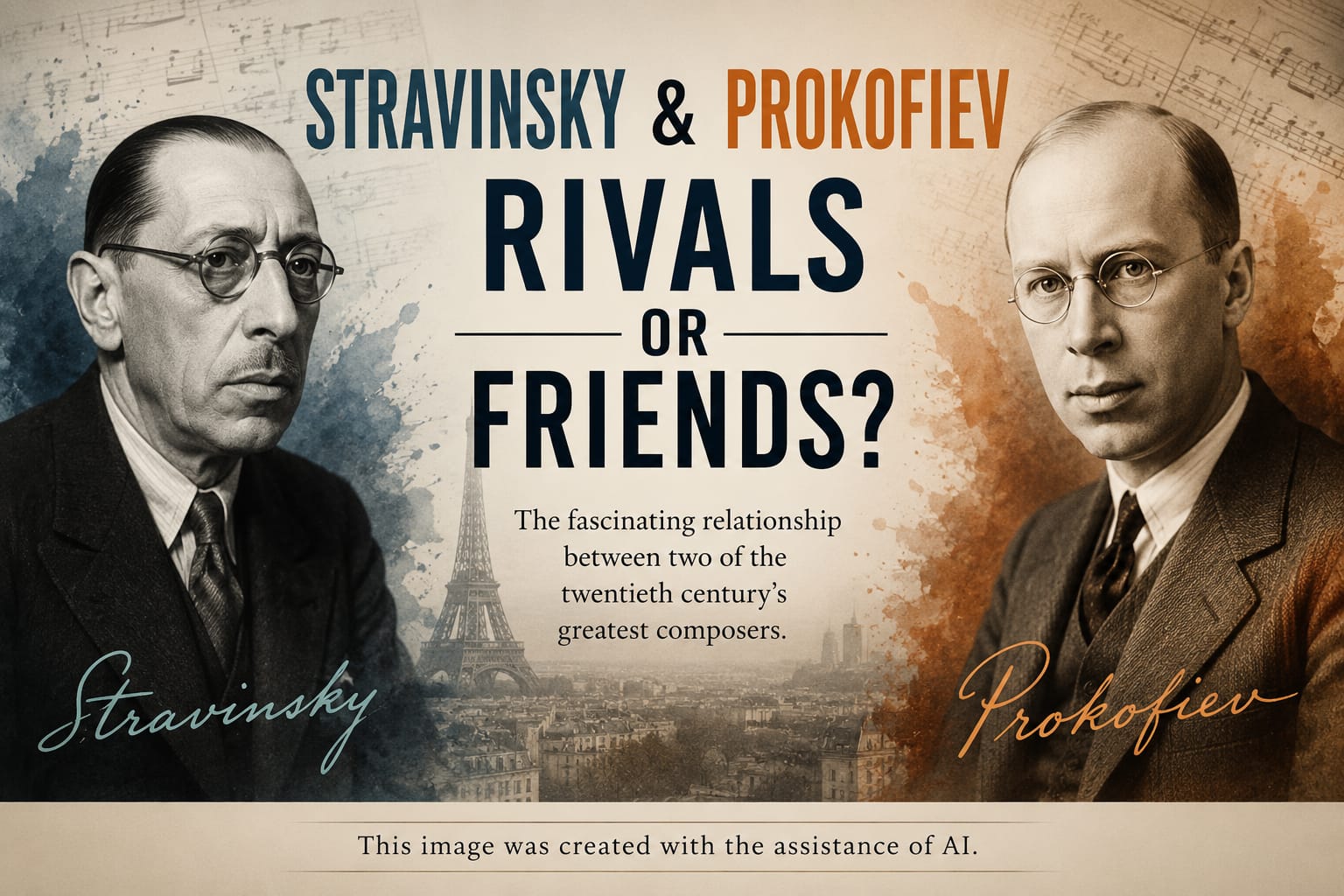
The history of classical music is full of famous rivalries. Mozart and Salieri, Brahms and Wagner, Debussy and Ravel—whether real or exaggerated, audiences have always been fascinated by stories of composers competing with one another.
Among twentieth-century composers, few relationships generate more curiosity than that of Igor Stravinsky and Sergei Prokofiev. Both were Russian. Both revolutionized modern music. Both became internationally celebrated. Yet they followed remarkably different artistic paths.
Did they admire one another? Did they compete? Or were they simply two brilliant composers whose careers occasionally crossed? The truth lies somewhere between friendship and rivalry.
Two Extraordinary Talents
Although they are often grouped together, Stravinsky and Prokofiev belonged to different musical worlds.
Stravinsky was born in 1882.
Prokofiev followed nine years later, in 1891.
When Prokofiev began attracting attention as a young composer, Stravinsky had already shocked the musical world with works such as The Firebird, Petrushka, and especially The Rite of Spring, whose 1913 premiere remains one of the most famous events in music history.
For the young Prokofiev, Stravinsky was already an established international celebrity.
Very Different Personalities
Their personalities differed almost as much as their music.
Stravinsky cultivated an image of intellectual discipline and artistic control. He carefully managed his public reputation, expressed strong opinions, and rarely hesitated to criticize other composers.
Prokofiev, by contrast, projected confidence mixed with youthful spontaneity. He enjoyed provoking audiences with bold harmonies and dazzling piano technique but often displayed a playful sense of humour that contrasted sharply with Stravinsky’s reserved character.
These differences naturally influenced their relationship.
Their First Encounters
The two composers met several times during the years following the Russian Revolution.
Like many Russian artists, both eventually settled in Western Europe.
Paris became an important meeting point for composers, performers, writers and painters.
Although they belonged to similar artistic circles, they were never close friends. Their encounters remained cordial but somewhat formal. Each recognized the other’s importance while maintaining a certain professional distance.
Artistic Differences
Perhaps the greatest obstacle to a closer friendship was their contrasting musical philosophy.
Stravinsky believed music should possess structure, clarity and objectivity. He famously argued that music expressed itself rather than external emotions. His works often emphasize rhythm, balance and precision.
Prokofiev approached composition differently. Although equally innovative, he embraced lyricism, irony and dramatic storytelling. His melodies are often more immediately memorable, while his harmonies balance modernity with accessibility.
To listeners today these differences may seem complementary. At the time, however, they represented competing visions of modern music.
Did They Compete?
In some respects, yes. Both sought performances from the same orchestras. Both collaborated with leading conductors. Both attracted the attention of critics across Europe and America.
Whenever two internationally celebrated composers occupy similar artistic territory, comparisons become inevitable.
Journalists frequently portrayed them as competitors. Yet there is little evidence that either composer viewed the other as a personal enemy. The rivalry was largely artistic rather than personal.
What Did Stravinsky Think of Prokofiev?
Stravinsky’s opinions could be unpredictable. At times he praised Prokofiev’s technical ability and originality. On other occasions he criticised certain works for lacking refinement or consistency. This inconsistency was not unusual.
Stravinsky also expressed sharply changing opinions about composers such as Tchaikovsky, Shostakovich and even Beethoven. His comments often reflected his mood as much as careful musical judgement.
What Did Prokofiev Think of Stravinsky?
Prokofiev generally respected Stravinsky’s achievements. As a young composer he admired the revolutionary impact of The Firebird and The Rite of Spring.
At the same time, Prokofiev was determined not to become a follower. He wanted audiences to recognise his own musical voice.
In diaries and letters he occasionally questioned certain aspects of Stravinsky’s style, but these remarks reveal artistic independence rather than hostility.
Like many ambitious composers, Prokofiev wished to establish himself alongside—not beneath—his famous contemporary.
Different Views of Russia
Their relationship was also shaped by politics. After the Russian Revolution both composers lived abroad.
However, their later decisions differed dramatically. Stravinsky remained in Western Europe before eventually settling in the United States. Prokofiev made the surprising decision to return permanently to the Soviet Union in 1936. This choice transformed his career.
While Stravinsky enjoyed artistic freedom in the West, Prokofiev increasingly worked under Soviet cultural policies that demanded accessible music serving political ideals.
Their professional worlds gradually moved further apart.
Mutual Respect Despite Differences
Despite disagreements, neither composer denied the other’s historical importance. Each understood that the twentieth century had room for different musical languages.
Stravinsky transformed rhythm. Prokofiev redefined melody.
Stravinsky explored neoclassicism. Prokofiev expanded dramatic expression.
Both left masterpieces that continue to shape modern concert programmes.
History has shown that their achievements complement rather than diminish one another.
Why They Are Still Compared
Music historians continue comparing Stravinsky and Prokofiev because they represent two contrasting answers to the same question:
How should twentieth-century music evolve?
Stravinsky sought innovation through structure, rhythm and formal clarity. Prokofiev pursued innovation through melody, harmony and theatrical imagination. Neither approach proved superior.
Instead, both enriched the musical landscape in different ways.
The Human Side
One reason the idea of rivalry persists is that audiences enjoy dramatic stories. A narrative of two musical geniuses battling for artistic supremacy is naturally attractive.
Reality is often less dramatic. Historical evidence suggests mutual respect mixed with professional competition—something entirely normal among creative artists. Neither composer devoted significant energy to attacking the other. Their greatest concern remained their own music.
A Shared Legacy
Today it is impossible to imagine twentieth-century music without either composer. Stravinsky changed the language of rhythm and orchestration. Prokofiev expanded the possibilities of melody, piano writing and dramatic composition.
Both influenced generations of composers, from Shostakovich and Britten to John Adams and many contemporary musicians.
Their contributions are no longer viewed as opposing forces but as complementary chapters in the history of modern music.
What this means for composers today
One of the most valuable lessons from Stravinsky and Prokofiev is that artistic influence does not require imitation. Great composers learn from one another while developing their own musical voice.
I find this idea particularly inspiring in my own work. Rather than adopting the language of a single composer, I try to combine lyrical writing, narrative development and orchestral colour into a personal musical style.
For listeners interested in orchestral storytelling, my album Gateway: A Psychological Introspection explores narrative through a minimal chamber orchestra inspired by Frederik Pohl’s novel.
I have also written about the compositional process behind several of my works:
Related music by Pilpil Music
Many of the ideas discussed in this article—developing a personal musical voice, balancing tradition with innovation, and writing music with a strong narrative identity—also shape my own compositions.
You may enjoy:
Conclusion
Were Stravinsky and Prokofiev rivals? In a professional sense, certainly. They competed for performances, critical recognition and artistic influence.
Were they enemies? The historical evidence says no. Their relationship was defined far more by mutual respect than by personal conflict. Each admired the other’s extraordinary talent while remaining committed to his own artistic vision.
Rather than seeing them as opponents, it may be more accurate to view them as two parallel innovators who transformed twentieth-century music in remarkably different—and equally enduring—ways.