
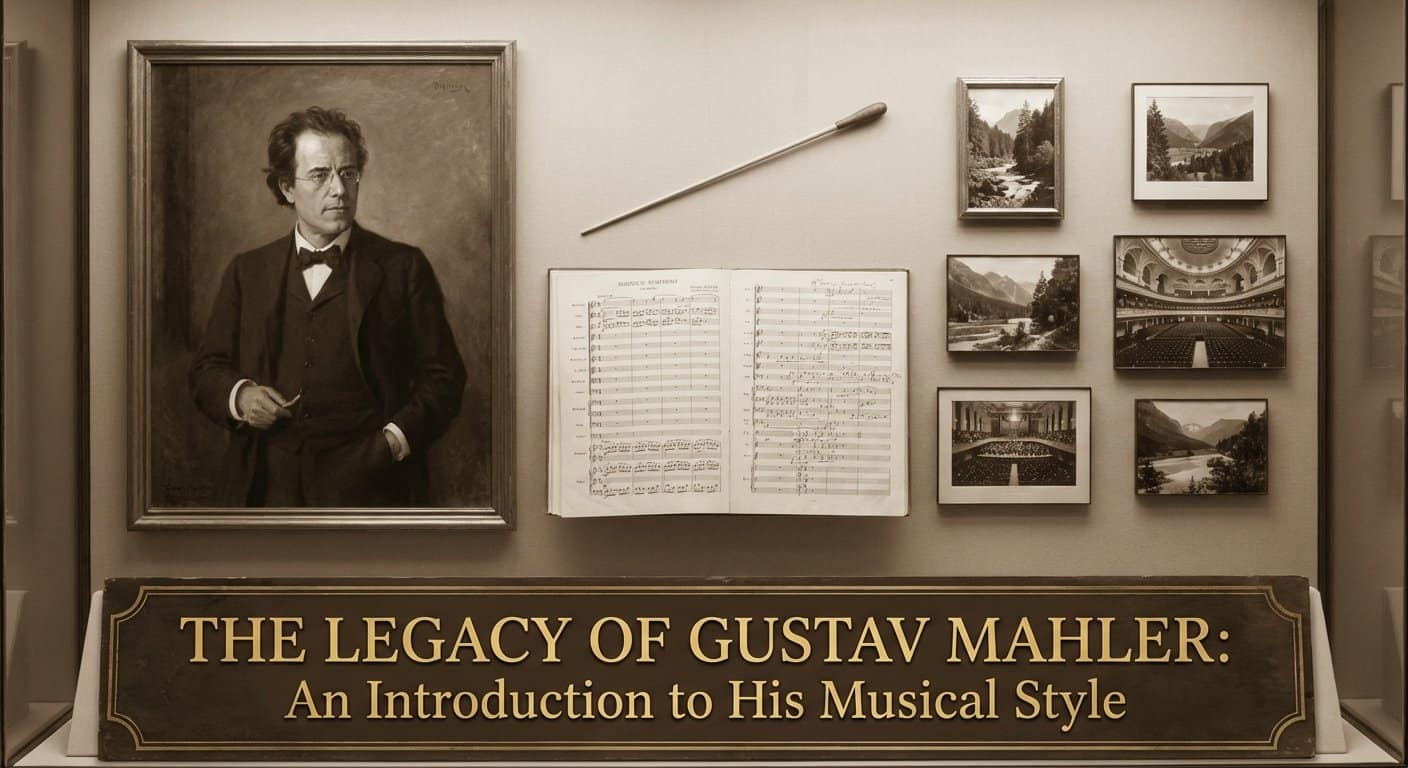
The Legacy of Gustav Mahler: An Introduction to His Musical Style
Gustav Mahler (1860–1911) remains one of the most influential composers in the evolution of orchestral emotional expression. His symphonies are particularly renowned for their advanced string voicing, extreme dynamic contrast, and ability to convey psychological depth through orchestration. Unlike many of his predecessors, Mahler treated the orchestra not merely as a harmonic framework, but as a living emotional system in which string textures play a central narrative role.
His integration of traditional Austro-German symphonic structure with innovative harmonic tension and orchestral layering established a new expressive model that continues to influence contemporary orchestral and cinematic composers.
Understanding String Voicing: Techniques and Emotional Impact
Mahler’s string writing is defined by its structural and emotional precision. Rather than using strings solely for harmonic support, he assigns them independent emotional functions through register separation, sustained harmonic tension, and layered counterpoint.
One of his most distinctive techniques is vertical emotional stratification: low strings often provide existential weight, while upper strings carry fragile or lyrical emotional lines. This register separation creates psychological depth within the orchestral texture.
Mahler also employs gradual dynamic expansion, where strings evolve from near silence to full orchestral intensity. This technique creates emotional inevitability rather than abrupt contrast, allowing tension to accumulate naturally.
Additionally, his use of sustained harmonic suspension delays resolution, extending emotional tension and increasing expressive impact. This principle has become foundational in modern cinematic scoring.
Mahler’s Emotional Resonance in Modern Film Scores
Mahler’s orchestral philosophy has deeply influenced contemporary film composers, particularly in the use of strings as emotional narrative drivers.
Composers such as Hans Zimmer, Jóhann Jóhannsson, and Alexandre Desplat employ Mahler-inspired techniques including:
• gradual dynamic layering
• sustained harmonic tension
• register-based emotional separation
• slow harmonic evolution
These techniques allow film scores to function as emotional architecture rather than simple accompaniment.
For example, Zimmer’s work in The Thin Red Line demonstrates Mahlerian string expansion, where emotional intensity grows through gradual orchestral accumulation rather than thematic development alone.
Mahler’s Influence on My Own Compositional Approach
As a contemporary composer working in instrumental and cinematic music, Mahler’s orchestral thinking has directly influenced my approach to emotional pacing and string voicing.
In several of my works, I explore gradual harmonic expansion and sustained string textures inspired by Mahler’s emotional architecture. Rather than relying on dense orchestration, I often use controlled register spacing and slow harmonic evolution to create emotional continuity.
You can hear examples of this approach in my cinematic and neoclassical releases, where string writing serves as the primary emotional carrier rather than decorative orchestration.
Listen to my cinematic works here
Conclusion: The Enduring Influence of Mahler on Film Music
Mahler transformed string writing into a vehicle for psychological and emotional storytelling. His orchestral techniques remain foundational not only in concert music but also in modern cinematic scoring.
Understanding his use of register, dynamics, and harmonic suspension provides invaluable insight for contemporary composers seeking to create emotionally compelling orchestral music.
His legacy continues not as historical reference, but as a living compositional framework still shaping modern sound.
If you are interested in orchestral writing, cinematic composition, or emotional string techniques, you may also explore: