
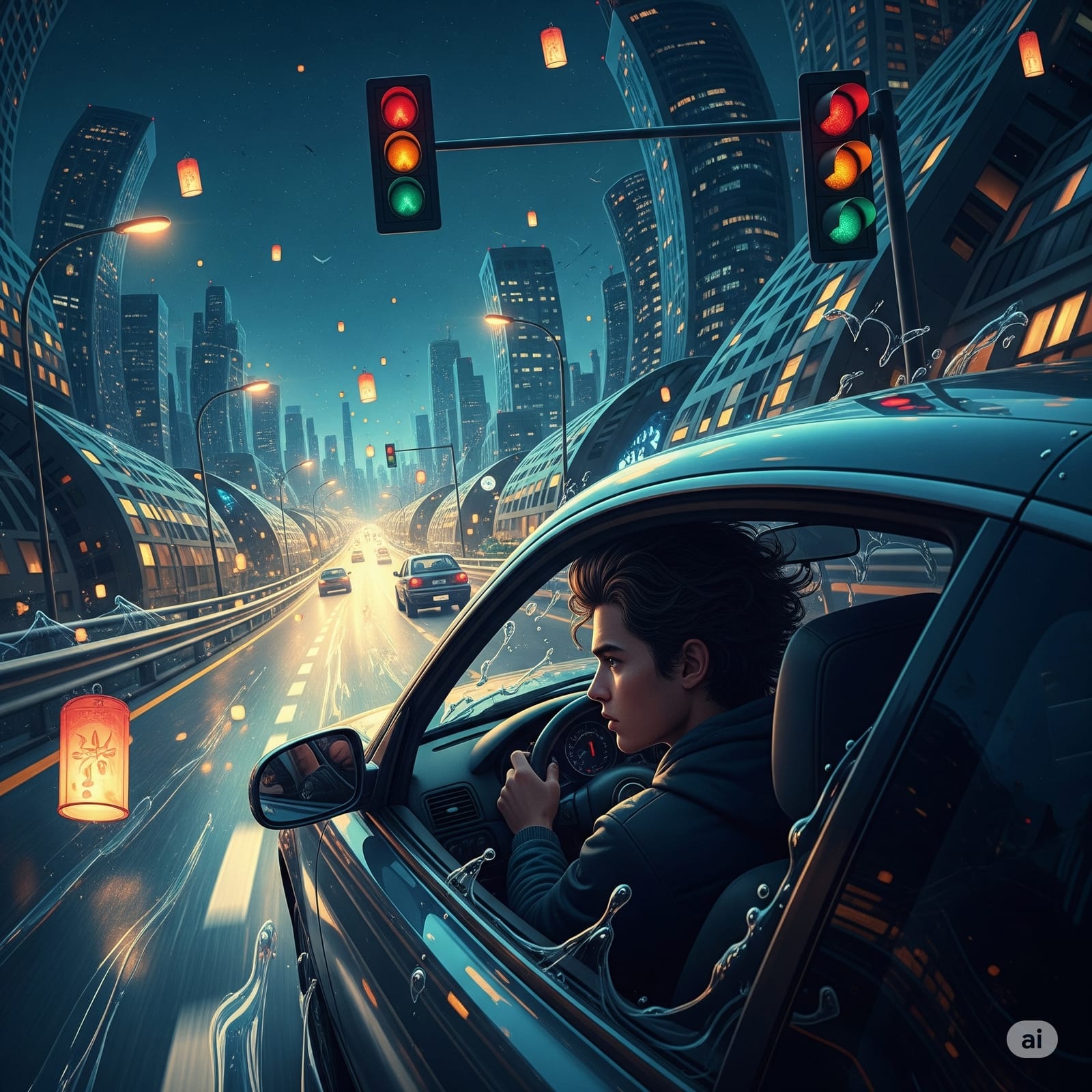
Orchestral composition process
This article explores my orchestral composition process through the piece “Crossroad Mood”. The music does not settle. It keeps moving.
What does a stressful night drive through a city sound like?
Crossroad Mood, from the album Urban Nightlife Stories, captures a tense and restless journey through a city at night.. Rather than depicting movement as freedom, the piece reflects urgency, fragmentation, and constant decision-making—like driving through intersections without pause.
Listen while reading and follow how the rhythmic engine drives the piece:
The Core Idea
This piece is built on continuous forward motion under tension. It sits between minimalism and cinematic writing, where rhythm defines structure instead of harmony.
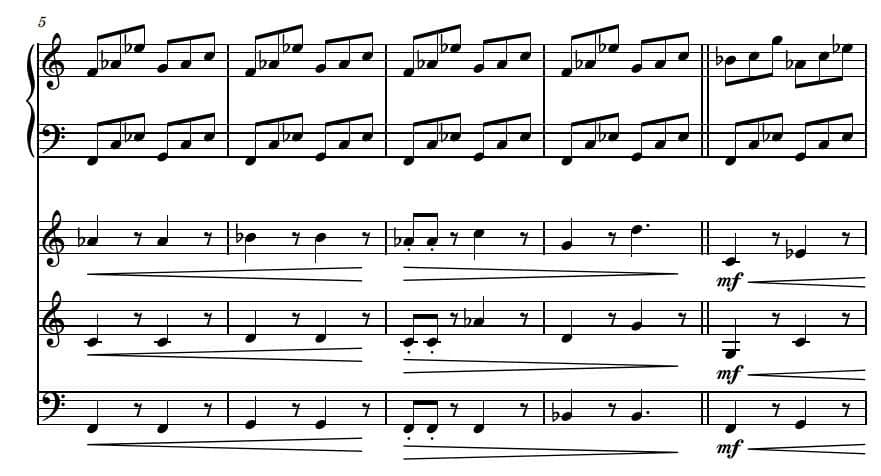
From the opening (♩ = 200) :
- a fast, relentless tempo is established
- repeating rhythmic figures appear immediately
- harmony (Fm9) suggests color rather than direction
This creates a sensation of:
- urgency
- instability
- lack of rest
The listener is placed inside a system that never stops.
This and other approaches to musical composition are also evident in pieces such as ‘After the neon fades’, ‘Parade’…
Rhythmic Engine
The defining element of the piece is a persistent rhythmic pattern. The piece does not move toward a destination—it is trapped in motion.
As seen throughout the score (pages 1–3) :
- continuous semiquaver motion drives the texture
- patterns repeat with minimal variation
- accents are subtle but constant
This rhythmic layer functions as:
- a mechanical engine
- a representation of motion (car, traffic flow)
- a structural backbone
Unlike expressive rubato-based writing, rhythm here is inflexible and controlling.
Harmonic Language
Harmony shifts frequently but avoids resolution.
Across the piece:
- Fm9 (opening)
- Emaj7
- Ebm7
- Dmaj7
- E7sus4
- C7sus4
These changes:
- do not follow traditional functional logic
- create abrupt color transitions
- reinforce disorientation
Harmony behaves like changing city lights—constantly shifting, never settling.
Texture and Orchestration
The orchestration reinforces fragmentation.
- upper voices carry continuous motion
- sustained lines appear in contrast (pp → mf → f)
- harmonic layers emerge and dissolve
At moments (e.g., page 4 onward) :
- dynamic expansion increases intensity
- glissandi introduce instability
- layered textures create density without clarity
The result is a sound space that feels:
- active
- crowded
- slightly overwhelming
Structural Behavior
Rather than a traditional form, the piece follows a process-based structure:
- Initial state — rhythmic engine established
- Expansion — harmonic and textural variation
- Accumulation — increased density and intensity
- Return (A1) — reactivation of initial material (page 9)
- Dissolution — gradual slowing (allargando) and release
This reflects the narrative:
movement → overload → continuation → exhaustion
Temporal Manipulation
Despite the fast tempo, time is manipulated internally.
- repeated patterns create perceptual loops
- harmonic shifts disrupt continuity
- acceleration and allargando sections distort flow (pages 8–9, 16)
The listener experiences:
- motion without arrival
- speed without direction
Compositional Approach
In this piece, I focused on:
- using rhythm as the primary structural driver
- avoiding harmonic resolution
- creating tension through repetition
- translating urban movement into musical behavior
The goal was not to describe a city, but to simulate the experience of moving through it under pressure.
Compositional Techniques in Crossroad Mood
This work combines a high-tempo ostinato with non-functional harmonic shifts and layered orchestration. The continuous rhythmic engine and abrupt harmonic changes place the piece within contemporary cinematic and neoclassical writing, where motion and texture define structure.
Final Thought
Crossroad Mood is not about arriving somewhere.
It is about being inside movement—constant, unresolved, and unavoidable.
Listen to Crossroad Mood and focus on how the rhythmic pattern never releases, creating constant motion without resolution.
If you would like more information on these topics, explore the following related posts: