
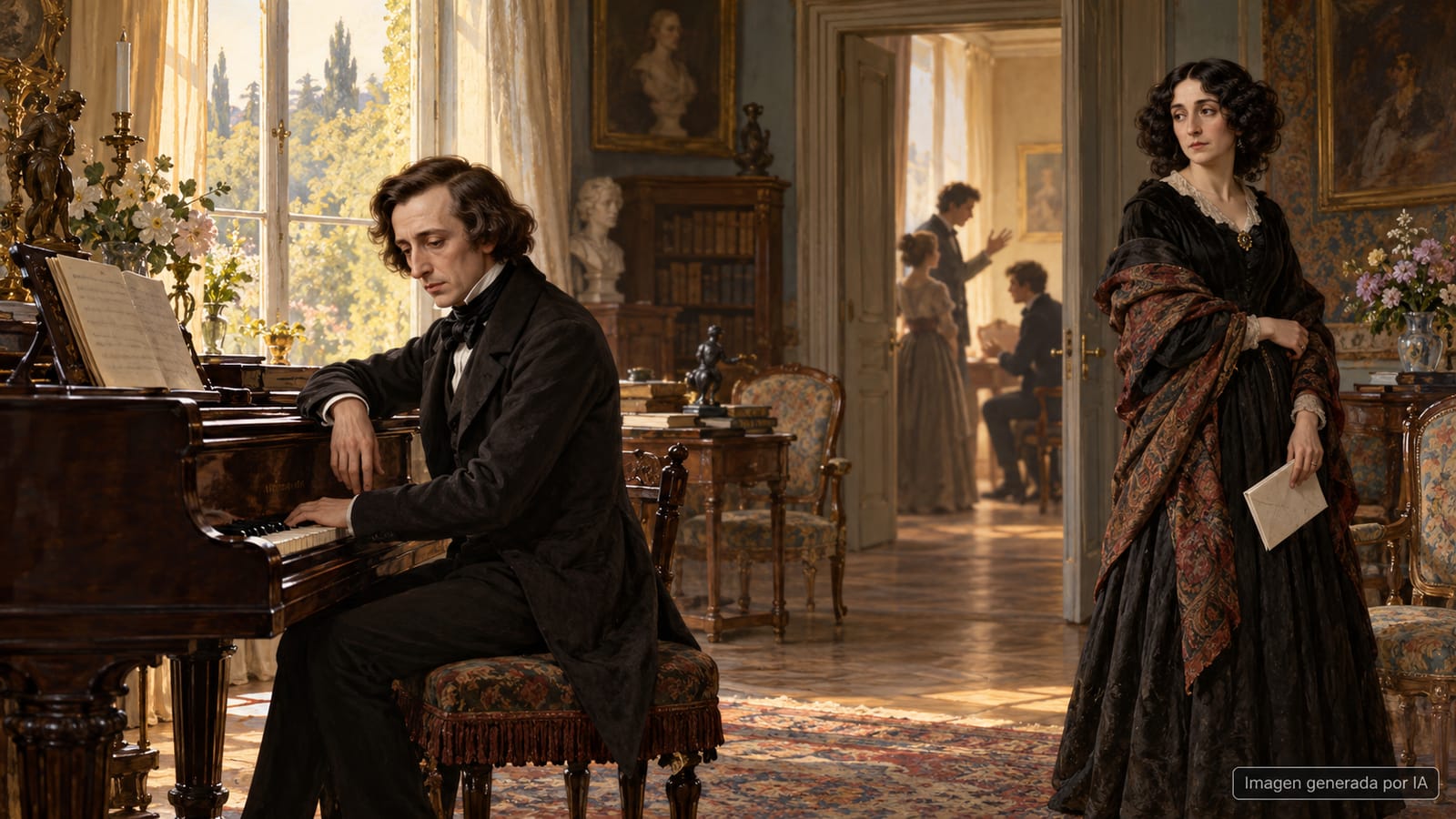
Frédéric Chopin and George Sand were together for nearly nine years. Their separation in 1847 is often reduced to one dramatic cause, but the evidence points to a more complicated story: tensions had been building, and a bitter family conflict finally put Chopin and Sand on opposite sides.
A partnership shaped by music and family
Chopin and Sand met in 1836 and became close after meeting again in 1838. Their life together moved between Paris and Sand’s country home at Nohant, where Chopin spent several summers composing. In 1838–39, they also traveled to Mallorca with Sand’s children, Maurice and Solange. The trip was difficult, but it became an important period in Chopin’s musical life: he worked on his Preludes, Op. 28, while Sand later wrote about the experience in A Winter in Majorca. Culture.pl recounts their meeting, Mallorca trip and years at Nohant; the Fryderyk Chopin Institute notes that many of his major works were written during their years together.
Their relationship was also part of a family household. Chopin grew close to Sand’s children, and the summers at Nohant gave him both a stable routine and time to compose. But as Maurice and Solange grew older, conflicts within the family increasingly affected the couple.
Was Lucrezia Floriani about Chopin?
Sand’s novel Lucrezia Floriani, serialized in 1846, added another source of tension. Its character Prince Karol is frail, introspective and Eastern European—a combination that led many readers to see Chopin in the portrayal. The novel has often been treated as a disguised account of their relationship, but resemblance alone cannot tell us exactly what Sand intended or how much it contributed to their separation. Culture.pl discusses the novel and the tensions surrounding it.
The book may have hurt Chopin, but it is not enough to explain the breakup on its own. By 1847, other strains—especially the family conflict—had become more immediate.
Solange’s marriage brought the conflict to a head
The clearest turning point came in 1847, amid a serious dispute involving Sand’s daughter Solange, Solange’s husband, the sculptor Auguste Clésinger, and Sand’s son Maurice. Chopin remained close to Solange and supported her during the conflict. Sand interpreted his stance as a betrayal of her and her family.
Some accounts frame the breakup as a story of jealousy over Solange. The correspondence gives firmer ground for a more cautious explanation: the couple became divided by a family dispute and by Chopin’s decision to remain loyal to Solange. A letter from Sand discussed by Polish Radio reflects her anger at Chopin’s change in attitude and his support for her daughter.
Their relationship ended in the summer of 1847. Sand’s letter to Chopin dated July 28 is often cited as marking the break; the Chopin Society in Hamburg’s account connects it to the family conflict.
After the separation
The end was painful, but it did not erase every bond between them. Chopin continued to correspond with Solange, and in letters he expressed concern about not hearing from Sand. They encountered one another briefly in March 1848, but did not reconcile. The Institut de France’s program based on Chopin’s letters recounts both his post-breakup correspondence and that final meeting.
So why did Chopin and George Sand separate? The best-supported answer is not a single insult, novel or act of jealousy. Their relationship had grown strained, and the 1847 conflict over Solange’s marriage and Chopin’s loyalty to her became the breaking point. The ending was complicated because the relationship itself had been: a partnership of affection, music and care, entangled with the pressures of family life.