
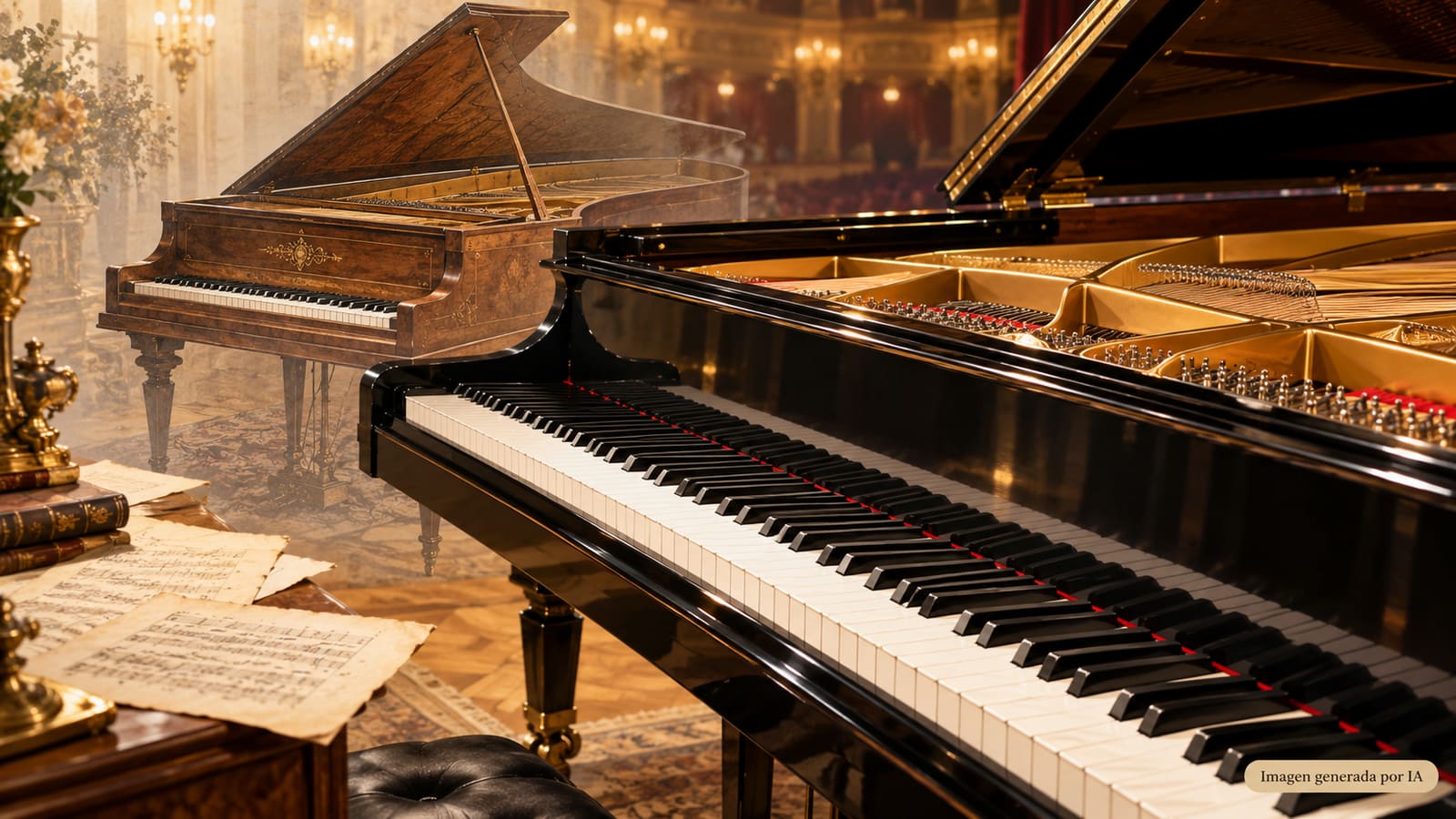
A standard piano has 88 keys because generations of piano makers gradually expanded the instrument’s range, and 88 became the format musicians and manufacturers settled on. It is a practical standard, not a limit imposed by physics—or by the human ear.
Those 88 keys comprise 52 white keys and 36 black keys, running from A0 at the bass end to C8 at the treble end. That span is seven and a quarter octaves.
The piano’s range grew over time
Early pianos had much shorter keyboards. By the late eighteenth century, five octaves—or 61 keys—was a common range. As concert halls grew and musical styles demanded louder instruments and a broader compass, piano makers steadily added keys. By the middle of the nineteenth century, seven-octave, 85-key pianos were common. The Metropolitan Museum of Art traces this expansion alongside changes to the instrument’s strings and construction.
The keyboard did not jump from 61 to 88 keys in one step. Makers extended its range over decades, while stronger frames and higher string tension helped pianos produce a louder sound. Yamaha’s history of piano manufacturing describes this gradual change and notes that 88 keys became the standard compass after the First World War.
Why 88, specifically?
The familiar modern range starts on A0 and ends on C8. It gives pianists more than seven octaves to work with, covering the range used by most piano music. As the format became standard, performers could expect the same span from one full-size piano to another, and composers could write with that range in mind.
Steinway & Sons helped popularize 88-key pianos in the late nineteenth century; the company describes how its instruments helped the layout gradually become standard. But 88 keys were the result of a broader evolution in piano design, not a magic number chosen in isolation. Steinway’s overview of the modern piano discusses its role in that change.
Is 88 the piano’s natural limit?
No. Some pianos have more keys. Bösendorfer’s Imperial concert grand has 97, extending the bass down to C0 for a full eight-octave range. The company says the instrument was developed after composer Ferruccio Busoni sought a wider bass range for performing Bach’s organ works. Bösendorfer describes the Imperial’s extended keyboard.
So the short answer is that 88 keys became a useful, widely adopted standard as pianos and musical expectations grew together. The instrument can have more; most players simply don’t need them for most of the repertoire.