

Composition process
This article explores my compositional process through the piece Beginning.
Beginning explores the emotional landscape of a new start: hope, uncertainty, expectation, and the gradual emergence of confidence. Originally written in 2021 for string ensemble and vibraphone, and later reimagined for brass quintet in 2026 as an additional piece for Brassing Reflections, the work transforms a personal and emotional concept into musical structure.
Rather than describing a specific event, the piece focuses on the universal experience of stepping into the unknown while imagining future possibilities.
The music behaves like a journey: it starts cautiously, develops through repetition and expansion, and gradually moves toward a brighter and more affirmative conclusion.
Listen while reading (two versions of the same piece):
The Core Idea
The piece is built on emergence.
From the opening bars (♩ = 80), musical material appears gradually:
- soft dynamic levels
- sparse textures
- repeated harmonic cells
- limited melodic movement
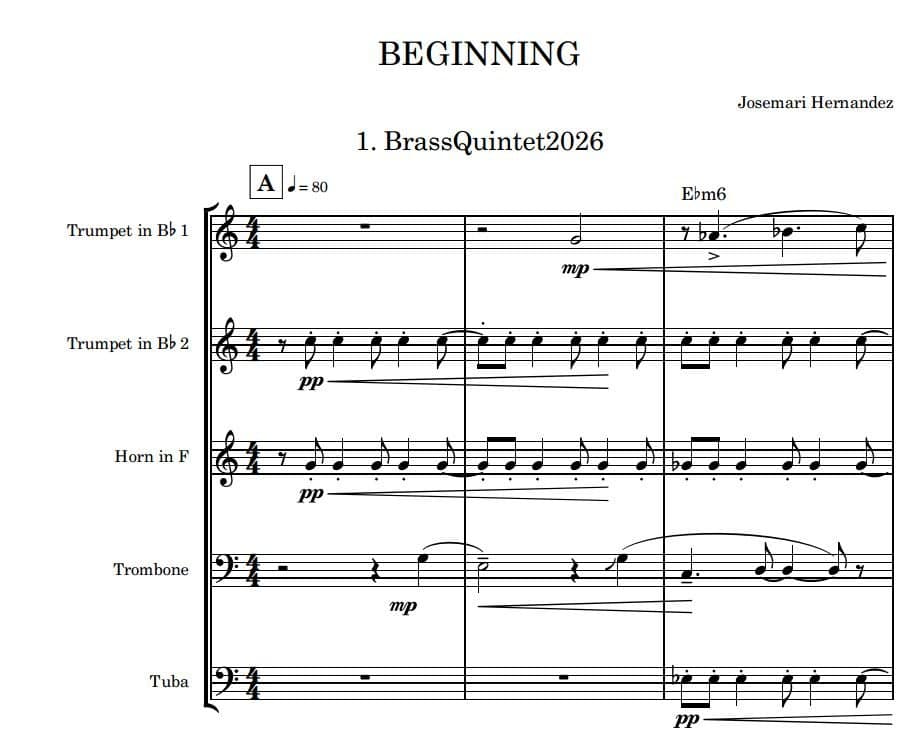
Nothing arrives suddenly.
Instead, the music grows organically, reflecting how new beginnings often develop: first as possibilities, then as intentions, and finally as actions.
The listener experiences a gradual transition from uncertainty toward confidence.
The A Section — Establishing the Atmosphere
The opening section defines the emotional world of the piece.
As heard in the first pages:
- Ebm6 and Cmaj7 sonorities alternate frequently
- accompaniment patterns create continuity
- melodic gestures remain simple and lyrical
- dynamics evolve gradually
The key characteristics are:
- stability
- patience
- expectation
- controlled growth
Rather than creating dramatic tension, the music creates anticipation.
The objective is to establish an emotional space where possibilities remain open.
Harmonic Language
Harmony plays a central expressive role.
Throughout the piece, recurring harmonic areas include:
- Ebm6
- Cmaj7
- Dm7
- Dm6
- Ddim7
These sonorities are not used primarily as functional harmonic progressions.
The recurring alternation between harmonic areas reinforces the sensation of looking forward while never fully abandoning uncertainty.
The harmonic language remains accessible while preserving ambiguity and emotional depth.
Rhythmic Behavior
Rhythm supports the idea of gradual development.
The piece relies heavily on:
- repeated accompaniment figures
- steady pulse
- limited rhythmic contrast
- progressive dynamic expansion
This produces:
- continuity
- forward motion
- emotional stability
Rhythm does not generate drama by itself.
Instead, it acts as the framework that allows harmony and orchestration to evolve.
The B Section — Expansion and Contrast
The B section introduces a different perspective on the same material.
Here:
- textures become more active
- instrumental interaction increases
- harmonic colour becomes richer
- dynamic range expands
The music begins to look outward rather than inward.
What was previously reflective becomes exploratory.
This section represents the moment when possibility starts becoming reality.
Return (A2/A3) — Confidence and Resolution
When the original material returns, it is no longer perceived in the same way.
The listener has already experienced the central expansion.
As a result:
- familiar harmonies acquire greater meaning
- textures feel fuller
- melodic gestures appear more confident
- the emotional direction becomes clearer
The return is not simply repetition.
It represents transformation through experience.
Texture and Orchestration
The brass quintet version emphasizes:
- warm harmonic resonance
- dialogue between upper and lower brass
- gradual dynamic shaping
- contrast between sustained lines and repeated figures
The ensemble functions as a single organism rather than a collection of soloists.
No instrument dominates the narrative for long.
Instead, responsibility for movement and colour is distributed across the group.
Compared with the original strings-and-vibraphone version, the brass arrangement introduces:
- greater timbral weight
- broader dynamic possibilities
- stronger architectural contrast
while preserving the contemplative nature of the original composition.
Structural Design
The piece follows an expanded ternary design:
- A — Expectation
- B — Exploration
- A’ — Transformation and confidence
This structure mirrors the psychological process of a new beginning:
- imagining possibilities
- taking the first steps
- returning with greater understanding
The emotional destination is not triumph.
It is acceptance of the journey ahead.
Compositional Approach
In this piece, I focused on:
- translating an emotional concept into musical behaviour
- creating development through repetition and variation
- balancing optimism and uncertainty
- maintaining coherence through recurring harmonic material
- allowing orchestration to drive emotional growth
The goal was to create a musical representation of hope in motion.
Compositional Techniques in Beginning
This work combines recurring harmonic cells, gradual dynamic expansion, distributed orchestration, and thematic transformation.
The result is a piece where emotional development emerges not from dramatic events, but from accumulation, growth, and changing perspective.
Final Thought
Beginning is about the moment before certainty.
The moment when possibilities are still unfolding and the future remains unwritten.
Through recurring harmonies, gradual expansion, and evolving orchestration, the piece seeks to capture the emotional energy that accompanies every new start.
Whether it is a new project, a new relationship, a new place, or a new stage of life, every beginning contains the same mixture of uncertainty and hope.
This music is dedicated to that moment.