
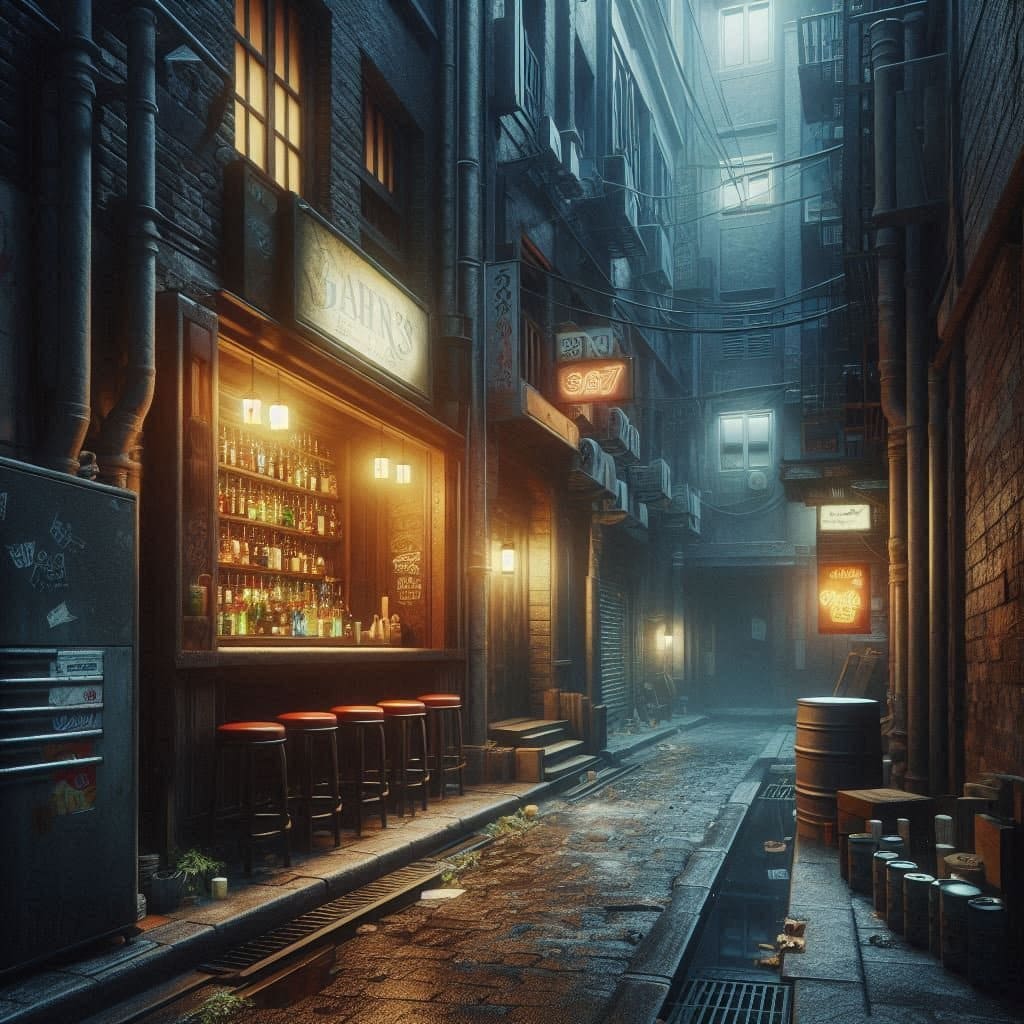
Some pieces are built around clarity and direct expression, while others explore ambiguity and contrast. Hidden Alleys, part of the album Urban Nightlife Stories, belongs to the second category. It is a composition that moves through shadowed spaces, suggesting the experience of walking through unknown or hidden corners of a city at night.
This piece explores how low-register instrumentation can shape atmosphere in instrumental music composition. Besides is not about movement in a physical sense, but about atmosphere — a sense of curiosity, tension, and discovery.
The Initial Concept
The starting point of Hidden Alleys was not a melody, but an idea: to create a musical space that feels uncertain and slightly mysterious. The image behind the piece is that of narrow streets and hidden paths, where visibility is limited and every turn suggests something unknown.
This concept led to a compositional approach based on contrast and low-register textures.
Structure: A Dialogue Between Question and Answer
The piece follows a clear ABA structure, but with a strong internal contrast.
- The A section functions as a kind of question. It introduces fragmented musical ideas, with an open and unresolved character. The harmony and rhythm suggest tension without providing clear direction.
- The B section acts as a response. It brings more definition and stability, offering a sense of temporary resolution to the uncertainty introduced earlier.
- The return to A reintroduces the initial ambiguity, reinforcing the idea that the journey remains open and unresolved.
This question–answer relationship gives the piece a narrative quality without relying on traditional melodic development.
Starting from Harmony and Texture
As in many of my compositions, the process began with a rhythmic and harmonic idea. In this case, the harmony was designed to avoid clear resolution, maintaining a sense of suspension.
The harmonic material is closely linked to the texture. Rather than supporting a melody, it defines the atmosphere itself. The chords are shaped to create density in the lower register, contributing to the dark and mysterious character of the piece.
An Unusual Instrumentation
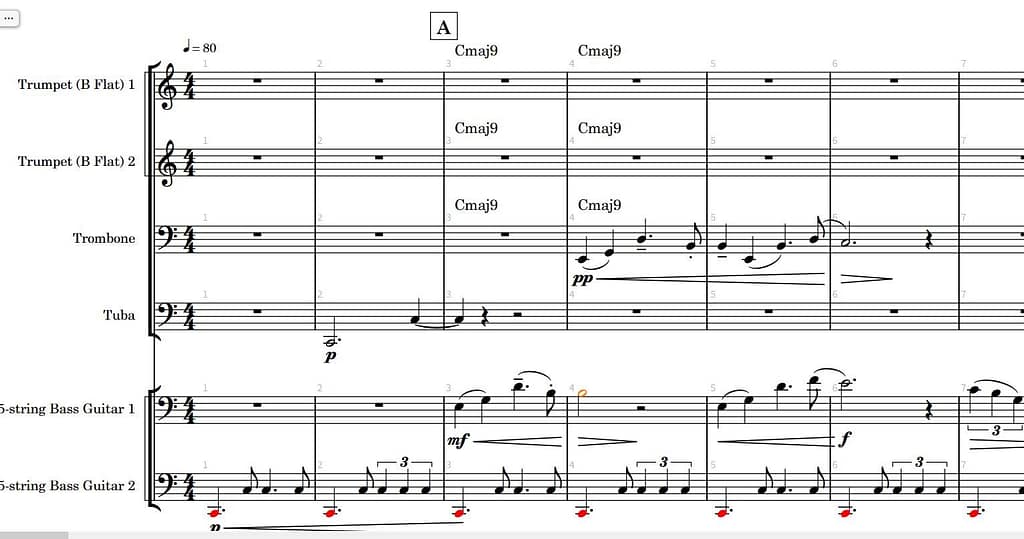
One of the defining features of Hidden Alleys is its atypical instrumentation:
- two trumpets
- trombone
- tuba
- two electric basses
This combination creates a sound world that is both unusual and highly characteristic.
The presence of the tuba and two electric basses reinforces the low-frequency spectrum, giving the piece a heavy and grounded sonic identity. This emphasis on the lower register plays a key role in generating the feeling of depth and obscurity.
The trumpets and trombone add definition and contrast. Rather than functioning in a traditional brass ensemble role, they interact with the low textures to create layers of tension and color.
Low Register as Atmosphere
In this piece, the lower register is not just a harmonic foundation — it is the core of the atmosphere.
The interaction between tuba and electric basses creates a dense and slightly unstable sonic floor. This texture supports the rest of the ensemble while also shaping the emotional character of the music.
The result is a sound that feels grounded but also uncertain, reinforcing the idea of moving through hidden and unfamiliar spaces.
Contrast Between Sections
The contrast between sections A and B is essential to the identity of the piece.
The A section is more fragmented and dark. It introduces ideas that do not fully resolve, creating a sense of questioning.
The B section, in contrast, is more structured and defined. The harmony becomes happier, and the musical gestures feel more intentional, as if providing an answer.
However, this resolution is not final. When the A section returns, the sense of ambiguity reappears, suggesting that the exploration is ongoing.
Rhythm and Space
Rhythm in Hidden Alleys is used sparingly. Instead of driving the music forward, it contributes to the sense of space.
Meditative and unhurried, evokes a sense of introspection
A Different Kind of Urban Scene
Within the context of Urban Nightlife Stories, Hidden Alleys represents a different aspect of the city at night.
While other tracks may focus on energy, movement, or social interaction, this piece explores a more introspective and less visible side of urban life — the spaces between the main streets, the quieter and more ambiguous areas.
It adds contrast to the album and expands its narrative range.
Final Thoughts
Hidden Alleys is a piece built on contrast, low-register texture, and an unconventional instrumental combination.
By focusing on atmosphere rather than melodic development, the composition creates a sense of mystery and exploration. The ABA structure, shaped as a dialogue between question and answer, provides a clear framework while allowing the music to remain open-ended.
Within the album, the piece functions as a moment of introspection — a walk through the less illuminated parts of the city, where sound, space, and uncertainty define the experience.
If you would like more information on these topics, explore the following related posts: