
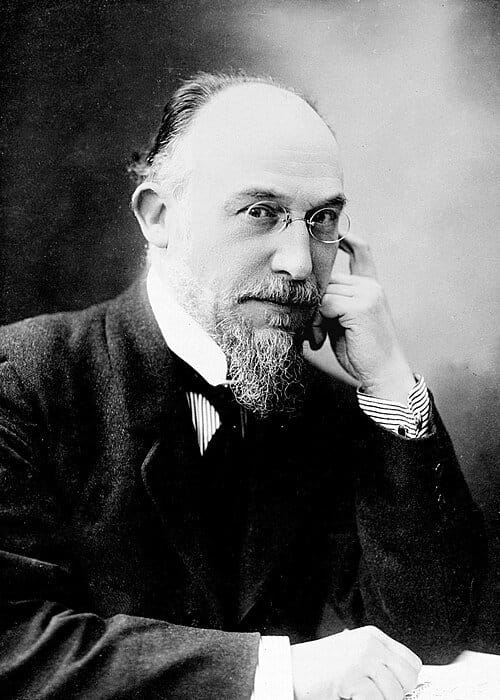
The Life and Times of Erik Satie
Born on May 17, 1866, in Honfleur, France, Erik Satie emerged from a lineage steeped in music. His mother, a talented pianist, and his father, a French composer, profoundly influenced Satie’s early appreciation for music. After moving to Paris with his family, Satie’s musical education commenced. He attended the Paris Conservatoire, where he was exposed to various musical styles that would later inform his own peculiar compositions. However, Satie’s unorthodox personality clashed with conventional education, leading to a dissubordinate attitude that would characterize his entire career.
In the late 19th and early 20th century, Satie began to cultivate an eccentric public persona. His disdain for the limitations of traditional music was epitomized in his rejection of the established norms. He defied categorizations of genre and embarked on a quest for originality. Satie’s compositions, such as the famous Gymnopédies, revolutionized contemporary music and hinted at the transition from romanticism to modernity. His ability to infuse simplicity with profound emotion marked his music as uniquely personal and abstract.
Satie’s lifestyle also reflected his unusual character; he famously adhered to a “white diet,” consisting solely of white foods and exhibited a fondness for avant-garde art and surrealism. His collaboration with artists like Claude Debussy and Victor Delaunay, as well as his friendships with other notable figures of the Parisian avant-garde scene, spurred his artistic evolution. Satie’s peculiarities, from his love of stacked pianos to his whimsical writings, offered an insight into the multidisciplinary aspects of his creativity. This artistic journey solidified his status as a pioneer, inspired countless musicians, and ultimately influenced the course of modern music.
Satie’s White Diet: A Unique Approach to Nutrition
Erik Satie, the avant-garde composer, was not only known for his innovative music but also for his peculiar habits, including his strict adherence to what he dubbed the “white diet.” This unusual nutritional regimen consisted solely of white foods—items such as eggs, sugar, and even grated bones, symbolizing simplicity and purity. Satie’s fascination with this monochromatic dietary pattern was not merely a reflection of eccentricity but intertwined with his broader artistic philosophy.
The rationale behind the white diet appears to be rooted in Satie’s belief in minimalism and the pursuit of simplicity, both in his music and lifestyle. By consuming only white foods, he aimed to eliminate distractions and embrace a certain aesthetic that resonated with his artistic vision. This paradoxical approach to nutrition highlights his desire to reflect the ethereal qualities he sought in his compositions. Satie’s preference for restricted dietary choices mirrors his views on artistic expression, which often emphasized clarity and directness in form.
Furthermore, the white diet serves as a lens through which we can understand Satie’s relationship with health and wellness. While some might argue that such a restrictive diet poses potential health risks, Satie seemed to prioritize his creative process over conventional health perceptions, often disregarding popular nutritional advice of his time. This decision likely underscores a philosophical underpinning evident in many of his works: the idea that the artist’s path must remain authentic, even if it defies societal norms. Ultimately, Satie’s white diet was more than just an unusual eating habit; it was a clear representation of his artistic identity and an embodiment of his distinctive worldview.
The Stacked Pianos: A Glimpse into Satie’s Living Space
Erik Satie, the quintessential eccentric of the early 20th century, resided in a diminutive one-room apartment in Paris where his unconventional lifestyle manifested in peculiar yet meaningful ways. Among the most striking features of his living space was the arrangement of two grand pianos stacked one atop the other. This odd configuration not only defined Satie’s artistic environment but also encapsulated the essence of his creative pursuits.
The stacked pianos served multiple purposes in Satie’s life. Pragmatically, the limited dimensions of his apartment necessitated such an arrangement, allowing him to maximize the utility of his confined space. However, on a deeper level, the dual pianos symbolized Satie’s relentless commitment to his craft and his unique approach to music. This distinct setup reflects his unorthodox methodology; he viewed composition not merely as a task but as a holistic expression of his identity.
Satie’s living arrangement revealed much about how he interacted with his work. The close proximity to both instruments allowed him the convenience of seamless transitions between composing and playing. This accessibility likely fueled his creativity, enabling him to explore diverse musical ideas without the burden of relocating between spaces. Having two pianos stacked together created a vertical dimension of sound, contributing to the distinctive layering and intricate textures present in his compositions.
Furthermore, the visual spectacle of the stacked pianos served as a metaphor for Satie’s innovative spirit. This poignant arrangement embodied his belief in breaking conventional barriers, both in architecture and in music. By integrating his living and artistic environments, Satie cultivated an atmosphere ripe for artistic exploration, demonstrating that the environment must cater to creativity, not confine it.
The Legacy of Erik Satie: Influence on Music and Beyond
Erik Satie’s influence on the realms of music and art resonates far beyond his lifetime. His distinctive approach to composition, characterized by simplicity and intentionality, laid the groundwork for the development of modern music. Satie’s embrace of experimental techniques and unusual structures in his works offered a refreshing contrast to the complexity of late Romantic music, paving the way for future generations of composers. One of his most significant contributions is the inspiration he provided for the Minimalist movement. Satie’s concept of reducing music to its essence—often employing repetitive motifs and sparse harmonies—encouraged composers like Steve Reich and Philip Glass to explore similar avenues in their creations.
Moreover, Satie’s rejection of traditional musical forms has provided both inspiration and intrigue for artists across various disciplines. His unconventional lifestyle choices, including his famously restricted diet and eccentric habits, have spurred interest in alternative approaches to creativity among contemporary artists. This fascination with the convergence of lifestyle and artistry invites many to examine their artistic processes through a lens that values personal expression and idiosyncrasy over conformity.
The legacy of Erik Satie is not solely confined to his music. His innovative ideas have permeated visual arts, literature, and performance, manifesting in various modern creative movements. The Surrealists, for instance, showcased his work as emblematic of absurdity, which mirrors their own artistic philosophy. Ultimately, Satie’s enduring impact on 20th-century creative movements emphasizes the importance of individuality and the celebration of eccentricity within art. As new generations of artists continue to be influenced by his legacy, the appreciation for Satie’s work endures, reminding us of the profound connections between lifestyle and creativity.
A brief musical sketch applying these techniques is available here.