
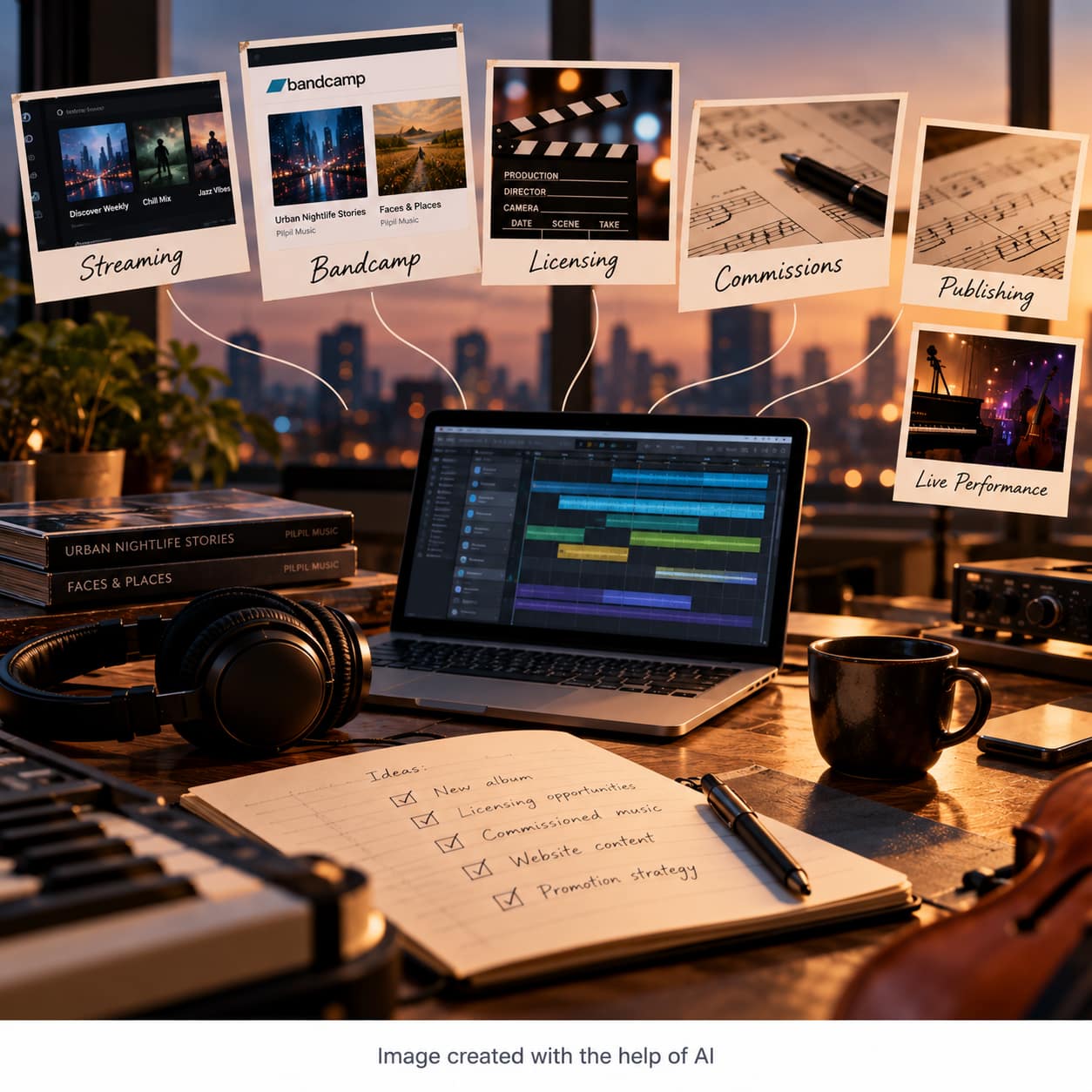
Streaming has made music more accessible than ever. Independent artists can distribute their recordings worldwide without relying entirely on traditional record labels. But making music available to listeners and earning a sustainable income from it are two different challenges.
For many independent musicians, streaming alone is an uncertain foundation for a career. Even when a track attracts listeners, the resulting income depends on the platform’s royalty model, the rights involved, the distribution agreement and the artist’s share of the revenue.
The solution is not necessarily to abandon streaming. It is to understand its role and build other ways for listeners, clients and music users to support your work.
As an independent instrumental composer, I have adopted this approach at Pilpil Music. Streaming remains useful for discovery, while my website provides the context behind my compositions and Bandcamp is my main destination for direct sales and listener support. I explain the reasons for this decision in Why I’m Focusing on Bandcamp.
So, what alternatives can independent musicians explore, and how can they combine them into a more sustainable strategy?
1. Understand What Streaming Royalties Actually Mean
One of the most persistent misconceptions about streaming is that every play generates a fixed amount of money for the artist.
That is not how Spotify calculates recording royalties. Its system allocates revenue according to streamshare: the proportion of eligible listening activity attributable to a recording in a particular market. The amount that ultimately reaches an artist also depends on rights ownership, distribution arrangements and contractual agreements.
Spotify explains this system in its official Royalties Guide.
Spotify also introduced a specific eligibility requirement in April 2024: recordings need at least 1,000 streams in the preceding 12 months to qualify for its recorded-music royalty pool. This is a Spotify policy, not a universal rule applying to every streaming service. Further details are available in Spotify’s explanation of its royalty eligibility policy.
The practical lesson is simple: high streaming numbers do not automatically translate into a sustainable income, and estimates based on a universal rate per stream can be misleading.
Streaming can nevertheless be valuable. It gives people a convenient way to discover unfamiliar music, return to favourite tracks and explore a catalogue.
Rather than measuring its success only through royalties, independent artists should also consider whether streaming helps them attract listeners who may later purchase an album, commission a composition or use their music in another context.
2. Direct Music Sales: Building a Relationship with Listeners
One of the clearest alternatives to streaming is selling music directly to listeners.
Platforms such as Bandcamp allow independent artists to offer individual tracks, singles and complete albums. Depending on the release settings, artists can also let listeners choose to pay more than the minimum price.
Bandcamp states that an average of 82% of the money from a purchase goes to the artist or label, with the remainder covering its revenue share and payment-processing fees. The actual amount varies by transaction. Its current artist and fee information explains how the model works.
A direct purchase has a different meaning from an individual stream. The listener has actively decided to acquire the music and support its creator.
For composers who release complete albums, this also provides an opportunity to present the music as a coherent artistic project rather than just a collection of tracks.
At Pilpil Music, for example, Urban Nightlife Stories explores jazz-influenced instrumental scenes inspired by city life after dark, while Faces & Places takes a different approach through original compositions for string quintet.
These albums represent distinct musical directions, each with its own instrumentation, atmosphere and compositional identity. Direct-to-fan sales provide a way for interested listeners to explore and purchase the complete projects.
For independent artists, the objective is not to persuade every listener to buy music. It is to give the people who genuinely value the work a straightforward way to support it.
3. Music Licensing and Synchronisation
Another potential source of income is licensing music for use in films, television, advertising, games, online video and other audiovisual productions.
This is particularly relevant to composers whose catalogues include instrumental, cinematic, ambient or mood-based music. A piece created independently may also suit a visual project, provided its musical character and usage rights match the production’s requirements.
Synchronisation licensing, often called sync licensing, involves permission to pair music with visual content. Depending on the agreement and the rights involved, a placement may generate an upfront licence fee and potentially additional royalties.
However, licensing is an opportunity, not a guaranteed source of income. Competition can be intense, suitable placements may take time to secure, and fees vary considerably.
A useful starting point is to organise a catalogue so that potential music users can understand what is available. Clear titles, accurate metadata, mood descriptions, genre information, durations and properly documented ownership can make a submission easier to evaluate.
Instrumental versions, alternate edits and high-quality files may also be useful when a production requires a particular duration or arrangement.
Composers should ensure that they have the necessary rights to offer a recording and its underlying composition, including any relevant co-writer, publisher or label permissions.
For further guidance on presenting your work professionally, see How to Confidently Pitch Your Music to Labels and Publishers.
4. Commissioned Compositions and Creative Services
Not every income stream needs to come from an existing catalogue.
Independent composers may also earn income by creating music for a specific purpose. Depending on their skills and interests, this can include original cues for videos, games, theatre productions, podcasts, short films or other commissioned projects.
Other possibilities include arranging, orchestration, adapting existing music for different ensembles or preparing scores for performance.
These activities work differently from streaming. Instead of waiting for a recording to accumulate listeners, the composer agrees on a defined creative task with a client.
The scope, delivery format, revision process, fee and rights should be established clearly before work begins. A commission may involve a one-time payment, a licence, retained ownership or another arrangement, depending on the agreement.
These services will not suit every musician, but they can complement an existing catalogue and provide opportunities to apply compositional skills in different settings.
5. Do Not Overlook Publishing and Performance Royalties
Recorded-music royalties are only one part of the music-rights landscape.
A recording and the musical composition embodied in it are distinct rights. Depending on the use and the relevant agreements, money may be due to recording rights holders, composers, publishers or other contributors through different payment routes.
Composers should therefore pay attention to work registration, ownership information, writer and publisher shares, identifiers and the requirements of the relevant collecting societies.
Accurate metadata matters because incomplete or inconsistent information can complicate royalty identification and payment.
For compositions used in audiovisual productions, documentation such as cue sheets may also be relevant to reporting musical usage and allocating royalties.
The precise arrangements depend on the country, the rights involved and the type of use. Artists should check the requirements of their collecting society, distributor, publisher or other rights administrator rather than assume that all royalties are handled by a single service.
For musicians who write original music, understanding these distinctions can help ensure that the income associated with their work is not overlooked.
6. Build an Audience Around the Music, Not Just the Release
A growing catalogue is more useful when listeners can understand what makes it distinctive.
Social media can introduce people to new music, but promotional activity becomes more effective when it leads somewhere useful: a well-organised website, a detailed release page, a direct purchase option or an explanation of how a composition was created.
A website can provide context that a streaming profile alone may not offer. It can explain instrumentation, describe a project’s concept, link related compositions and give interested listeners a clearer picture of the work.
For example, my Inside the Music articles explore the compositional thinking behind individual pieces. These articles provide another way for people interested in the music to discover the ideas, structure and techniques involved.
This kind of material can support a release without turning every post into a sales message. It gives listeners a reason to engage with the music and explore related work.
The objective is not to be present on every platform. It is to establish a consistent path from discovery to deeper engagement and, where appropriate, direct support.
7. A Website, Bandcamp and Streaming Can Serve Different Purposes
Independent artists do not necessarily need to choose a single platform for everything.
A more practical approach is to give each channel a clear role:
- Streaming platforms make music accessible and can help new listeners discover a recording.
- Bandcamp provides a direct-to-fan space for album and track purchases.
- An artist’s website presents the catalogue, background information, credits, articles and links to relevant releases.
- Licensing and professional submissions make selected works available for potential opportunities in film, games, advertising and other media.
These channels can reinforce one another. A listener might discover a track on a streaming service, visit the artist’s website to learn about the album and then purchase the release on Bandcamp.
That journey will not happen for every listener, and no platform can guarantee it. The value lies in providing clear options for people who want to go further.
My own approach is to concentrate on the website and Bandcamp while keeping a presence on streaming services for accessibility and discovery. I explain this strategy in more detail in Why I’m Focusing on Bandcamp.
8. Choose Income Streams That Fit Your Music
There is no single business model that works for every independent musician.
A touring performer may depend heavily on concerts and merchandise. A session musician may earn more from recording work and commissions. A composer of instrumental music may find direct album sales, licensing, publishing royalties and bespoke composition more relevant.
The important thing is to choose opportunities that fit both the music and the artist’s circumstances.
A useful first step is to review the catalogue and ask:
- Which recordings are most suitable for direct sales?
- Which pieces could plausibly fit audiovisual projects?
- Are the rights, credits and metadata in order?
- Could arranging, orchestration or commissioned composition provide an additional service?
- Does the website make it easy for listeners and potential clients to understand the work and take the next step?
It is better to develop a few realistic opportunities carefully than to pursue every possible revenue stream without a clear plan.
9. Think in Terms of a Sustainable Catalogue
A music catalogue can become more valuable as it develops, not simply because it contains more tracks, but because its works are presented clearly and can reach different audiences and uses.
An album may attract direct purchases. An individual piece may find a listener through streaming. Another work may be suitable for a commission or licensing opportunity. An article about the creative process may lead someone to discover a composition they had not encountered before.
These outcomes are neither automatic nor guaranteed. They depend on the music, the audience, the rights and the work involved in making the catalogue visible.
Nevertheless, a carefully organised catalogue gives an independent artist more ways to present and reuse their creative work than relying on streaming numbers alone.
This is why I see music distribution, direct sales, licensing and editorial content as connected parts of a broader strategy rather than isolated activities.
Final Thoughts: Beyond Streaming
Streaming remains an important part of the modern music industry. It provides accessibility and opportunities for discovery, and it can generate meaningful royalties for some artists.
But streaming alone may not provide a dependable income for many independent musicians, particularly when their audiences are still developing.
A more resilient approach combines the channels that make sense for the individual artist: direct sales, licensing, commissions, publishing royalties, professional services and a catalogue that listeners can explore beyond a single track.
For Pilpil Music, that means keeping streaming available while focusing my efforts on the website and Bandcamp, where listeners can discover complete releases and support my compositions directly.
If you enjoy instrumental music, you can explore the Pilpil Music catalogue on Bandcamp or discover projects such as Urban Nightlife Stories and Faces & Places.
The aim is not to find one platform that solves every problem. It is to build a thoughtful relationship between the music, the people who discover it and the opportunities that allow independent composition to continue.