
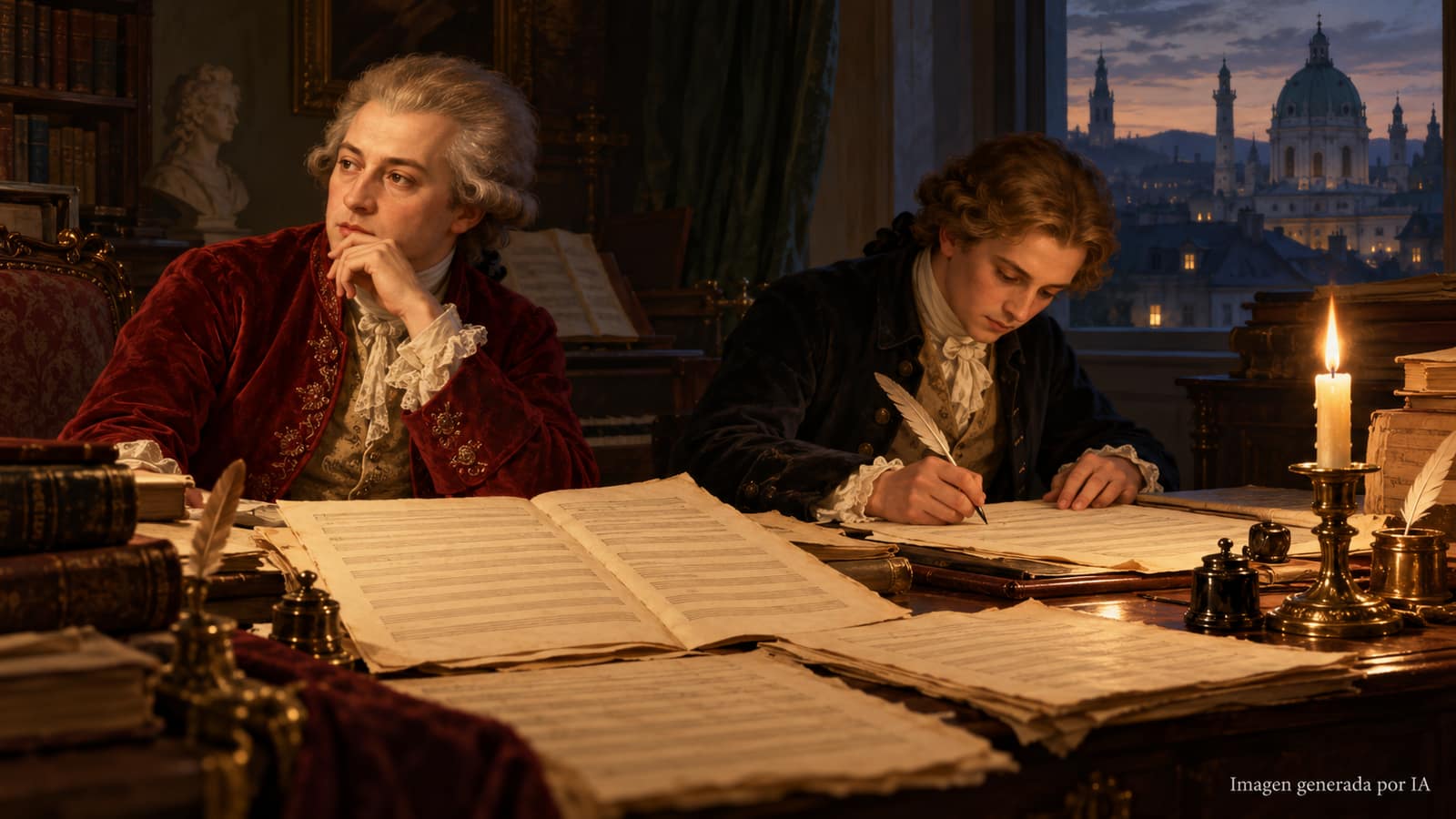
The Requiem in D minor is one of Mozart’s most famous works—and one of classical music’s most persistent mysteries. But the familiar version performed today was not written entirely by Mozart. He left a substantial body of music and sketches; after his death, other musicians completed and orchestrated the score.
The clearest way to understand the Requiem is to separate composition from completion. Mozart supplied much of its musical substance, but the surviving score also reflects the work of Joseph Eybler and, above all, Franz Xaver Süßmayr.
An unfinished commission
Mozart worked on the Requiem in 1791, while also writing The Magic Flute and La clemenza di Tito. The commission came through an intermediary acting for Count Franz von Walsegg, who had a reputation for commissioning music and presenting it as his own. Mozart died on December 5, 1791, before completing the work. The Austrian National Library’s account traces the commission and the score’s complicated history.
What Mozart completed
Mozart left the Introitus (Requiem aeternam) and the Kyrie in substantially complete form. The Kyrie’s main musical conception is his, though some of its orchestral writing may have been supplied or finished by others.
For much of the Sequence, Mozart wrote the vocal lines and bass, and sometimes indicated parts of the instrumental accompaniment. This includes the Dies irae, Tuba mirum, Rex tremendae, Recordare and Confutatis. The music was not fully orchestrated throughout, so a finished performance requires more than simply copying Mozart’s surviving notes.
The Lacrimosa breaks off after Mozart’s opening eight bars of vocal music. It is the most striking point where the manuscript shows the work stopping mid-movement. Mozart also left unfinished material for the Offertory, including Domine Jesu and Hostias. The Mozarteum’s digital edition distinguishes Mozart’s surviving fragments from the later completed score.
Eybler’s attempt—and Süßmayr’s completion
After Mozart’s death, his widow Constanze first asked Joseph Eybler, a composer who had studied with Mozart, to continue the work. Eybler added orchestral material to parts of the Sequence but stopped during the Lacrimosa. His additions survive in the working materials; he did not complete the Requiem.
Constanze then turned to Franz Xaver Süßmayr, another of Mozart’s pupils. Süßmayr prepared the version that became the traditional Requiem: he completed the orchestration and supplied the music needed to finish the work. In the surviving score, the Sanctus, Benedictus and Agnus Dei appear only in the completed version, not among Mozart’s finished movements. The closing Lux aeterna reuses music from the opening Requiem aeternam and the Kyrie, with the text adapted to the ending.
The Austrian National Library notes an important uncertainty: Süßmayr said he composed the missing sections, but scholars have wondered whether Mozart left him sketches or instructions that are now lost. No surviving evidence settles that question.
So, who wrote Mozart’s Requiem?
Mozart composed the opening movements and left substantial musical material for much of what follows. Eybler made an incomplete attempt to continue the orchestration. Süßmayr turned the unfinished materials into the complete work most listeners recognize today.
There may also have been another helping hand: some accounts attribute parts of the Kyrie’s orchestration to Mozart’s pupil Franz Jacob Freystädtler. That is one reason it is too simple to divide the Requiem neatly between Mozart and Süßmayr. The score history summarized by Hyperion also describes Mozart’s short Lacrimosa fragment and the later contributions.
The familiar Requiem is therefore neither a wholly completed Mozart score nor a work invented from scratch by Süßmayr. It is a posthumous collaboration built around Mozart’s surviving composition, with its final shape determined by the musicians who carried it across the finish line.