
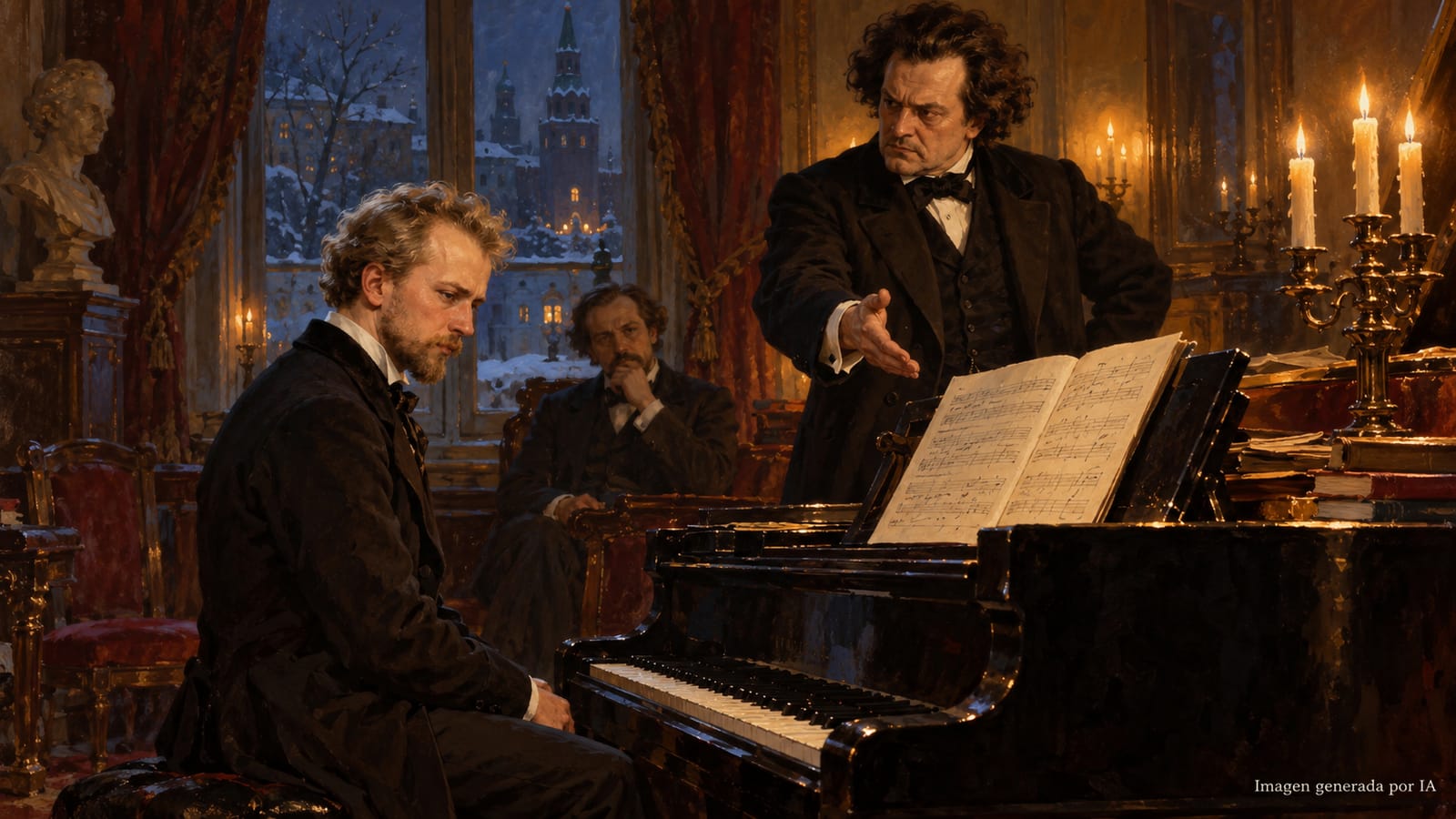
Today, Tchaikovsky’s First Piano Concerto is one of the best-known works in the classical repertoire. But when the composer first played it for pianist and conductor Nikolai Rubinstein, Rubinstein reportedly said that almost the whole piece needed to be rewritten.
The story is often told as a simple clash between a visionary composer and a hostile critic. The details are more interesting: Tchaikovsky had asked Rubinstein for practical advice about the piano part, and received a sweeping rejection of the concerto itself.
Tchaikovsky wanted a pianist’s advice
Tchaikovsky composed his Piano Concerto No. 1 in B-flat minor, Op. 23, between late 1874 and early 1875. He was not a virtuoso pianist, so he turned to Nikolai Rubinstein, one of Moscow’s leading pianists and a close friend, to assess whether the solo part worked at the keyboard.
Tchaikovsky later explained that he wanted a strict critic to point out anything technically awkward or ineffective. He played the concerto for Rubinstein at the Moscow Conservatory on Christmas Eve in 1874, with composer Nikolay Hubert also present. Tchaikovsky’s account of the meeting, written to Nadezhda von Meck several years later, describes his expectation of practical comments—and the silence that followed his performance.
Rubinstein’s devastating verdict
After Tchaikovsky finished playing, Rubinstein began a forceful critique. In the composer’s account, Rubinstein called the concerto impossible to play, described passages as clumsy, and said the work was artistically poor. He reportedly declared that only “two or three pages” could be kept; the rest, he said, should be discarded or completely rewritten.
Tchaikovsky was deeply hurt. He had asked for advice about the piano writing, but understood Rubinstein’s response as a rejection of the music as a whole. When Rubinstein later offered to perform the concerto if Tchaikovsky revised it to his specifications, the composer refused.
“I will not change a single note,” he replied, according to his letter. He sent the concerto to pianist and conductor Hans von Bülow, who responded enthusiastically and accepted the dedication.
The Boston premiere proved the concerto could win an audience
The concerto received its first performance in Boston on October 25, 1875, with von Bülow as soloist and Benjamin Johnson Lang conducting. The audience welcomed it warmly, and von Bülow sent Tchaikovsky reports of its success. The American critics were less unanimous: some admired the work, while others found it strange and overly modern. Tchaikovsky Research’s performance history records the enthusiastic reception and the concerto’s subsequent performances.
That response did not instantly settle the debate. It did, however, show that Rubinstein’s refusal was not the final word on the concerto’s appeal. The work soon reached Russian audiences, and it began establishing the place in the repertoire that it holds today.
Rubinstein changed his mind
The relationship between the two musicians did not remain frozen in that painful room at the Conservatory. At the Moscow performance in December 1875, Rubinstein conducted while Sergei Taneyev played the solo part. A few years later, Rubinstein performed the concerto himself in Paris.
That reversal is one reason the story deserves nuance. Rubinstein’s first response was severe, but his later actions show that he came to support the work. The episode was a painful professional disagreement between two musicians who continued to have a complicated relationship—not a lifelong feud.
Did Tchaikovsky ever revise the concerto?
Yes. Tchaikovsky revised the concerto in 1879 and again in the late 1880s. Those later changes are sometimes treated as proof that Rubinstein had been right. They show that Tchaikovsky kept reconsidering the score, but they do not mean he accepted Rubinstein’s demand to rewrite the work wholesale. The familiar version also reflects a complicated publication history, and some later changes have been debated by scholars. The work history and revision notes trace the different versions.
The distinction matters: in 1874, Tchaikovsky refused to reshape his concerto under pressure. Later, with performances and experience behind him, he chose to make revisions of his own.
Why did Rubinstein reject it?
Rubinstein’s objections included the concerto’s piano writing, which he considered awkward and difficult to play. But Tchaikovsky remembered the criticism as much broader: Rubinstein disliked the work’s musical character and thought it needed radical changes.
The concerto was also an ambitious piece from a composer still developing his orchestral voice. Its dramatic scale, bold opening and demanding solo part made a strong impression, but they also challenged the expectations of some musicians and critics. The original disagreement involved both practical questions about pianism and a difference in artistic judgment.
From rejected manuscript to repertory favorite
Tchaikovsky’s First Piano Concerto was not rejected by every pianist, audience or concert hall. One influential musician rejected its first version in private; another, Hans von Bülow, championed it in public. Tchaikovsky stood by the piece, then revised it on his own terms.
The famous opening now feels inevitable: sweeping orchestral chords, a broad melody and a piano part that announces itself with confidence. Its journey began with a painful refusal, but the concerto’s history was shaped just as strongly by Tchaikovsky’s resolve—and by the audiences who were ready to hear it.