
Introduction
Loquat exists in two different versions: the original piano solo, written in 2021, and a later version for brass quintet, published in 2022 on Brassing Reflections.
Although the instrumentation changes considerably, the two versions are connected by the same compositional idea. Interestingly, the title Loquat was not inspired by the subject matter of the piece. I chose the word randomly from a dictionary while looking for a title, and the music developed independently from it. There is therefore no specific person, place or story behind the title.
The brass version gave me the opportunity to take material originally conceived for a single instrument and redistribute it among five different voices, turning a largely vertical piano texture into a more conversational ensemble.
In this article, I will focus mainly on the brass quintet version and explain how the piece develops through repetition, variation, harmonic colour, rhythmic interaction and changes in instrumentation.
Listen while reading
Composition Process
The Core Idea
The starting point of Loquat is relatively simple: a melodic idea surrounded by harmonies whose colour is often more important than their traditional functional role.
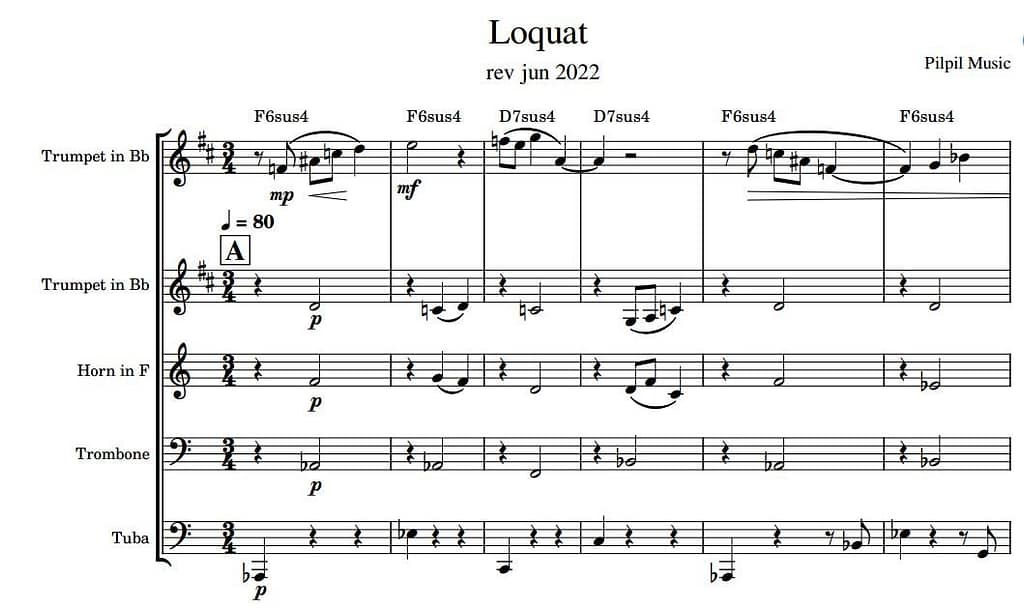
The score opens quietly at ♩=80. The first trumpet introduces the principal melodic material while the other instruments establish a relatively sparse harmonic and rhythmic environment. The opening harmony already reveals an important characteristic of the piece: chords such as F6sus4 and D7sus4 are used not simply as conventional dominant or tonic functions, but as sonorities with their own colour.
This gives the opening a slightly suspended quality. The music moves forward, but the harmony does not always provide a strong sense of traditional tonal direction.
That was important to the character I wanted for the piece.
The A Section
The opening A section establishes most of the musical vocabulary that will return throughout the composition.
The first trumpet carries much of the melodic responsibility, using short phrases, sustained notes and ornamental figures. Underneath it, the second trumpet, horn and trombone provide complementary material, while the tuba establishes the lower register with relatively economical rhythmic figures.
The result is deliberately lighter than a full brass ensemble texture.
Rather than presenting the five instruments as a single block of sound, I wanted them to behave as separate voices.
The score also moves between 3/4 and 4/4, which helps prevent the recurring phrases from becoming mechanically symmetrical.
Harmonic Language
Harmony is one of the most important elements in Loquat.
The chord symbols reveal a vocabulary dominated by:
- major seventh chords;
- minor seventh chords;
- sixth chords;
- ninth chords;
- suspended fourth chords;
- dominant seventh chords.
The opening includes sequences such as F6sus4, D7sus4, B♭6sus4, A7sus4 and Dmaj7, while later sections introduce sonorities such as C♯maj7, C7, Dm7 and F♯m11.
This harmonic language allows me to move between areas without making every transition sound like a conventional modulation.
A particularly useful technique here is the movement between chords that are relatively close in colour but distant in traditional tonal function. The result is a harmony that sounds coherent without always being predictable.
For me, this is one of the defining characteristics of the piece.
Rhythmic Behavior
Rhythm in Loquat is not based on a single repeating ostinato. Instead, it comes from the interaction between different rhythmic layers.
Triplet figures appear frequently in the melodic instruments, while the lower voices often provide shorter, accented gestures. Rests are also important: the brass instruments frequently enter and leave the texture rather than playing continuously.
This creates small spaces between the phrases.
The rhythmic language becomes increasingly active as the piece develops, but the basic pulse remains clear.
There is also a gradual increase in tempo. The opening sections are marked at ♩=80, B1 moves to ♩=90, and C1 reaches ♩=95. The final return to A3 brings the tempo back to ♩=80.
The tempo therefore becomes part of the formal design rather than simply a performance parameter.
The B Section
B1: Increasing the Energy
At B1, the music begins to behave differently.
The tempo increases to 90 BPM and the writing becomes more active. The instruments exchange shorter figures and the rhythmic density increases.
The harmony also moves through a different sequence, including Gmaj7, A6, F♯m11, A7, C7, Dm7 and C♯maj7.
This section therefore functions as a contrast without abandoning the harmonic vocabulary established at the beginning.
It is not a completely new musical world. Instead, it takes familiar materials and increases their intensity.
Return: A2
After B1, the music returns to material derived from A.
This is where the architecture of Loquat becomes particularly important.
The return is not a literal repetition. The material is redistributed and modified. Different instruments take greater prominence, the register changes and the harmonic sequence is adjusted.
I think of these returns less as repetitions and more as different views of the same musical object.
The listener recognizes the material, but it has changed.
C1: The Peak
C1 provides the strongest contrast in the piece.
The tempo reaches ♩=95, and the harmony moves toward F9 and A♭maj9 sonorities. The brass writing becomes considerably more active, with the two trumpets taking prominent melodic roles while the horn and trombone provide additional internal movement and the tuba reinforces the rhythmic foundation.
The texture is denser here than in the opening.
The change is therefore produced through several parameters simultaneously:
tempo + register + rhythmic density + harmonic colour + instrumental activity.
Rather than introducing an entirely unrelated theme, I preferred to intensify the existing material.
Return: A3
At A3, the tempo returns to ♩=80.
This is an important structural decision. After the increased activity of C1, the return to the original tempo creates a sense of release.
The harmonic language also returns toward the sonorities associated with the beginning, including F6sus4 and D7sus4.
The piece therefore ends by returning to its original musical environment rather than trying to create a completely new conclusion.
The final bars, beginning around measure 99, reduce the material to sustained tones across the ensemble. The individual voices converge into a much more static sonority, giving the ending a feeling of suspension rather than a strongly cadential resolution.
Texture and Instrumentation
Writing Loquat for brass quintet required a fundamental change from the piano version.
A pianist can produce melody, harmony, bass and internal accompaniment simultaneously. A brass quintet cannot treat those elements in exactly the same way.
The solution was to distribute the musical functions among the instruments.
The first trumpet frequently carries the principal melodic material.
The second trumpet acts both as a melodic partner and as harmonic reinforcement.
The horn occupies an important middle register, often connecting the upper and lower voices.
The trombone provides another layer of harmonic and melodic support.
The tuba generally anchors the lower register and contributes strongly to the rhythmic character.
The score shows how these roles change throughout the piece rather than remaining fixed.
This redistribution was probably the most significant compositional challenge in creating the brass version.
Structural Design
The formal structure can be summarized as:
A → A1 → B1 → A2 → C1 → A3 → Coda
The important point is that the A material does not simply return unchanged.
Each recurrence modifies one or more musical parameters:
- instrumentation;
- register;
- rhythmic density;
- dynamics;
- tempo;
- harmonic context.
This gives the piece a developmental quality despite the recurring formal structure.
The labels A1, A2 and A3 in the score make this approach explicit.
Compositional Approach
One of the things I find interesting about Loquat is the relationship between repetition and transformation.
I don’t see repetition as necessarily meaning that the music has stopped developing.
A musical idea can return several times and still perform a different structural function each time.
In Loquat, the recurring A material acts almost like a reference point. The listener becomes familiar with it, while the surrounding changes provide the sense of movement.
The B and C sections therefore do not need to introduce completely different thematic material. Their purpose is to alter the conditions in which the existing material is heard.
Compositional Techniques in Loquat
Several techniques are particularly important in the piece:
1. Harmonic colour
Extended and suspended chords are used as colouristic structures rather than purely functional harmony.
2. Motivic transformation
The principal material returns several times, but each recurrence is modified.
3. Instrumental redistribution
Material is transferred between the five brass instruments, changing its timbre and register.
4. Dynamic shaping
The score makes extensive use of crescendos, diminuendos and contrasting dynamic levels to shape phrases.
5. Tempo as structure
The movement from 80 to 90 and then 95 BPM before returning to 80 creates a large-scale arc of increasing and decreasing energy.
6. Rhythmic contrast
Triplets, syncopated figures, accents and rests are combined to create movement without depending on a constant ostinato.
From Piano to Brass Quintet
The two versions of Loquat also illustrate something that interests me as a composer: the same musical idea can acquire a different identity when the instrumentation changes.
The piano version naturally presents the music as a combination of melody and harmony controlled by a single performer.
The brass version separates those functions among five performers.
That changes not only the timbre but also the way the music breathes.
A phrase written for piano can be continuous. A brass ensemble has to deal with breath, articulation, balance and the physical separation between players.
Consequently, the brass version is not simply a transcription of the piano piece. It became an opportunity to reconsider how the original musical material could work when distributed among different voices.
Final Thought
Loquat is a relatively compact composition, but its structure is based on a principle that I return to frequently in my music: developing an idea without abandoning its identity.
The piece begins with a small amount of material and gradually changes its energy, harmony, rhythm and instrumentation.
For me, the interesting part is not how many different ideas can be introduced, but how much can be extracted from one idea before it stops feeling like the same idea.
The 2021 piano version and the 2022 brass quintet version are two different answers to that question.
If you would like more information on these topics, explore the following related posts: