
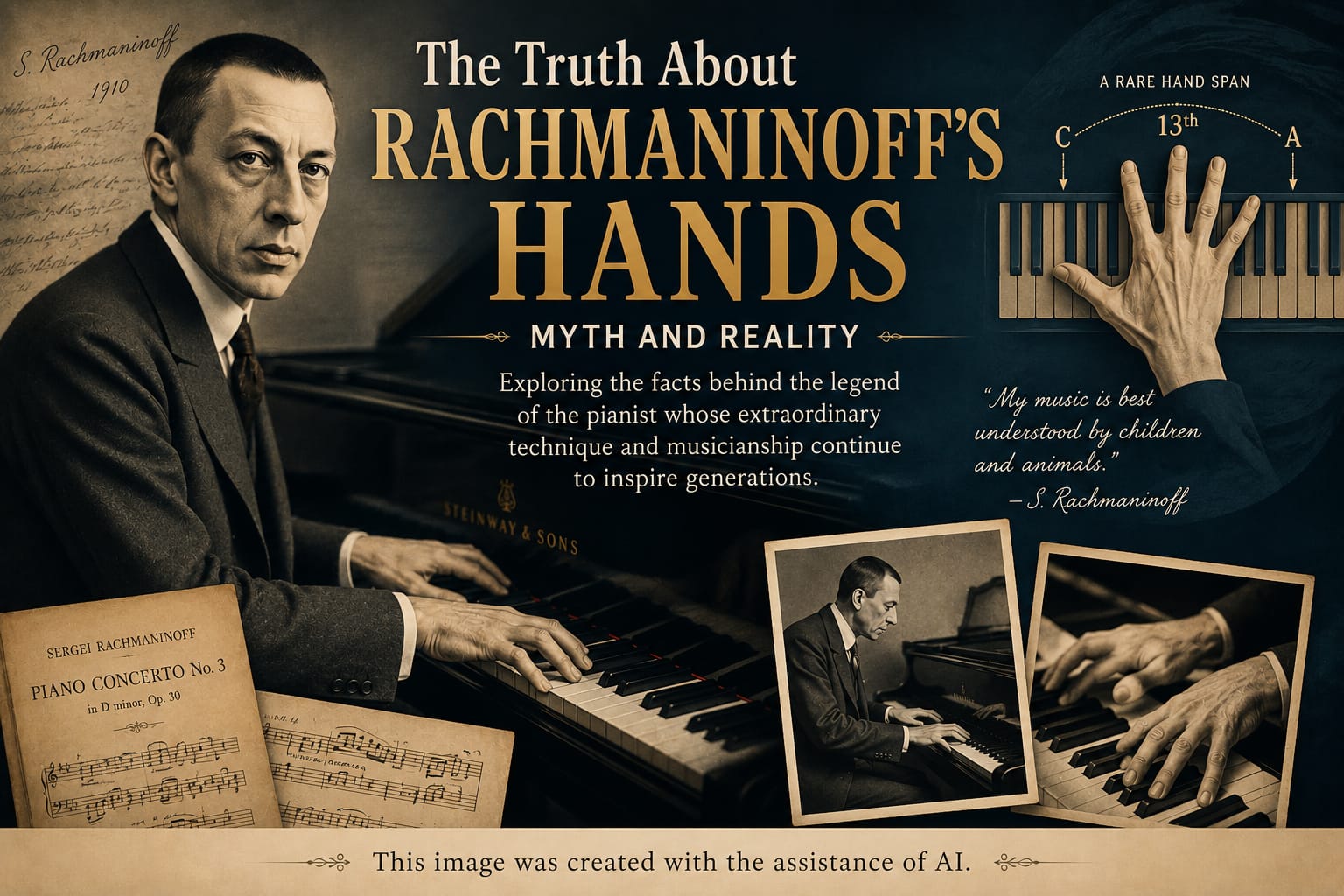
Few topics in classical music generate as much fascination as Sergei Rachmaninoff’s hands. Pianists, music lovers, and even people with little knowledge of classical music have heard stories about his supposedly gigantic hands. Some claim he could effortlessly play impossible chords. Others believe his music is difficult simply because he composed for himself.
But how much of this is actually true?
The reality is more interesting than the legend.
The Legend of Rachmaninoff’s Hands
If you search online for information about Rachmaninoff, you will quickly find statements such as:
- He could reach a thirteenth on the piano.
- His hands were among the largest ever recorded for a pianist.
- Only pianists with exceptionally large hands can perform his music.
Although these statements contain some truth, they often exaggerate the facts.
Rachmaninoff certainly possessed unusually large hands, but his extraordinary pianism cannot be explained by anatomy alone. His success resulted from a rare combination of physical ability, technical mastery, musical intelligence, and years of disciplined practice.
How Large Were His Hands?
No official measurements of Rachmaninoff’s hands exist.
Instead, historians rely on photographs, eyewitness accounts, and the music itself.
Most experts agree that he could comfortably span a major thirteenth—for example, from C to A two octaves above. This is considerably larger than the reach of the average pianist, who can comfortably span an octave and, with training, often a ninth or tenth.
Being able to reach a thirteenth is extremely rare, even among professional pianists.
However, it is important to remember that hand span varies depending on flexibility, relaxation, and the position of the wrist. A maximum stretch does not necessarily represent the intervals a pianist can comfortably play during a fast passage.
More Than Just Large Hands
Many people assume Rachmaninoff’s technical brilliance came simply from having large hands.
This is misleading.
Large hands certainly helped him execute wide chords, but they cannot explain his remarkable control, tone production, and musical expression.
His recordings reveal qualities that have nothing to do with anatomy:
- extraordinary rhythmic precision,
- remarkable voicing,
- seamless legato,
- subtle pedaling,
- effortless phrasing.
Many pianists possess larger-than-average hands, yet very few have demonstrated Rachmaninoff’s artistry.
Did His Hands Influence His Compositions?
The answer is undoubtedly yes.
Many of Rachmaninoff’s piano works contain enormous chords, widely spaced textures, and dense sonorities that reflect what he himself could comfortably play.
Examples include:
- Piano Concerto No. 2
- Piano Concerto No. 3
- Prelude in C-sharp Minor
- Sonata No. 2
- Études-Tableaux
- Moments Musicaux
Some passages contain chords that exceed an octave by a considerable margin, making them intimidating for pianists with smaller hands.
Yet Rachmaninoff himself expected performers to adapt when necessary.
Breaking chords, redistributing notes between the hands, or slightly altering voicings has long been accepted practice.
Even today, many concert pianists make discreet adjustments without compromising the musical result.
Did He Ever Talk About His Hands?
Interestingly, Rachmaninoff rarely discussed the subject.
Unlike many virtuosos who emphasized technical challenges, he preferred to speak about music rather than physical ability.
Friends and colleagues occasionally mentioned his impressive reach, but Rachmaninoff himself never presented it as the secret of his success.
Instead, he consistently emphasized hard work and musical understanding.
The Famous Photographs
Several famous photographs have contributed to the legend.
Images showing Rachmaninoff’s long fingers resting on a keyboard often circulate online, sometimes accompanied by exaggerated claims.
While the photographs clearly show unusually long fingers, perspective can easily distort apparent size.
A hand photographed close to the camera naturally appears larger.
Nevertheless, contemporary witnesses consistently described his hands as exceptional, confirming that the photographs are not entirely misleading.
Can Average Pianists Play Rachmaninoff?
Absolutely.
This is perhaps the greatest misconception surrounding his music.
Thousands of pianists successfully perform Rachmaninoff despite having completely average hands.
The secret lies in intelligent technique rather than physical size.
Professional pianists frequently:
- roll large chords,
- redistribute notes,
- omit doubled notes,
- use subtle pedaling,
- adjust fingering.
These adaptations are standard musical practice and are often impossible for listeners to detect.
What matters is preserving the musical character rather than reproducing every note exactly as written.
Other Pianists with Remarkable Hands
Rachmaninoff was not unique in possessing unusual physical characteristics.
Franz Liszt reportedly had exceptionally long fingers.
Josef Hofmann, despite having relatively small hands, developed extraordinary techniques that allowed him to perform works many considered impossible.
Vladimir Horowitz, another legendary pianist, demonstrated incredible flexibility despite not having exceptionally large hands.
This diversity illustrates an important truth:
There is no ideal hand size for becoming a great pianist.
Technique, intelligence, and musical imagination remain far more important.
Why the Myth Persists
The fascination with Rachmaninoff’s hands reflects a broader human tendency to seek simple explanations for extraordinary achievements.
It is easier to believe that genius resulted from unusual anatomy than from decades of dedication.
Yet Rachmaninoff spent countless hours studying, composing, practicing, and refining his craft.
His large hands undoubtedly offered certain advantages, but they cannot explain the emotional depth of his music, the elegance of his interpretations, or the lasting appeal of his compositions.
Those qualities emerged from his extraordinary musicianship.
What Modern Research Suggests
Biomechanics researchers studying piano performance increasingly emphasize efficiency of movement rather than maximum hand span.
Large hands can sometimes create disadvantages:
- reduced agility,
- increased muscular tension,
- greater difficulty in rapid finger independence.
Conversely, pianists with smaller hands often develop highly efficient movement strategies that compensate remarkably well.
Modern pedagogy therefore focuses less on physical dimensions and more on healthy technique.
This perspective reinforces the idea that Rachmaninoff’s greatness cannot be reduced to anatomy alone.
Conclusion
Sergei Rachmaninoff did possess unusually large hands.
He could almost certainly span intervals that most pianists cannot reach comfortably, and this physical advantage influenced his compositional style.
However, the popular image of Rachmaninoff as a pianist whose greatness depended solely on gigantic hands is a myth.
His artistry resulted from exceptional musicianship, profound musical insight, disciplined practice, and remarkable technical refinement.
Perhaps the most inspiring lesson is this:
Rachmaninoff’s music does not belong only to pianists with extraordinary hands.
It belongs to every musician willing to approach it with intelligence, patience, and respect for the composer’s extraordinary musical imagination.