
A Squirrel and His Cherry Tree, released in 2022 for solo piano, explores movement, playfulness, and rhythmic vitality through repetitive patterns and bright harmonic motion.
The piece is built around a strong rhythmic pulse that remains active almost continuously. Rather than lyrical introspection, the music focuses on agility, momentum, and the unpredictable energy of constant movement.
This article explores my compositional process through this piece.
Listen while reading:
Composition Process
The Core Idea
The piece is driven by rhythmic propulsion and repetitive accompaniment patterns.
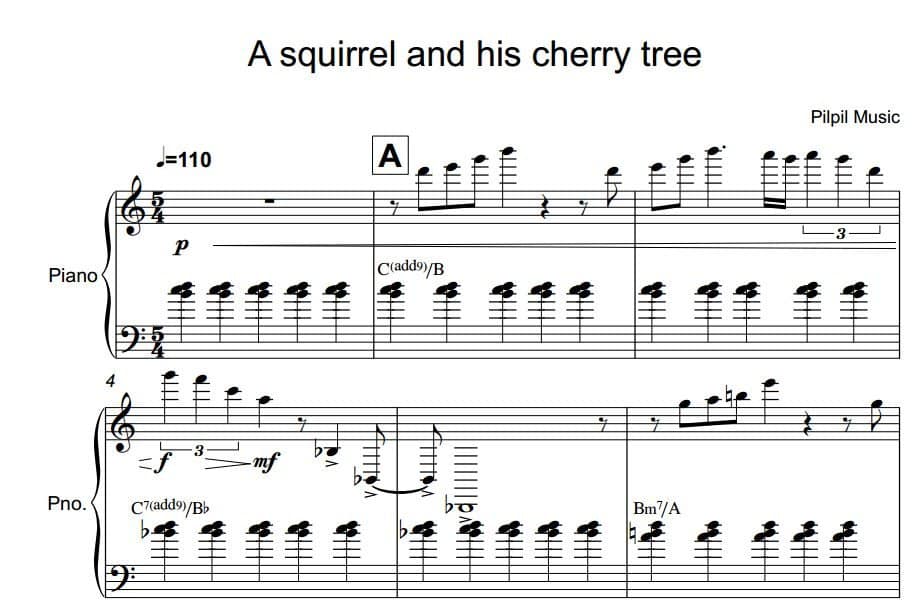
From the opening (♩ = 110) :
- the left hand establishes a constant ostinato-like pulse
- melodic gestures appear in short energetic fragments
- harmony shifts rapidly while maintaining continuity
This creates:
- forward momentum
- lightness
- playful tension
The music behaves almost like continuous motion in nature: quick, irregular, but always energetic.
The A Sections — Rhythmic Identity
The A sections (A, A1, A2, A3) define the main identity of the piece.
Recurring harmonic areas include:
- E♭maj7
- E°
- Dm7
- D7
- D7(#5)
The accompaniment maintains repeated rhythmic figures while melodic fragments move rapidly above them.
This creates:
- continuity through repetition
- rhythmic insistence
- constant activity
The piece does not rely on large thematic development. Instead, variation emerges through:
- harmonic color
- register changes
- rhythmic articulation
The rhythmic insistence gives the impression of restless curiosity, constantly jumping from one idea to another.
Harmonic Language
Harmony functions through color and motion rather than traditional resolution.
Across the piece, we encounter:
- altered dominants
- diminished harmonies
- suspended tonal centers
- chromatic transitions
Particularly important are:
- E°
- D7(#5)
- F7(#5)/C#
- A♭m7/E♭
These sonorities:
- destabilize tonal expectation
- create playful unpredictability
- reinforce continuous movement
Harmony acts less as destination and more as momentum.
Rhythmic Behavior
Rhythm is the central structural force of the piece.
Throughout the score:
- repetitive accompaniment figures remain almost uninterrupted
- accents shift subtly
- melodic lines interact dynamically with the pulse
This produces:
- kinetic energy
- perpetual motion
- dance-like vitality
The repeated rhythmic engine creates the sensation of quick movement and restless activity.
The B Section — Harmonic Diversion
The B section introduces contrast through harmonic displacement and expanded texture.
Here:
- harmony becomes more chromatic
- textures become denser
- melodic motion broadens slightly
The harmonic movement through:
- Gmaj7/D
- A♭m7/E♭
- C#m6
- F7(#5)/C#
creates temporary instability before returning to the rhythmic certainty of the A material.
This section feels less grounded and more exploratory.
Return (A2 / A3) — Reaffirmation of Motion
When the A material returns:
- rhythmic insistence becomes even clearer
- the accompaniment regains dominance
- harmonic tension resolves through repetition itself
The return does not function as dramatic resolution, but as recovery of momentum.
The ending maintains movement almost until silence.
Texture and Piano Writing
The piano writing is strongly pattern-based.
The left hand provides:
- continuous rhythmic grounding
- harmonic propulsion
- mechanical continuity
The right hand introduces:
- fragmented melodic gestures
- rhythmic accents
- dynamic contrast
Rather than melody over accompaniment, both hands participate equally in generating movement.
Structural Design
The piece follows a cyclic ABA-derived structure:
- A — rhythmic identity established
- B — harmonic and textural deviation
- A1 / A2 / A3 — progressive return and reinforcement
This structure supports:
- repetition with variation
- continuity without stasis
- energetic coherence
Compositional Approach
In this piece, I focused on:
- using repetitive rhythm as structural identity
- creating movement through accompaniment patterns
- maintaining constant energy
- balancing playfulness and tension
The goal was to create a piece that feels alive, agile, and continuously active.
Compositional Techniques in A Squirrel and His Cherry Tree
This work combines repetitive rhythmic cells, chromatic harmonic shifts, and pattern-based piano writing. The interaction between rhythmic continuity and harmonic instability creates a dynamic musical surface characteristic of contemporary minimalist and neoclassical piano music.
Final Thought
A Squirrel and His Cherry Tree is not about narrative development.
It is about movement itself.
Through repetitive rhythm, harmonic color, and continuous momentum, the piece creates a playful musical space where energy never fully settles.
If you would like more information on these topics, explore the following related posts: