
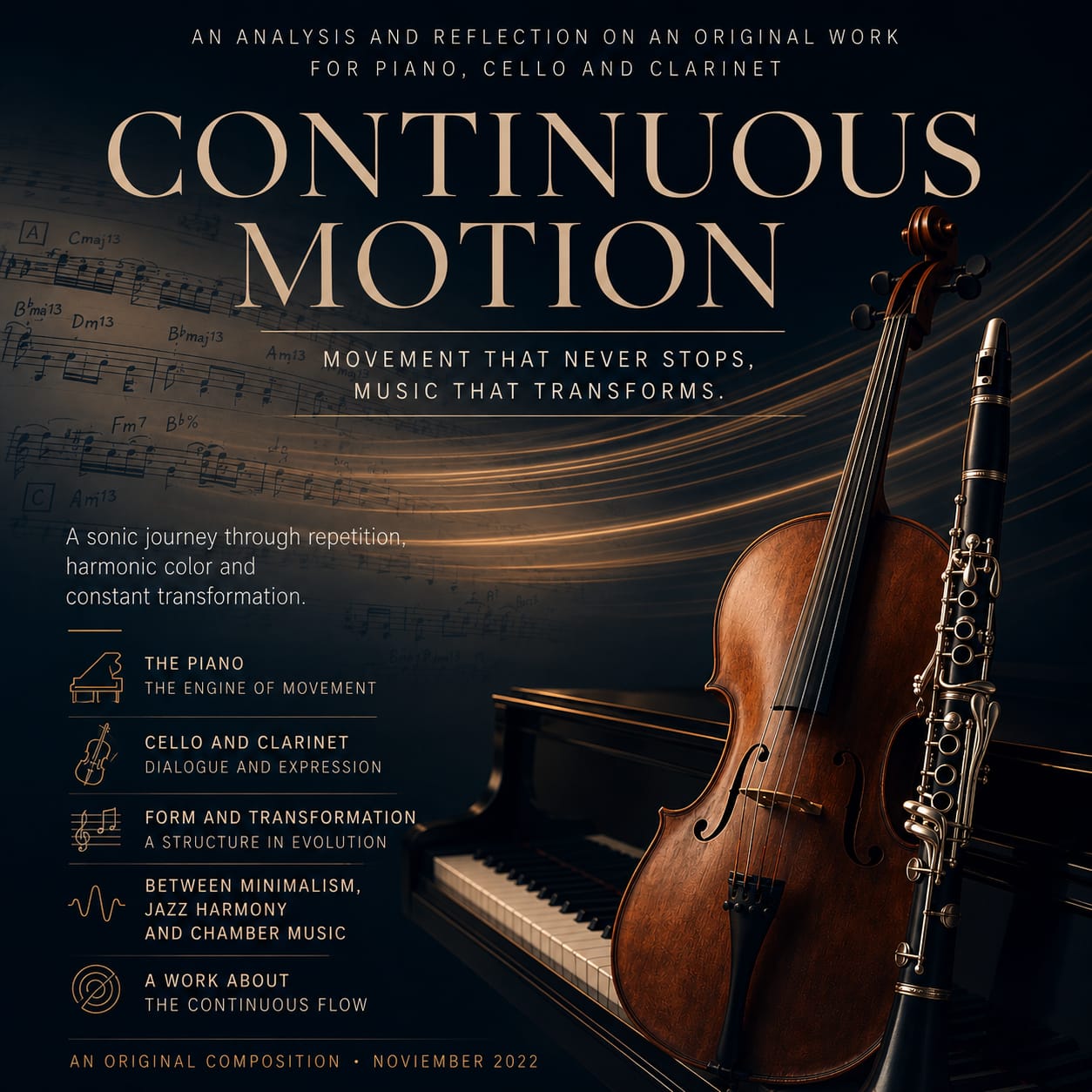
There are compositions born from melody, others from harmony, and some from rhythm. Continuous Motion emerged from movement itself: the idea of a musical current that never completely settles, always advancing, transforming, breathing. Written in November 2022 for piano, cello and clarinet, the piece explores repetition, gradual harmonic shifts and the tension between stability and change.
The title reflects both the structural and emotional core of the work. Almost every section is built around flowing piano ostinatos that create a sense of perpetual travel. Rather than presenting abrupt contrasts, the composition evolves organically, allowing small harmonic and textural changes to reshape the atmosphere over time.
This article explores my compositional process through this piece.
Listen while reading (two versions of the same piece):
The piano as the engine
From the opening bars, the piano establishes the pulse of the piece through repeating broken-chord patterns. These figures are intentionally persistent, functioning almost like a minimalist mechanism, yet the harmonic language avoids strict minimalism by constantly introducing color tones and modal inflections.
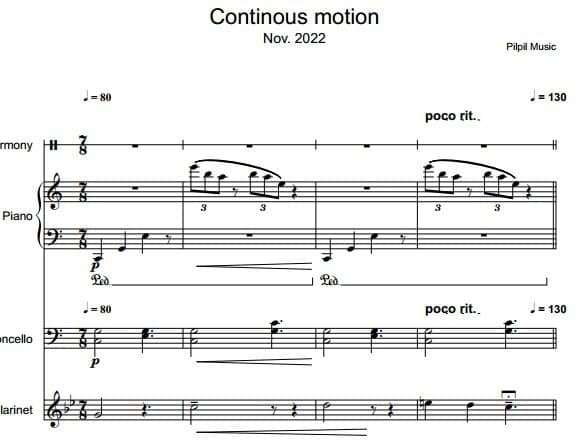
Much of the harmonic vocabulary revolves around extended jazz-influenced sonorities such as Cmaj13, Dm13, Bbmaj13 and altered dominant colors. Instead of resolving dramatically, these harmonies drift into one another, creating continuity rather than punctuation. The listener experiences harmony as motion instead of destination.
The left and right hands of the piano rarely behave as isolated layers. They operate together as a flowing texture whose main purpose is propulsion. Even during quieter passages, the underlying rhythmic activity continues almost uninterrupted.
The role of the cello and clarinet
While the piano provides continuity, the cello and clarinet shape the emotional narrative.
The cello often acts as the lyrical anchor of the ensemble. In many passages it introduces long sustained tones over the piano ostinatos, creating tension between linear movement and harmonic suspension. At other moments, especially in the middle sections, it becomes more rhythmically active and conversational. The use of pizzicato in section C introduces a lighter and more transparent texture before the music gradually rebuilds intensity.
The clarinet provides contrast through phrasing and timbral flexibility. Sometimes it doubles or reinforces harmonic colors; elsewhere it floats above the ensemble with more improvisatory gestures. Its ability to move smoothly between warmth and brightness made it ideal for a piece centered on fluid transformation.
Rather than treating the instruments as soloists accompanied by piano, the composition aims for interdependence. The three voices continuously exchange roles between foreground and background.
Formal design and transformation
The structure of Continuous Motion is based on evolving sections rather than traditional thematic development.
The work introduces an initial atmosphere around Cmaj13 before moving through a chain of harmonic regions including Dm13, Bbmaj13, Am13 and Abmaj13. These harmonic transitions are essential to the emotional pacing of the piece. Each area preserves the rhythmic identity established at the beginning while subtly changing the emotional temperature.
A significant transformation occurs in section B, where the tempo increases and the harmonic language becomes more unstable through chromatic movement and altered sonorities such as Fm7 and Bb%. The texture grows denser and more energetic, giving the impression that the music is accelerating internally even when the pulse remains controlled.
Section C introduces a more open and transparent sound world through pizzicato cello writing and suspended harmonic colors including add9 and #11 sonorities. This moment acts almost like suspended time before the return of earlier material.
The reprise of the opening ideas is not a literal repetition. By the final pages, the listener hears familiar harmonic movement differently because the preceding sections have altered its emotional meaning. The ending gradually dissolves through ritardando and thinning textures rather than concluding with a dramatic cadence.
Between minimalism, jazz harmony and chamber music
One of the central ideas behind Continuous Motion was combining repetitive motion with harmonic richness. The repetitive piano writing may evoke certain minimalist aesthetics, but the harmonic language is closer to jazz-influenced contemporary chamber music.
The extended chords and smooth voice-leading were important compositional tools. Instead of creating tension through rhythmic complexity, the piece generates interest through evolving harmonic color and orchestration.
At the same time, the work remains intentionally accessible. Despite the harmonic sophistication, the emotional language is direct: movement, reflection, acceleration and release.
A piece about flow
More than anything, Continuous Motion explores the psychological effect of uninterrupted continuity. Even when the harmony darkens or the texture becomes more intense, the music keeps moving forward. There are very few complete stops, both literally and emotionally.
The piece reflects the idea that transformation often happens gradually, almost imperceptibly, through accumulation rather than rupture. Motion itself becomes the narrative.
For this reason, the ending does not attempt to provide a definitive conclusion. The music simply fades from view, as though the motion continues beyond the final bar.
If you would like more information on these topics, explore the following related posts: