
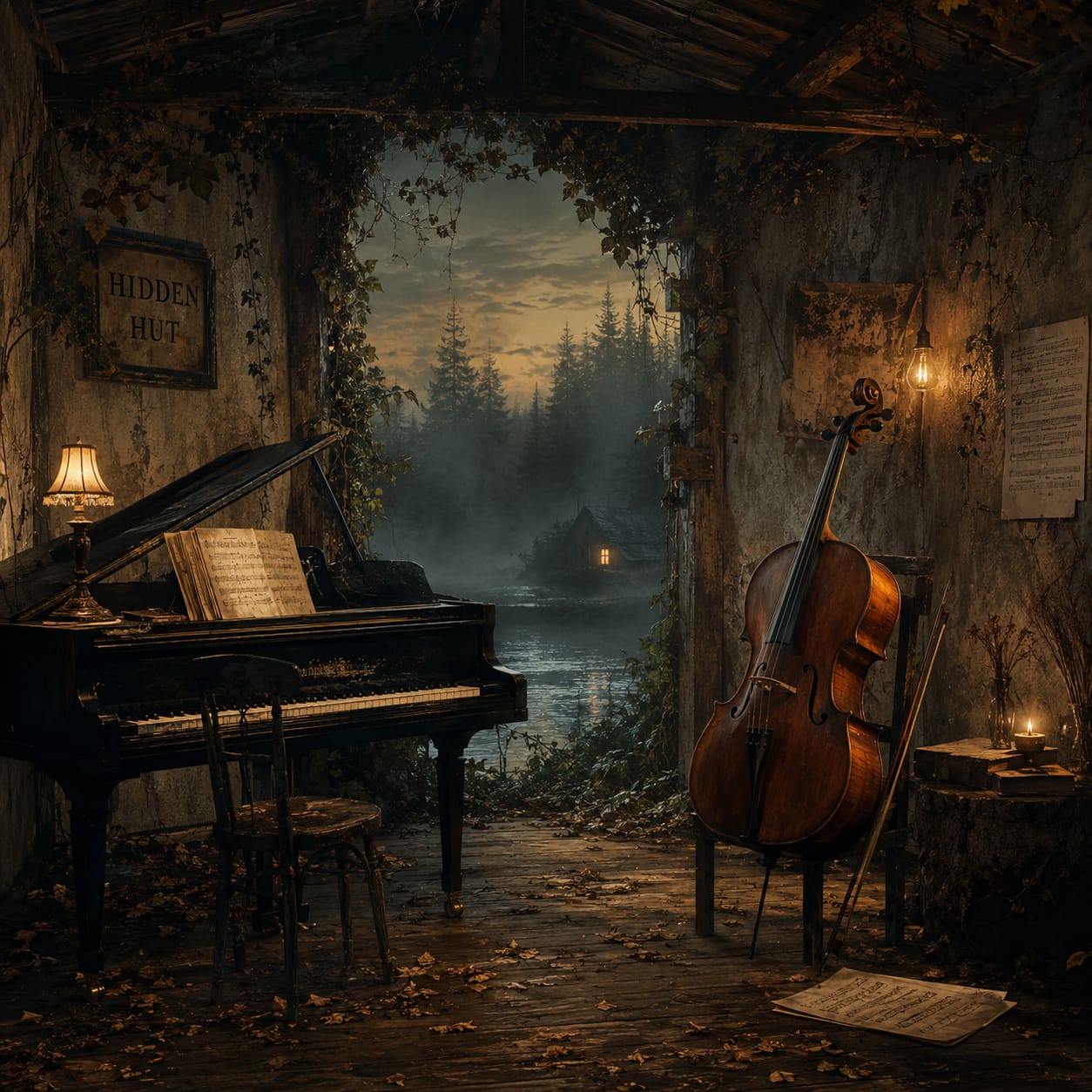
Hidden Hut, originally released for solo piano in 2022 and later adapted for piano and cello in the album Piano & Cello Junction, explores stillness, distance, and hidden spaces through harmonic suspension and gradual motion.
Unlike tension-driven works, this piece focuses on containment. The music moves carefully, as if revealing a place that remains partially concealed.
This article explores my compositional process through this piece. The piece uses suspended harmony and repetition to create continuity without traditional resolution.
Listen while reading (two versions of the same piece):
Composition Process
The Core Idea
The piece is built on slow harmonic motion and suspended melodic gestures.
From the opening (♩ = 60 → 90) :
- isolated piano gestures emerge gradually
- harmony avoids clear resolution
- the cello introduces long, restrained melodic lines
This creates:
- a sense of distance
- controlled stillness
- quiet expectation
The music does not attempt to progress quickly. It unfolds carefully.
The A Section — Harmonic Suspension
The first section (A) establishes the main atmosphere of the piece.
Recurring harmonic areas include:
- Gmaj7/D
- Gmaj7(b5)/Db
- Fmaj7/C
- B7(b5)
These sonorities:
- avoid traditional cadential behavior
- create ambiguity between tonal centers
- emphasize color over resolution
Rather than directional harmony, the piece relies on harmonic suspension.
The piano introduces repeating harmonic patterns while the cello sustains longer melodic phrases above them.
Rhythmic Behavior
Rhythm remains restrained throughout the work.
- slow pulse
- repeated accompaniment figures
- absence of strong accents
This produces:
- temporal suspension
- calm continuity
- lack of urgency
The listener perceives movement, but without pressure.
The B Section — Interior Contrast
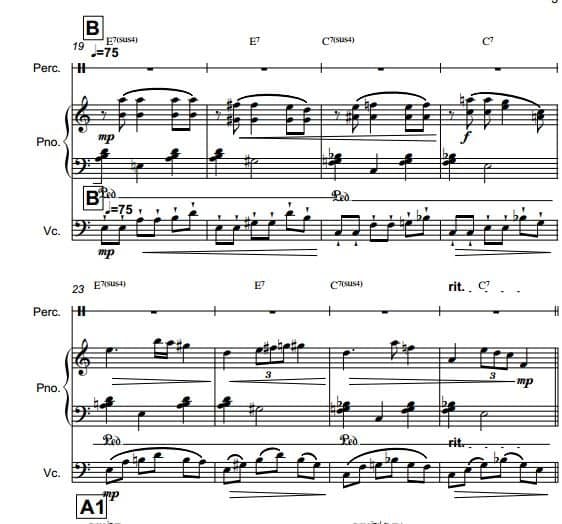
The B section (♩ = 75) introduces contrast through texture and harmonic tension.
Here:
- articulation becomes more active
- harmonic movement increases
- melodic gestures become more fragmented
The harmonic language shifts toward:
- E7(sus4)
- E7
- C7(sus4)
- C7
This creates:
- instability
- ambiguity
- a more introspective atmosphere
The contrast does not break the calm character of the piece, but introduces hidden tension beneath the surface.
Return (A1 / A2) — Reappearance of Space
When the A material returns, the original harmonic atmosphere is restored.
However:
- dynamics expand slightly
- texture becomes denser
- melodic interaction increases
The same material now feels:
- more fragile
- more distant
- more emotionally exposed
The return functions less as repetition and more as recollection.
Texture and Instrumentation
The piano–cello version expands the original solo piano texture. The cello acts less as a solo voice and more as an extension of the harmonic atmosphere.
The piano provides:
- harmonic grounding
- repeated accompaniment patterns
- spatial resonance
The cello introduces:
- sustained melodic continuity
- timbral warmth
- expressive phrasing
The interaction between both instruments creates a chamber texture built on balance rather than contrast.
Structural Design
The piece follows an expanded ABA design:
- A — harmonic suspension and calm motion
- B — increased harmonic tension and fragmentation
- A1 / A2 — return and gradual dissolution
The structure supports the central idea:
- revealing tension slowly
- returning to stillness without full resolution
Compositional Approach
In this piece, I focused on:
- using suspended harmony instead of functional progression
- creating continuity through repetition
- controlling tension through texture and register
- maintaining emotional restraint
The goal was to create a musical space that feels hidden, distant, and partially unresolved.
Compositional Techniques in Hidden Hut
This work combines suspended harmonic language, repetitive accompaniment figures, and restrained melodic writing. The interaction between harmonic ambiguity and slow rhythmic motion creates an introspective atmosphere characteristic of contemporary neoclassical chamber music.
Final Thought
Hidden Hut is not about dramatic development.
The piece never fully resolves because the place it represents is never fully revealed.
Through suspended harmony, restrained motion, and gradual transformation, the piece explores the feeling of discovering a hidden place that never fully reveals itself.
Listen to the piece and focus on how repetition and harmonic ambiguity create continuity without resolution.
If you would like more information on these topics, explore the following related posts: