
Orchestral composition process
What does a musical celebration sound like?
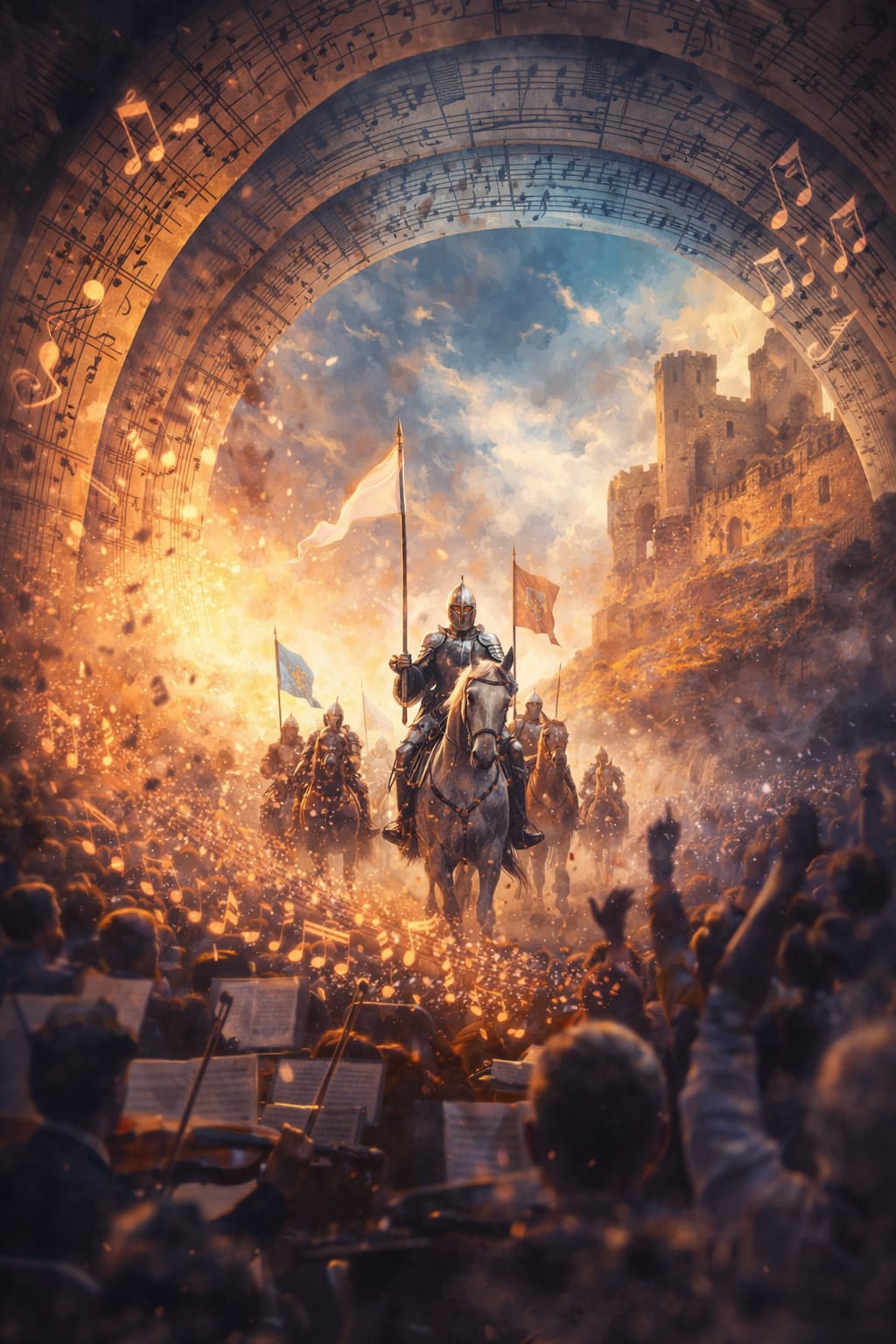
This article explores my orchestral composition process through the piece “Parade”. It captures the energy of a crowd as knights pass through the castle, transforming movement and rhythm into a continuous musical flow. Part of the album Forgotten Castle, inspired by the castle of Astúlez, the piece reflects not the architecture itself, but the human activity that once filled it.
The focus here is movement, brightness, and shared excitement. Listen while reading:
The Core Idea
The piece is built around continuous forward motion. The constant rhythmic drive reflects the visual flow of a parade: continuous, layered, and always moving forward.
The piece sits between rhythmic minimalism and cinematic orchestral writing, where repetition defines structure rather than harmony.
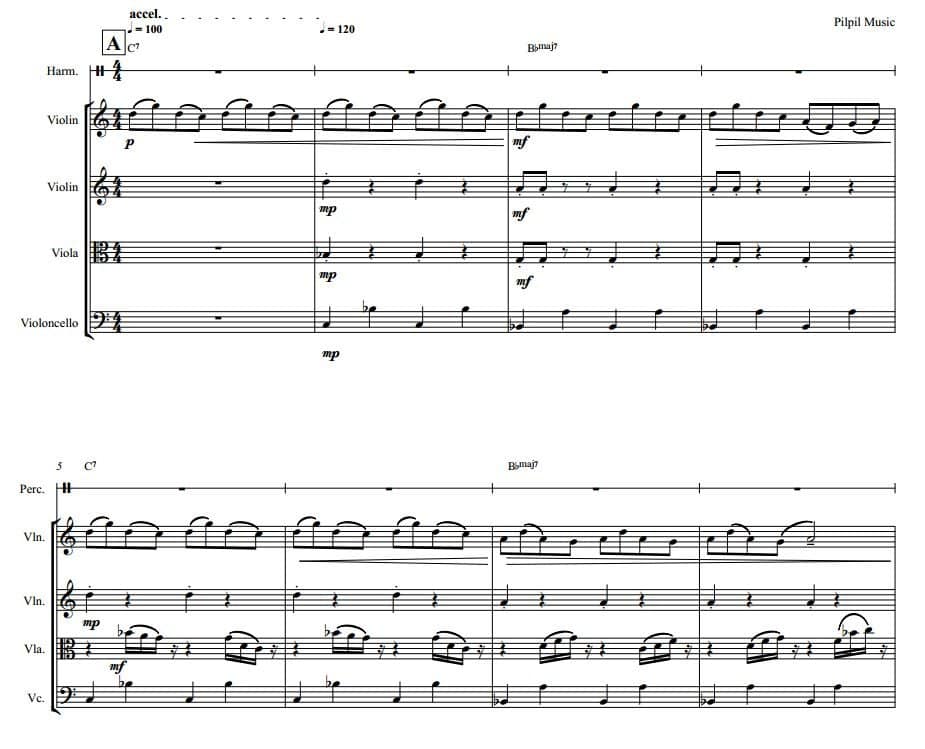
From the opening bars, a fast tempo (accelerating toward ♩ = 120) establishes an energetic character. Rather than relying on large melodic statements, the music is driven by a persistent rhythmic pattern in semiquavers, which defines the identity of the piece.
This repeating figure functions as a motor:
- it creates momentum
- it maintains tension
- it unifies the entire structure
The Rhythmic Motif
The most characteristic element appears early and remains present throughout: a repetitive semiquaver pattern distributed across the strings.
As seen in the first page of the score :
- the first violin introduces flowing, articulated figures
- accompanying voices reinforce the pulse
- the pattern repeats with slight variations
This motif is not developed in a traditional sense. Instead, it is:
- repeated
- recontextualized
- passed between voices
This creates a sense of celebration in flow, like a parade that never stops advancing.
Harmonic Language
The harmonic framework supports clarity and brightness rather than complexity.
The opening alternates between sonorities such as C7 and B♭ major areas , creating a tonal environment that feels:
- stable
- open
- accessible
Later sections introduce shifts (A minor, G major, F major regions visible in the score), but always within a clear harmonic space. Harmony here does not drive the form—it supports the rhythmic energy.
Texture and Orchestration
The piece is written for a string quartet.
The orchestration emphasizes:
- rhythmic clarity
- layered flow
- contrast between articulation types
For example:
- violins carry the continuous momentum
- lower strings reinforce harmonic grounding
- pizzicato passages (visible in mid sections ) add percussive definition
- glissandi introduce color and variation without breaking momentum
The result is a texture that is active but controlled, avoiding saturation.
Development
The piece evolves through density and articulation, not thematic transformation.
As it progresses:
- more voices participate simultaneously
- dynamics increase toward forte passages
- articulation becomes more defined
Sections such as the central build-up and later returns (A1) reuse the same material, but:
- with different balance
- increased intensity
- altered orchestration
This reinforces the idea of a procession that grows in presence as it advances.
Structural Design
The structure can be understood as a cycle of energy:
- Initial drive — introduction of the rhythmic engine
- Expansion — layering and increased density
- Contrast — articulation changes (pizzicato, glissandi)
- Return (A1) — reappearance of the main material with greater intensity
- Final drive — acceleration and culmination
The ending maintains the forward energy rather than resolving it, preserving the sense of ongoing movement.
Compositional Approach
In this piece, I focused on:
- using a single rhythmic idea as the core identity
- maintaining continuous flow without interruption
- keeping harmony clear and supportive
- varying texture instead of developing themes
The goal was not contrast, but consistency with variation.
Compositional Techniques in Parade
This piece uses a loop-based rhythmic cell in semiquavers as its primary structural element. The redistribution of this pattern across the ensemble, combined with clear harmonic areas and articulation changes, creates a dynamic yet coherent musical surface typical of contemporary cinematic and neoclassical writing.
Final Thought
Parade is not about narrative development—it is about presence.
Through fast rhythmic motion and repeated patterns, the piece captures a moment of collective joy: a procession that moves forward with energy, color, and continuity, echoing the life that once filled the walls of the castle.
Listen to Parade as part of the album Forgotten Castle, where each piece connects to a broader narrative. To fully understand its role and meaning, listen to the complete album and experience how the works interact and complement each other.
If you would like more information on these topics, explore the following related posts: