
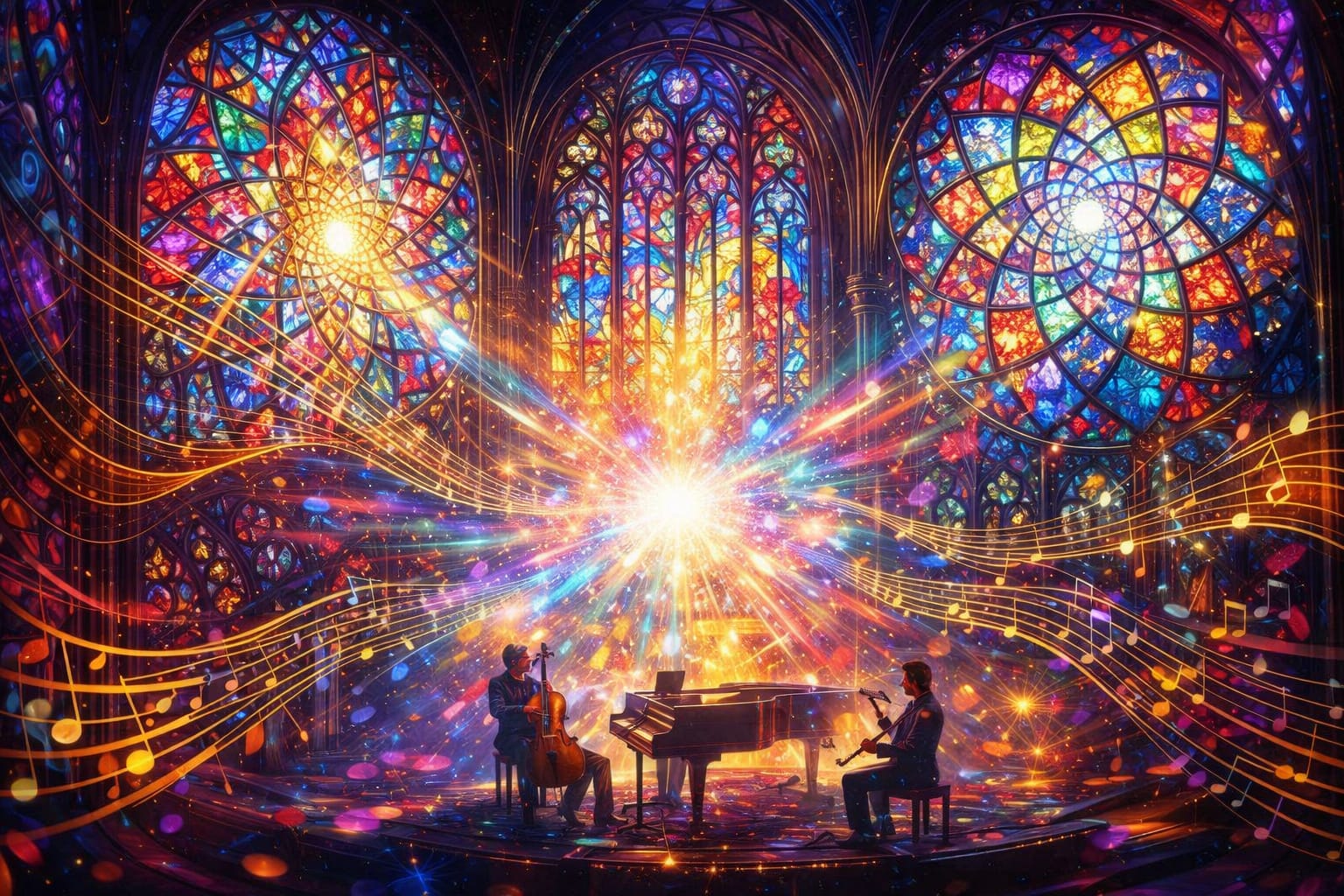
How can a visual experience become music?
When I composed Stained Glass, I was not trying to describe a stained-glass window through melody. I wanted to capture something more elusive: the way light moves through colored glass, changing the perception of shapes, colors and space from one moment to the next.
That idea became the starting point for the composition.
Instead of building the piece around a conventional theme and developing it through contrasting sections, I worked with short rhythmic cells, shifting harmonic colors and constantly changing instrumental textures.
The result is a piece in which the music behaves more like changing light than a traditional narrative.
There are two versions of Stained Glass: a chamber version for piano, cello and clarinet, and a version for woodwind ensemble. The instrumentation changes, but the underlying compositional idea remains the same.
Listen while reading. See 2 versions above (Piano, cello & clarinet – Woodwind chamber)
The Core Idea: Motion Without a Fixed Image
The central concept behind Stained Glass is movement.
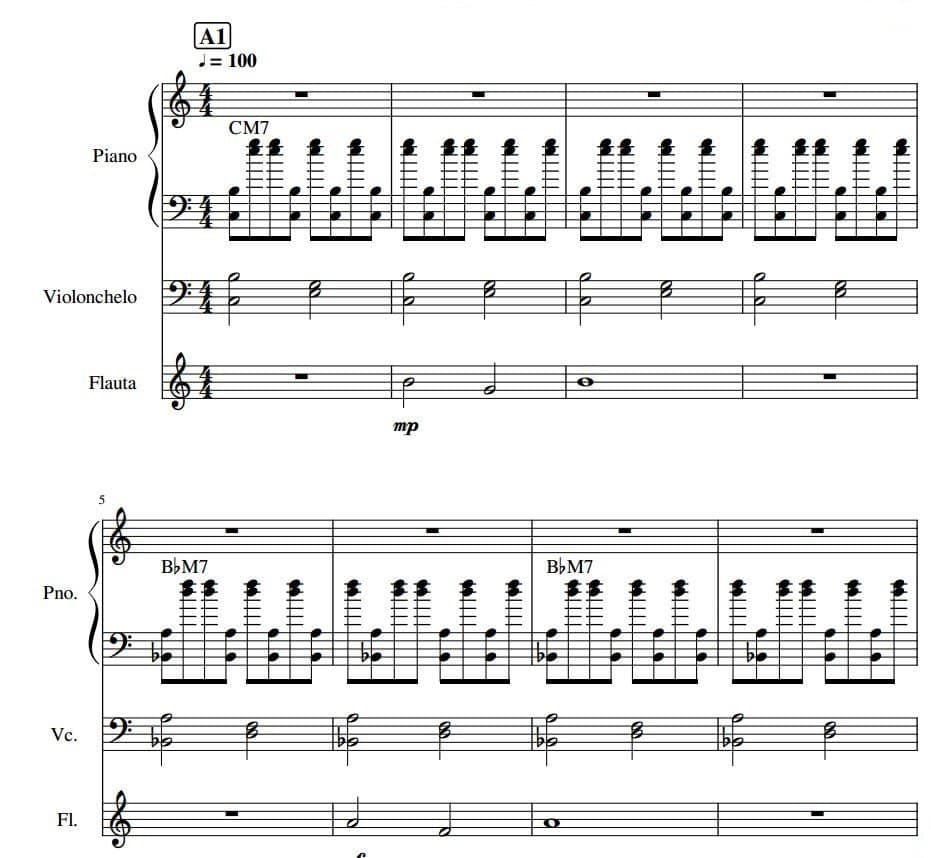
At the beginning of the piece, small rhythmic cells appear and begin to interact. Rather than presenting a long, clearly defined melody, I wanted the listener to perceive a surface that is constantly changing.
Short figures are repeated, displaced and redistributed between instruments.
This creates an important compositional principle:
The material remains recognizable, but its context is never completely stable.
That is similar to looking at stained glass while the light changes. The window itself does not move, but our perception of it does.
Building the Music from Small Rhythmic Cells
One of the main techniques I used in Stained Glass was to construct the texture from relatively small rhythmic figures.
The musical language relies on:
- Short repeated motifs
- Continuous rhythmic subdivision
- Small changes in articulation and emphasis
- Displacement between instrumental voices
- Redistribution of material throughout the ensemble
I was interested in what happens when a small musical idea is repeated without simply being copied.
A rhythmic cell can remain essentially the same while its register, instrumentation, harmonic context or relationship with the surrounding voices changes.
This creates movement without requiring a completely new theme.
The listener therefore hears something familiar, but never exactly the same.
Harmonic as Color
Harmony plays a different role in this piece.
Rather than using chords primarily to create a traditional functional progression, I used them as changes of harmonic colour.
Early sections of the composition include sonorities such as:
- B♭maj7
- E♭m7
- Dm7
The important element is not simply the chord itself, but what happens to the surrounding texture when the harmony changes.
A harmonic shift can alter the perceived colour of the entire passage without stopping the rhythmic flow.
This was particularly important for the original visual concept.
If the rhythmic activity represents the movement of light, the harmony provides something closer to the changing colour of that light.
Orchestration: Moving the Texture Between Instruments
Stained Glass exists in two different versions, and this provided an opportunity to explore the same compositional material through different instrumental combinations.
Piano, Cello and Clarinet
In the chamber version, the piano carries much of the rhythmic activity.
The cello and clarinet can then sustain, reinforce or reshape the surrounding texture.
This creates a more concentrated sound world, where the three instruments interact closely.
Listen to the Piano, Cello & Clarinet version on Bandcamp
Woodwind Ensemble
The woodwind version allows the same basic idea to become more distributed.
Rapid figures can move between flutes and oboes, while the clarinet can connect different layers of the texture. The bassoons provide harmonic grounding underneath the more active upper voices.
The result is not simply an orchestration of the first version.
Changing the instrumentation changes the way the same musical concept is perceived.
This is one of the aspects of orchestration that I find particularly interesting: the compositional identity of an idea can remain intact while its acoustic character changes completely.
Listen to the Woodwind Ensemble version on Bandcamp
Development Through Density
The development of Stained Glass is based less on introducing completely new material and more on changing the density and distribution of existing material.
As the piece progresses:
- More voices become active.
- Rhythmic layers begin to overlap.
- Harmonic areas change.
- Existing material returns in different combinations.
- The texture becomes progressively denser.
This creates development without relying on conventional thematic contrast.
In some sections, the listener is essentially hearing the same musical world from a different perspective.
That is closely connected to the original image behind the composition: the stained-glass window remains the same, while the light changes the way we perceive it.
Structure: Variation Through Continuity
The structure of the piece can therefore be understood as a process of continuous transformation:
Initial texture → Expansion → Reframing → Increased density → Dissolution
The returning sections do not necessarily introduce completely new musical ideas. Instead, previously established material is reorganized.
A different instrument may take over a figure.
A rhythmic pattern may move into another register.
A harmonic change may alter the perceived colour.
Several independent layers may become more densely combined.
The structure emerges from these transformations rather than from strong contrasts between unrelated sections.
What I Was Trying to Achieve
With Stained Glass, I wanted to explore how much musical movement can be created from relatively limited material.
The composition is based on four main ideas:
- Small rhythmic cells provide the basic movement.
- Harmonic colour changes the atmosphere without interrupting the flow.
- Orchestration distributes the movement between instruments.
- Variation in density creates the sensation of development.
The challenge was to maintain continuous activity without making the texture feel completely saturated.
For me, the composition is therefore less about telling a story and more about creating a changing perceptual environment.
From Visual Perception to Musical Texture
This is ultimately what Stained Glass is about.
A stained-glass window is static. The light passing through it is not.
Colours appear to change. Shapes become more or less prominent. Different areas attract our attention.
I tried to reproduce that principle through music.
The rhythmic cells provide continuous movement. The harmony changes the colour. The orchestration determines where the listener’s attention moves. Changes in density alter the overall intensity.
The result is not a musical illustration of a particular window.
It is an attempt to translate the experience of changing light into musical texture.
Final Thought
Stained Glass is not about melody or narrative. It is about perception.
Through rapid rhythmic motion and shifting harmonic color, the piece transforms a visual experience into sound: a constantly changing field of light, where no moment is exactly the same as the previous one.
If you want to explore how these ideas translate into sound, listen to the full piece and compare both versions of Stained Glass:
The piece sits stylistically between post-minimalism and contemporary neoclassical composition, where repetitive structures, harmonic color, and textural transformation define the musical language. Its approach to repetition and texture connects with composers such as Philip Glass or John Adams, while maintaining a more fragmented and color-driven orchestral writing.
If you would like more information on these topics, explore the following related posts: