
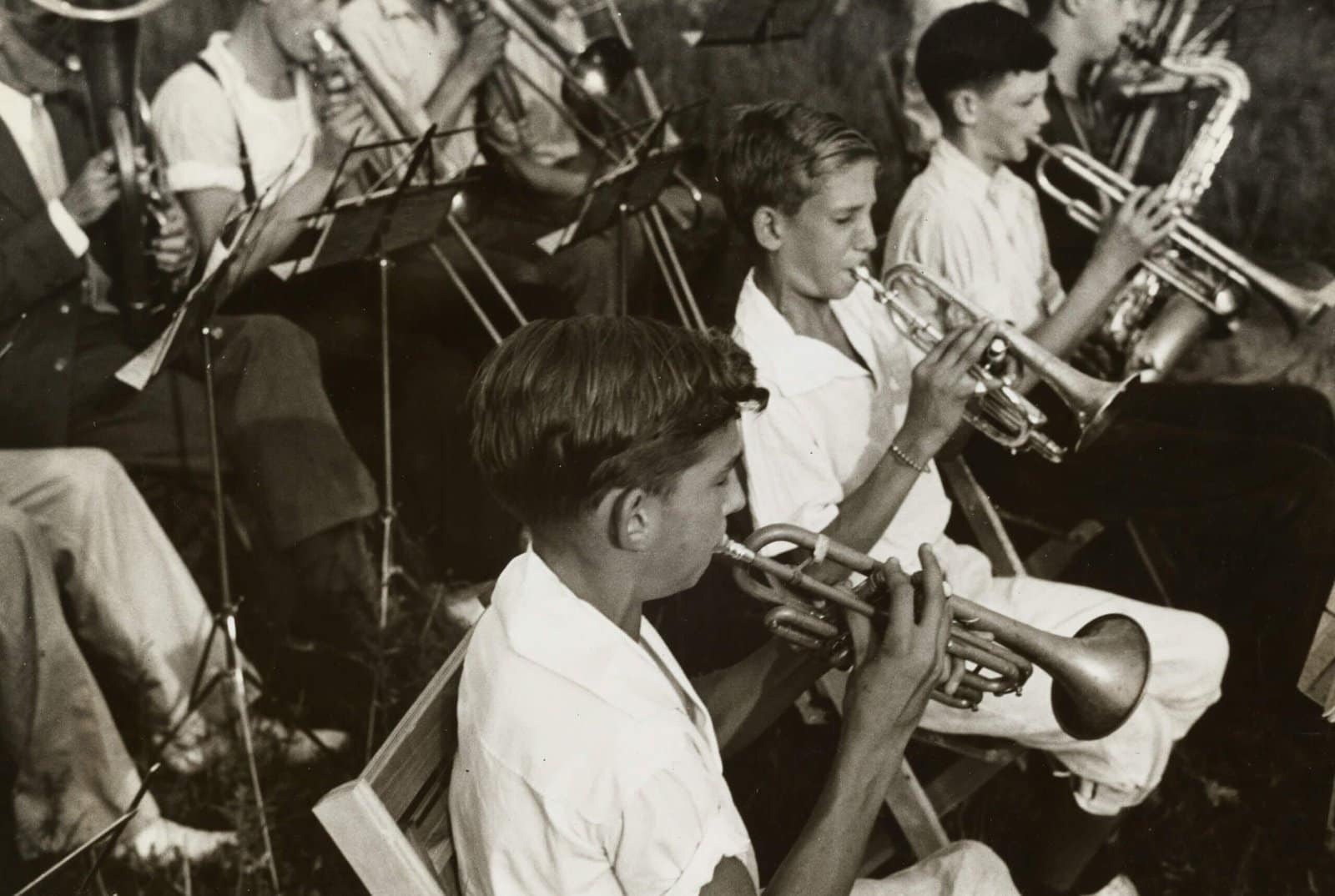
Introduction: An Instrument with a Remarkable History
The trumpet is one of the most recognisable instruments in the brass family. Its bright, penetrating sound has made it an important part of military ceremonies, religious celebrations, orchestral music, jazz and contemporary popular music.
However, the instrument we know today is the result of a long process of musical and technological development. Its history extends from ancient signaling instruments to the natural trumpets of European musical traditions and, eventually, the development of valves that transformed its technical possibilities.
These changes did more than improve the instrument’s construction. They influenced how composers wrote for the trumpet, how musicians approached performance and how the instrument became established in different musical traditions.
Understanding the evolution of the trumpet therefore means exploring both its physical development and the changing musical roles it has played throughout history.
1. Ancient Origins: Trumpets Before the Modern Trumpet
Long before the modern brass instrument existed, different civilizations used trumpet-like instruments for communication, ceremonies and military signaling.
These early instruments were made from a variety of materials, including metal, animal horns, shells and wood. Their construction and sound varied considerably according to the culture and purpose for which they were designed.
Ancient Egyptian metal trumpets, for example, were associated with ceremonial and military contexts. The Greeks and Romans also developed their own signaling instruments, including the Greek salpinx and several Roman brass and horn instruments.
It is important to distinguish these early instruments from the modern trumpet. They were not simply early versions of today’s valved instrument, nor did they all share the same construction. Rather, they represent a broader historical tradition of using powerful, sustained sounds for communication and ceremonial purposes.
As societies and musical practices developed, these instruments gradually acquired more specialised forms and functions.
In Europe, the trumpet became increasingly associated with court ceremonies, military display and public occasions. Its powerful sound made it particularly suitable for outdoor performances and formal events.
The transition from relatively simple signaling instruments to the longer natural trumpets used in European musical traditions was an important stage in this development.
2. The Natural Trumpet and Its Role in Early Music
The natural trumpet was an important predecessor of the modern instrument. Unlike today’s standard trumpet, it had no valves and relied on the natural harmonic series produced by the vibration of the player’s lips and the air column inside the tube.
This meant that performers could play certain notes more easily than others. The instrument was particularly suited to its higher register, where the harmonic series provides pitches that can be used to construct melodic passages.
During the Renaissance, the trumpet increasingly became part of organised instrumental ensembles and court music. Its construction developed into the familiar long, looped form, while specialist performers refined the demanding techniques required to play it.
The Baroque period brought particularly significant developments in trumpet writing. Composers discovered how effectively the instrument could contribute to both orchestral brilliance and elaborate melodic passages.
One of the best-known examples is Johann Sebastian Bach’s Brandenburg Concerto No. 2 in F major, BWV 1047. Its trumpet part is written for the high-register clarino technique and demands considerable virtuosity from the performer.
George Frideric Handel also made effective use of the trumpet in works such as his Water Music, where its brilliant sound contributes to the festive and ceremonial character of the orchestral writing.
The natural trumpet therefore played an important role in establishing the instrument as more than a signaling device. It became a sophisticated musical voice, although its technical limitations required considerable skill from performers.
3. The Evolution of Trumpet Design: From Natural Trumpets to Valves
For centuries, the absence of valves restricted the natural trumpet to the notes available within its harmonic series. Although skilled performers could achieve impressive results, playing chromatic passages across a wide range of registers remained difficult.
Instrument makers therefore experimented with different construction methods to expand the trumpet’s possibilities.
During the eighteenth century, keyed trumpets and other alternative designs attempted to overcome some of these limitations. The keyed trumpet, for example, used holes and keys to make additional notes accessible. Anton Weidinger became particularly associated with this instrument and inspired important works by Joseph Haydn and Johann Nepomuk Hummel.
A more decisive transformation came with the development of valves in the early nineteenth century.
Valves change the length of the instrument’s tubing by directing the air through additional sections. This allows the performer to alter the instrument’s effective length and produce a much more complete chromatic scale.
The development of valve mechanisms involved several inventors and successive improvements. Heinrich Stölzel and Friedrich Blühmel were among the important early contributors, with a joint patent for brass-instrument valves granted in 1818.
The introduction of valves fundamentally changed trumpet performance and composition. Musicians could now perform chromatic melodies with greater flexibility, while composers gained access to a wider range of melodic and harmonic possibilities.
Other developments in manufacturing and instrument design followed. Modern orchestral trumpets commonly use three valves, although piston and rotary systems are both found in different instrument traditions.
Different trumpet types also emerged to meet specific musical requirements. The B-flat and C trumpets are widely used in orchestral and ensemble settings, while the piccolo trumpet is particularly useful for certain high-register Baroque repertoire.
These innovations helped establish the modern trumpet as a highly versatile instrument.
4. The Trumpet in Classical Music
The trumpet has maintained an important position in classical music throughout several historical periods.
In Renaissance and early Baroque music, it was often associated with ceremonial writing, ensembles and festive occasions. Its brilliant sound was particularly effective in large architectural spaces, where it could reinforce vocal and instrumental textures.
During the Baroque period, composers explored its upper register and expressive potential through solo passages and orchestral writing. Bach’s Brandenburg Concerto No. 2 remains one of the most demanding and recognisable examples.
The Classical and Romantic periods brought further changes. As the design of brass instruments developed, composers gradually gained greater freedom to write melodic passages and more varied harmonic material for the trumpet.
The emergence of the keyed trumpet and subsequently the valved instrument contributed to this transformation.
The trumpet became increasingly integrated into the symphony orchestra, where it could perform several different functions: reinforcing climactic passages, introducing fanfares, providing rhythmic definition or carrying an important melodic line.
Its sound also allowed composers to create strong contrasts between different orchestral sections.
In modern orchestral writing, the trumpet remains an essential instrument, combining technical precision with a wide expressive range.
5. The Trumpet in Jazz: Improvisation and Personal Expression
Jazz transformed the trumpet’s musical identity in a different direction.
The instrument became one of the defining voices of jazz, particularly through the contributions of performers who expanded its expressive and improvisational possibilities.
Louis Armstrong was a fundamental figure in this development. His rhythmic freedom, phrasing and approach to improvisation helped establish the trumpet as a leading solo instrument in early jazz.
Dizzy Gillespie subsequently became one of the central figures in bebop. His playing combined extraordinary technical ability with complex harmonic ideas and an innovative approach to phrasing.
Miles Davis explored a different expressive territory. His work in cool jazz, modal jazz and later jazz fusion demonstrated how the trumpet could be used with restraint, subtlety and experimentation rather than relying exclusively on brilliance and technical display.
These musicians helped redefine the instrument’s expressive possibilities.
Jazz also expanded the use of mutes, articulation, pitch bending and other techniques. The trumpet became not simply an instrument capable of producing powerful melodies, but a highly individual voice through which performers could develop their own musical identities.
Contemporary artists such as Wynton Marsalis continue to maintain a strong connection with jazz tradition while exploring its continuing possibilities.
6. The Trumpet in Contemporary Music
Today, the trumpet can be found in an exceptionally broad range of musical contexts.
In classical and contemporary orchestral music, it continues to perform both traditional and experimental roles. Composers may use extended techniques, unusual mutes, different playing registers and contrasting timbres to create new sonic possibilities.
In jazz, the instrument remains central to swing, bebop, cool jazz, fusion and many other styles.
The trumpet is also widely used in funk, soul, pop, rock, hip-hop and Latin American musical traditions.
Mariachi music provides a particularly recognisable example of its role in popular and traditional culture. The trumpet’s strong projection and melodic character make it an essential element of many mariachi ensembles.
In electronic and experimental music, trumpet recordings can be processed, layered or combined with synthesised sounds. This creates new relationships between acoustic performance and digital production.
Such approaches demonstrate that the trumpet’s evolution is not limited to physical design. The instrument continues to develop through changes in composition, performance techniques, recording technology and musical taste.
7. The Trumpet’s Sound: Technique, Timbre and Expression
One of the most distinctive characteristics of the trumpet is its ability to produce a powerful sound that can remain clearly audible within a large ensemble.
Sound production begins with the player’s lips vibrating against the mouthpiece. This vibration excites the air column inside the instrument, creating a series of resonant pitches.
The player changes notes through a combination of lip tension, airflow, articulation and valve operation.
The instrument’s construction also influences its timbre. Bore characteristics, bell design, mouthpiece selection and manufacturing details all contribute to the resulting sound.
Beyond the basic production of notes, trumpet players use a wide range of techniques to shape musical expression.
Legato and staccato articulation allow performers to create contrasting musical gestures, while flutter-tonguing, mutes, pitch bends and other techniques extend the instrument’s tonal vocabulary.
In jazz, these possibilities are especially important for improvisation and individual expression. In orchestral music, the trumpet can move between brilliant fanfares, sustained melodic passages and subtle supporting roles.
Its expressive range is therefore much wider than its reputation as a purely loud or heroic instrument might suggest.
Conclusion: An Instrument That Continues to Evolve
The history of the trumpet reflects a continuous interaction between instrument design, musical tradition and artistic creativity.
From ancient signaling instruments to the natural trumpets of Renaissance and Baroque music, and from the development of valves to contemporary performance techniques, each stage has expanded the instrument’s possibilities.
Its role in classical music and jazz demonstrates how technical innovation can influence musical language and create new forms of expression.
Today, the trumpet remains an essential part of many musical traditions. Its ability to adapt to different styles, ensembles and technologies ensures that it continues to offer composers and performers a rich field for exploration.
The trumpet’s evolution is therefore not simply a story of mechanical improvements. It is also a story of how musicians have continually discovered new ways to use its distinctive voice.
Exploring the Trumpet in Contemporary Composition
The trumpet continues to offer composers many possibilities beyond traditional orchestral and jazz writing.
In my own instrumental compositions, I have explored different ways of incorporating brass instruments into contemporary musical settings.
For example, Loquat — Inside the Composition examines a brass quintet version of a piece originally written for piano. The first trumpet introduces the main melodic material, while the other instruments contribute complementary lines, harmonic colour and rhythmic interaction.
Another example is Hidden Alleys, where two trumpets interact with trombone, tuba and electric basses to create an unconventional instrumental texture.
Both pieces illustrate how the trumpet can contribute to musical expression in different ways, depending on its role within the ensemble.
For a broader selection of these jazz-influenced instrumental compositions, you can also explore Urban Nightlife Stories.